Alejandro Davidovich Fokina Claims Shanghai Masters in Historic Win 2026
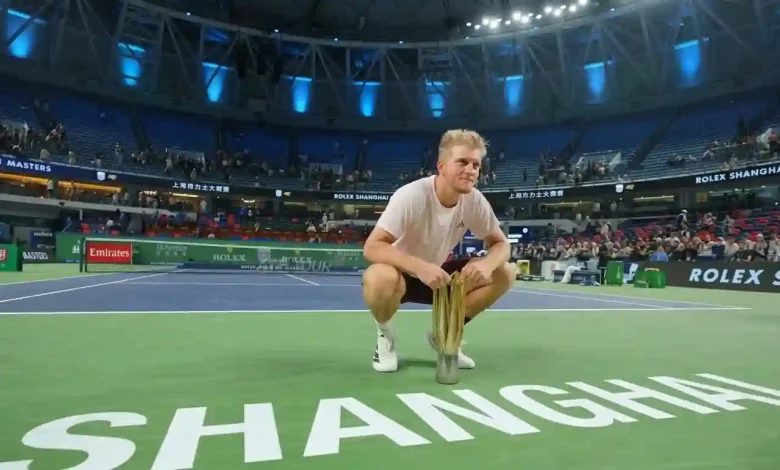
Table of Contents
Alejandro Davidovich Fokina waited seven grueling seasons on the professional circuit to hoist his inaugural ATP Tour trophy, but his long-delayed coronation has transformed into an avalanche of silverware. On Sunday in Shanghai, the 26-year-old Spaniard completed an extraordinary chapter in modern tennis history by rallying past younger compatriot Rafael Jodar 1-6, 7-6(5), 6-4 to claim the prestigious Rolex Shanghai Masters crown. The victory not only sealed his maiden ATP Masters 1000 championship but also marked his third title in a matter of months, solidifying one of the most remarkable late-season surges in recent memory.
For years known as one of the tour’s most naturally gifted shotmakers, Davidovich Fokina had often struggled with emotional volatility and tactical inconsistency during pivotal moments. However, since securing his maiden victory on grass at the Mallorca Championships in June, the Spaniard has engineered a profound competitive renaissance. Backed up by a dominant title run at the Chengdu Open last month, his triumph under the lights at the Qizhong Forest Sports City Arena signals his definitive arrival among the global elite of men’s tennis.
Alejandro Davidovich Fokina Breaks Through on the Global Stage
Since turning professional and making his ATP main draw debut in April 2019, Davidovich Fokina carried the heavy burden of being dubbed a prodigy without the trophies to show for it. His junior Wimbledon crown in 2017 showcased his explosive athleticism, drop-shot mastery, and relentless foot speed. Yet, across seven years and multiple runner-up finishes—most notably at the Monte-Carlo Masters in 2022—the winner’s circle eluded him. That drought created an agonizing narrative that followed him across continents.
The breakthrough in Mallorca broke the psychological seal. While top-tier tennis often revolves around powerhouse figures who dominate early, players like Davidovich Fokina demonstrate that athletic maturation is rarely linear. As seen in global athletic arenas, persistence often dictates who ultimately ascends, a reality that mirrors how Shin Ohashi shatters expectations through pure athletic resilience. Davidovich Fokina channelled that exact endurance to reshape his narrative in 2026.
Inside the Shanghai Final: A Grueling Comeback Against Rafael Jodar
Entering the Shanghai final, Davidovich Fokina faced a rising sensation in 19-year-old Rafael Jodar. The clash provided an enthralling generational battle between two distinctly different styles of Spanish tennis. In the opening set, Jodar appeared unburdened by the moment, unloading heavy topspin forehands and capitalizing on Davidovich Fokina’s sluggish start to run away with the opener 6-1 in just 28 minutes.
Davidovich Fokina looked physically flat in the early exchanges, struggling to find depth against the teenager’s heavy kick serves. Rather than unraveling—as older versions of the Spaniard might have done—he adjusted his court position, stepping back to neutralize Jodar’s angle generation. High-pressure tactical pivots of this caliber parallel the intensity seen when modern champions like Carlos Alcaraz demands supreme execution from their support systems under grand stage lights.
The Turning Point: Navigating the High-Stakes Second Set Tiebreak
The second set evolved into a war of attrition. Both players protected their service games with ferocious intensity, trading grueling baseline rallies that routinely exceeded 15 shots. With no breaks of serve conceded, the set barreled into a mandatory tiebreak, where Davidovich Fokina’s hard-won veteran experience ultimately tipped the scales.
Trailing 3-4 in the breaker, Davidovich Fokina produced a breathtaking backhand passing shot down the line before executing his trademark disguised drop shot to earn set point. When Jodar pulled a forehand wide at 5-6, the match reset, sending the Chinese crowd into raptures. Surviving pressure points of that magnitude requires an iron will, reminiscent of the composure displayed when Max Verstappen targets flawless precision on race tracks with zero margin for error.
Closing the Door in the Deciding Set
Energized by claiming the second set, Davidovich Fokina seized immediate control of the third. An early break of serve in the third game provided the cushion he needed. Using his superior defensive coverage, he repeatedly forced Jodar to play extra balls from awkward positions. Serving for the championship at 5-4, Davidovich Fokina remained ruthless, holding to 15 and falling onto his back as history was written.
From Mallorca to Chengdu and Shanghai: The Triple Crown Run
The arc of Davidovich Fokina’s season has been nothing short of staggering. Having never lifted an ATP trophy prior to June, he now boasts three titles across two distinct surfaces within a four-month window:
- Mallorca Championships (ATP 250 – Grass): Overcame top-seeded rivals to capture his maiden title on home soil, proving his adaptability across varying grass speeds.
- Chengdu Open (ATP 250 – Hard): Traversed high-altitude hardcourts without dropping a single set, showcasing dramatic improvements in his first-serve percentage.
- Rolex Shanghai Masters (ATP Masters 1000 – Hard): Defeated three top-15 players en route to the final before overturning a set deficit to secure the biggest prize of his professional journey.
The physical conditioning required to sustain form across the Asian swing cannot be overstated. Elite athletes continually push human performance boundaries across disciplines, just as Yumeki Kojima shatters conventional athletic limits through relentless training cycles. Davidovich Fokina arrived in Shanghai sharp, energized, and tactically disciplined.
Tactical Shift: Mental Fortitude and Baseline Aggression
Central to Davidovich Fokina’s transformation has been a fundamental restructuring of his coaching team and daily mindset. While always blessed with speed, he previously relied heavily on improvised defense rather than constructive offense. In Shanghai, his second-serve return points won reached an impressive 54%, allowing him to dictate rallies early.
Furthermore, his emotional composure during critical junctures has matured immensely. Professional sport at this altitude penalizes even momentary lapses in concentration. The tactical maturity Davidovich Fokina demonstrated mirrors the laser focus demanded in team sports, where leaders like Tyler Adams regains tactical control in high-tempo midfields. Davidovich Fokina has traded erratic brilliance for consistent, repeatable patterns of play.
Statistical Overview: Analyzing the Championship Run
The statistical metrics behind Davidovich Fokina’s three-title blitz illuminate just how drastically his output has surged over the past 120 days. The table below illustrates his progression from a tour journeyman to a dominant ATP Masters champion:
| Tournament | Surface | Tier | Final Opponent | Scoreline | Key Stat (1st Serve %) |
|---|---|---|---|---|---|
| Mallorca Open | Grass | ATP 250 | Sebastian Baez | 6-3, 6-2 | 68% In / 76% Won |
| Chengdu Open | Hard (Outdoor) | ATP 250 | Lorenzo Musetti | 7-5, 6-3 | 71% In / 81% Won |
| Shanghai Masters | Hard (Outdoor) | ATP Masters 1000 | Rafael Jodar | 1-6, 7-6(5), 6-4 | 66% In / 74% Won |
The Changing Guard in Spanish Men’s Tennis
Spanish tennis has stood as a global superpower for over two decades, spearheaded by Rafael Nadal and carried forward by younger stars. Davidovich Fokina’s triumph in Shanghai emphasizes the sheer depth of the Iberian nation’s talent pool. The presence of Jodar on the opposite side of the net only further highlighted the fertile ground of Spanish tennis academies.
Just as intense international competitions define rivalries across continents—such as when India beat Pakistan on the cricket pitch to capture the imagination of millions—the internal competition within Spanish tennis drives every compatriot to elevate their standards. Facing an aggressive up-and-comer like Jodar gave Davidovich Fokina the exact crucible needed to cement his status as a national leader on tour.
ATP Tour Rankings Impact and Race to the Finals
The 1,000 ranking points gained from his Shanghai victory provide a monumental boost to Davidovich Fokina’s world ranking. Projected to surge inside the ATP Top 12 for the first time in his career, he is now within striking distance of the coveted Nitto ATP Finals in Turin. Such a leap changes the trajectory of his career, affording him top-eight seedings at Grand Slams and first-round byes at subsequent Masters tournaments.
Maintaining momentum during end-of-year scheduling requires rigorous physical preservation. In elite sports, strategic withdrawal and schedule management are vital to prevent breakdowns, an issue that became prominent when Jannik Sinner out for mandatory recovery periods forced tournament organizers to realign draws. How Davidovich Fokina balances European indoor appearances in Basel and Paris will dictate his year-end standing.
Looking Forward: Transforming Masters Success into Grand Slam Contention
With three titles locked in his display cabinet, the conversation around Alejandro Davidovich Fokina shifts irrevocably from “when will he break through?” to “can he win a Major?” His versatile game thrives across surfaces, having previously reached quarterfinals at Roland Garros and the second week of the US Open. Armed with newfound tactical belief, his ceiling has expanded dramatically.
As modern sports evolve, stars frequently face intense public scrutiny regarding their workload and psychological readiness, echoing how Coco Gauff speaks out about player welfare and high-pressure expectations on the WTA Tour. If Davidovich Fokina retains this equilibrium between fiery passion and cold-blooded execution, the Spanish maestro may well turn his triple-title season into an era of sustained dominance at the sport’s highest peaks.