Shin Ohashi Shatters World Record in 200m Breaststroke
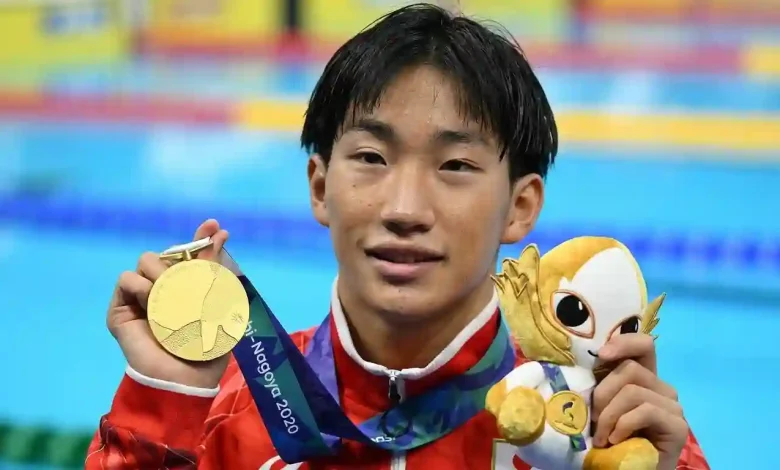
Table of Contents
Shin Ohashi delivered one of the most astonishing individual performances in modern competitive swimming on Thursday, shattering the men’s 200 metres breaststroke world record with a blistering time of 2:04.83. The 17-year-old Japanese sensation entered the Asian Games aquatic arena with immense promise, but few analysts anticipated that he would dismantle a global standard previously regarded by elite coaches as virtually untouchable. By clocking 2:04.83, Ohashi became the first swimmer in history to plunge beneath the 2:05 threshold in the event, establishing a new epoch for competitive breaststroke and electrifying spectators worldwide.
Shin Ohashi Rewrites Swimming History at the Asian Games
Entering the competition, the benchmark stood at 2:05.48, established by China’s triple-world-champion Qin Haiyang during the 2023 World Aquatics Championships in Fukuoka. Qin’s swim had knocked significant fractions off the existing standard, yet Ohashi sliced a massive 0.65 seconds off that performance in a single race. From the opening horn, the Japanese prodigy demonstrated total command over his pacing, hydrodynamics, and kick turnover. Spectators witnessed history unfolding length by length as the virtual world-record line fell steadily behind his rhythmic underwater pullouts.
Ohashi’s historic milestone arrives amid a renaissance in youthful athletic excellence across the continent. Just twenty-four hours earlier, the aquatics world witnessed another prodigy rewrite the narrative when thirteen-year-old Yu Zidi completed an unbelievable hat-trick of gold medals for China. Inspired by that momentum, Ohashi capitalized on pristine pool conditions and fierce regional rivalries to carve his name permanently into the record books. His swim mirrors historic breakthrough moments where young phenoms emerge on the international stage, much like when dynamic talents redefine competitive standards across global tournaments like the Yumeki Kojima shatters sports metrics or when athletic phenoms capture headlines in championship showdowns.
Deconstructing the 2:04.83 Split Times and Stroke Mechanics
A granular look at Ohashi’s race sheet reveals unmatched tactical maturity. While many young breaststrokers rely heavily on early speed and surrender ground across the grueling final fifty metres, Ohashi executed an exquisitely balanced split schedule. His opening fifty metres saw him touch in 28.52, maintaining exceptional body line and minimal frontal resistance. He passed the 100-metre turn at 1:00.31, preserving energy through powerful glides between stroke cycles.
The pivotal separation took place during the third 50-metre lap. Navigating the notorious third leg in 32.11, Ohashi retained a long, low stroke cadence that allowed him to conserve physical resources while matching the world record pace. On the final lap home, when lactic acidosis routinely stalls breaststroke rhythm, Ohashi dropped his head, amplified his kick tempo, and surged through the final 15 metres with unmatched power, touching the touchpad at 2:04.83. Biomechanical commentators highlighted his streamlined underwater dolphin kicks and flawless streamline entries off every turn as the decisive factors that minimized deceleration.
Following the Slipstream of China’s Phenom Yu Zidi
The electric atmosphere inside the venue had already reached fever pitch prior to Ohashi stepping onto the starting block, thanks largely to 13-year-old Chinese phenomenon Yu Zidi. Yu had mesmerized the international swimming fraternity over the previous three days, securing three individual golds with poise that defied her young age. Her meteoric rise provided an undeniable spark of competitive inspiration throughout the athletes’ village, demonstrating that youthful vigor combined with precise technique can dismantle established hierarchies.
Ohashi acknowledged the pervasive influence of Yu’s triumphs in his post-race remarks, noting that witnessing younger swimmers attack races fearlessly eliminated any hesitance in his own strategic approach. The parallel journeys of both competitors highlight how high-stakes multi-sport events foster peer-driven elevation. Much like how world-class contenders feed off peer intensity during intense tournament atmospheres like the Davis Cup Final 8, the Asian Games pool served as an amphitheater of shared momentum where teenage athletes repeatedly rewrote the limits of human performance.
Toppling Qin Haiyang: Analyzing the Shift in Global Breaststroke
Qin Haiyang’s dominance in 2023 had appeared to cement Chinese dominance in men’s breaststroke for the foreseeable future. Qin had swept the 50m, 100m, and 200m distances at the Fukuoka championships, displaying an aggressive, high-turnover stroke style that disrupted traditional training dogmas. Overcoming a standard set by an athlete of Qin’s stature elevates Ohashi from a promising junior prospect to the definitive frontrunner of the discipline.
Swimming analysts have noted that Ohashi blends the explosive front-end power pioneered by recent champions with the classical rhythmic conservation traditionally taught by Japanese coaching academies. While Qin’s world-record split prioritized sheer power over early distance per stroke, Ohashi managed to maintain a sustainable stroke count across all four lengths. This technical divergence points toward an evolving tactical philosophy in world aquatics, prompting coaching staffs across Europe, Australia, and the Americas to revisit long-course training regimens ahead of premier international meets.
Record Progression and Performance Metrics
The progression of the men’s 200m breaststroke world record highlights the steady elimination of tenths of seconds over decades, making Ohashi’s substantial 0.65-second reduction an extraordinary anomaly in contemporary sports science. The following table illustrates the historical journey of the long-course world record leading up to Ohashi’s historic swim.
| Swimmer | Nation | Time (LCM) | Date / Event | Key Split (100m) |
|---|---|---|---|---|
| Kosuke Kitajima | Japan | 2:07.51 | 2008 Japan Open | 1:01.37 |
| Daniel Gyurta | Hungary | 2:07.28 | 2012 London Olympics | 1:01.15 |
| Akihiro Yamaguchi | Japan | 2:07.01 | 2012 National Sports Festival | 1:01.08 |
| Ippei Watanabe | Japan | 2:06.67 | 2017 Tokyo Championships | 1:01.04 |
| Anton Chupkov | Russia | 2:06.12 | 2019 World Championships | 1:01.44 |
| Zac Stubblety-Cook | Australia | 2:05.95 | 2022 Australian Trials | 1:01.89 |
| Qin Haiyang | China | 2:05.48 | 2023 World Championships | 1:00.72 |
| Shin Ohashi | Japan | 2:04.83 | Asian Games | 1:00.31 |
Japan’s Storied Lineage in Elite Breaststroke Competition
Ohashi’s achievement does not exist in a vacuum; it stands as the latest chapter in Japan’s illustrious breaststroke heritage. From the era of four-time Olympic champion Kosuke Kitajima to former world record holders Akihiro Yamaguchi and Ippei Watanabe, Japanese swimming federations have consistently placed rigorous emphasis on biomechanical efficiency, streamline precision, and kick synchronization. Ohashi’s breakthrough restores Japan to the summit of the discipline, triggering celebrations across the nation’s sporting establishment.
Coached within the elite Japanese junior development system, Ohashi has spent years refining his mechanics under the watchful eye of veteran trainers. The technical pedigree that produced Olympic legends has now adapted to 21st-century sports telemetry, integrating underwater video analysis and pressure-plate sensors to optimize force output during the kick cycle. This tradition of continuous adaptation reflects broader athletic methodologies where meticulous refinement leads to championship milestones, similar to the precision driving that propelled stars when Max Verstappen targets racing perfection or when dynamic playmakers ignite stadiums as seen when Kylian Mbappe hails team brilliance.
Youth Movement Reshaping International Aquatics
The dual impact of Ohashi and Yu Zidi underscores an unprecedented shift in modern aquatic athletics, where teenagers are not merely contending for podium finishes but actively reshaping the outer limits of world records. Historically, the men’s 200m breaststroke was considered a mature swimmer’s domain, requiring years of physical conditioning to withstand the extreme aerobic and anaerobic strain of the event. Ohashi’s triumph at just seventeen years old shatters that conventional paradigm.
Advances in youth athletic monitoring, biomechanics, recovery science, and nutrition have enabled teenage competitors to attain world-class physical output without compromising developmental longevity. This structural evolution across sports mirrors high-profile breakthroughs across other athletic disciplines, whether tracking tactical brilliance when Cole Palmer injury concerns shift soccer dynamics, or assessing individual brilliance where Atlanta Braves clinch NL divisional victories. Young prodigies are stepping into intense environments with fearless conviction, discarding long-held dogmas about age limitations.
Coaching Methodologies and Scientific Innovation
Behind Ohashi’s historic split lies a rigorous sports science regimen designed specifically for adolescent physiology. Japanese sports scientists utilized real-time lactate profiling and hydrodynamic flow simulators to structure Ohashi’s workout loads, preventing overtraining while enhancing his stroke velocity. Unlike past generations that emphasized grinding high-mileage water sessions, modern methodologies emphasize quality speed intervals and specialized dryland resistance work aimed at strengthening core stabilizers and adductor muscles crucial for breaststroke kicking.
Tactical Implications for the Upcoming Olympic Cycle
With his 2:04.83 performance, Ohashi has altered the competitive calculus heading into the next Olympic Games. Rival nations that had organized their strategic scouting around Qin Haiyang, Zac Stubblety-Cook, and Leon Marchand must now recalculate their target times. Swimmers aiming for Olympic gold can no longer assume a 2:05-mid swim will guarantee a spot atop the podium; Ohashi has pushed the barrier into the sub-2:05 territory, forcing competitors to adapt or risk being left behind in preliminary heats.
The psychological shockwaves of this race will ripple across national trials across the globe. Defending international medalists will have to scrutinize their pacing models, particularly through the middle 100 metres where Ohashi established his decisive lead. Furthermore, Ohashi’s breakthrough elevates Japan’s medal prospects in team relays, giving them an unmatched breaststroke leg capable of matching or exceeding the world’s fastest sprint breaststrokers in medley events.
Reactions From Global Coaches and Competitors
Reactions to Ohashi’s world record have flooded in from swimming federations across the globe. Australian coaching staffs described the swim as a technical masterclass, praising Ohashi’s composure across the final 25 metres. International swim commentators noted that breaking a world record by over six-tenths of a second in the contemporary era represents an extraordinary leap in athletic achievement, drawing comparisons to historic leaps that redefined entire sports eras.
The competitive camaraderie displayed in the arena was equally poignant. Competitors from China, South Korea, and Singapore embraced Ohashi in the recovery pool, recognizing the magnitude of the moment. As the Asian Games continue, the swimming world will be watching Ohashi’s upcoming individual and relay outings with immense anticipation. His stunning swim has not only etched his name alongside the legends of Japanese athletics but has also ignited a thrilling new era for international competitive swimming.