Phoenix Planet Born From Stellar Ashes Discovered by Astronomers 2026
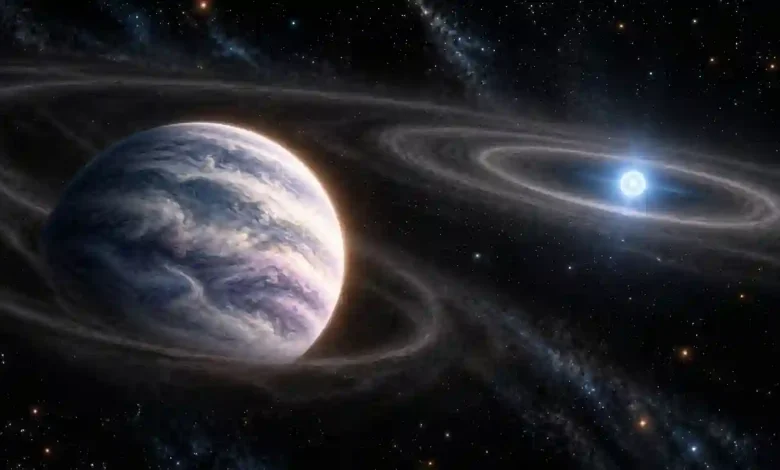
Table of Contents
Phoenix planet discoveries represent a transformative leap forward in exoplanetary science, upending classical assumptions regarding planetary life cycles and stellar destruction. In classical mythology, the phoenix is immortalized as an avian marvel destined to incinerate only to resurrect anew from its embers. Astronomers have officially identified an exoworld that embodies this mythological resurrection with staggering astrophysical fidelity. This exoplanet, formed far beyond our solar system, did not merely endure the violent demise of its host star; evidence suggests it coalesced directly out of the stellar debris shed during that host’s dying throes. Orbiting an intensely dense white dwarf remnant, the newly analyzed celestial body presents the planetary science community with an unprecedented case study of second-generation planet formation.
Phoenix Planet: Rising from Cataclysmic Stellar Ruin
For decades, conventional planetary astronomy held that worlds form almost exclusively within primordial circumstellar disks of gas and dust encircling young protostars. While modern instruments have allowed researchers to map cosmic phenomena ranging from unusual stellar signatures to a green star discovery, few expected worlds to organize after a star has exhausted its nuclear furnace. When a star exceeding the mass of our sun runs out of core hydrogen, it swells into a luminous red giant, engulfing internal planets and violently shedding its exterior envelope into interstellar space. The dense remnant left behind is a white dwarf—an Earth-sized core retaining roughly half the parent star’s original mass.
In the system examined by researchers, the planetary body appears to have formed not before this destructive evolutionary arc, but in the aftermath. The stellar winds, mass ejections, and expansive thermodynamic upheaval generated during the asymptotic giant branch (AGB) phase yielded a dense circumstellar ring of recycled dust, silicate ash, and heavy elements. From this cooling reservoir, gravitation took over once more, aggregating accreted debris into a fully realized world. To uncover such a world orbiting a white dwarf challenges long-held models regarding planetary survival and birth thresholds.
Astrophysical Mechanisms of Second-Generation Formation
The realization that a planet could coalesce from the ashes of an exploded or shed stellar envelope hinges on precise thermodynamic and gravitational prerequisites. In the immediate aftermath of a star’s red giant or asymptotic giant transition, the expelled envelope disperses rapidly into interstellar space unless constrained by specific dynamical architectures. If a close companion or residual angular momentum captures a fraction of this ejected material, a fallback disk can develop around the newly unmasked white dwarf.
Within this fallback accretion disk, conditions bear striking resemblances to the protoplanetary disks observed around newborn stellar nurseries, albeit with distinct chemical signatures. Modern investigations into planetary science frequently intersect with deep space mapping, much like how instruments such as the Curiosity rover captures elemental shifts across distant planetary terrains. Around a white dwarf, however, the fallback disk is enriched with carbon, oxygen, neon, and heavy refractory elements produced during the progenitor star’s advanced fusion cycles. Over timescales estimated at several tens of millions of years, planetesimals collide, accrete, and stabilize, ultimately yielding a brand new secondary planetary body.
White Dwarf Environments and Debris Disks
White dwarfs represent the ultimate endpoint for approximately 97 percent of all stars in our Milky Way galaxy. Possessing immense surface gravities and intense ultraviolet emissions in their early cooling phases, their surrounding orbits are hostile environments. The presence of metallic pollution in white dwarf atmospheres has long suggested that ancient asteroids or shattered cometary bodies periodically plunge into the stellar remnant’s gravitational well. Recent theoretical frameworks, mirrored in advanced computational analysis and autonomous modeling akin to autonomous interceptor trajectories, indicate that disrupted orbital debris can maintain sustained planar coherence rather than immediately falling inward.
When a substantial fallback disk establishes equilibrium, gravitational instabilities within the disk allow dust grains to overcome electrostatic barriers and assemble into pebble-sized conglomerates. As these pebbles aggregate into kilometer-wide planetary embryos, the system avoids tidal disruption provided the orbit lies outside the Roche limit of the white dwarf. At this safe orbital baseline, the newly forged exoplanet settles into an orbit devoid of giant planet competitors, surviving in a radically altered solar architecture.
Observational Data and Detection Methodologies
Detecting an exoplanet orbiting a white dwarf presents notable observational challenges. Traditional radial velocity methods struggle because white dwarf spectra are severely pressure-broadened, displaying few narrow absorption lines necessary for measuring fine gravitational wobbles. Consequently, astronomers rely heavily on high-precision transit photometry, gravitational microlensing, and infrared excess surveillance. Modern launch platforms and private space initiatives, such as those cataloged in reports on commercial space launch advances, continue to deploy next-generation space telescopes optimized for detecting these ultra-faint orbital signatures.
Because a white dwarf has a physical radius comparable to that of Earth, an exoplanet of terrestrial or sub-Neptune dimensions transiting in front of it produces an enormous transit depth, sometimes blocking a substantial portion of the remnant star’s total light output. The discovery of this phoenix-like exoplanet demonstrated distinct photometric dips, paired with an unexpected mid-infrared excess indicating that residual dust rings still envelop parts of the inner orbital architecture.
Comparative Analysis: Main Sequence vs Post-Stellar Planet Formation
Understanding how a second-generation planet differs from first-generation planets formed during primordial star creation provides crucial context for its unique nature. The table below outlines the principal divergence between these evolutionary pathways.
| Physical Parameter | Primordial Main Sequence Planet | Phoenix Exoplanet (Second-Generation) |
|---|---|---|
| Parent Body State | Hydrogen-fusing protostar or main sequence star | Degenerate carbon-oxygen or helium white dwarf |
| Disk Composition | Pristine primordial nebula (predominantly Hydrogen/Helium) | Recycled stellar ash (enriched Carbon, Oxygen, heavier metals) |
| Formation Timeline | First 5–10 million years of stellar lifetime | Post-AGB phase, tens to hundreds of millions of years after death |
| Orbital Proximity | Ranges broadly from 0.01 AU to hundreds of AUs | Strictly bounded by the remnant’s tidal Roche disruption limit |
| Radiation Regime | Stable stellar flux driven by steady core hydrogen fusion | Cooling degenerate thermal radiation; strong initial UV flux |
| Volatile Retention | Water, methane, ammonia readily condensable in outer bands | Extreme dehydration initially; volatiles delivered via residual comets |
The Fate of Our Solar System: Analogies to the Sun
The confirmation of a world born from expelled stellar remnants forces humanity to reconsider the ultimate fate of our own planetary backyard. In approximately five billion years, the Sun will exhaust its core hydrogen, expanding into a red giant whose outer atmospheric layers will engulf Mercury, Venus, and almost certainly Earth. Yet, the question of what happens to the outer solar system remains a subject of intense scientific inquiry, echoed across research tracking long-term space environments like orbital computing missions.
If the Sun expels roughly half of its mass during the planetary nebula phase, orbital expansion will push Mars, Jupiter, Saturn, and the icy worlds outward. If sufficiently dense residual envelopes form fallback rings around the remnant solar core, the raw materials could trigger a localized resurgence of planet formation. A future intelligent civilization surveying the solar white dwarf billions of years from today might observe a reconstructed terrestrial sphere forged from the vaporized residues of the inner planets and the outer convective envelope of the former Sun.
Planetary Composition and Atmospheric Viability
Could life ever establish a foothold on a resurrected world? The thermodynamic reality surrounding a white dwarf is vastly different from that around a hydrogen-burning star. A white dwarf produces heat entirely through cooling degenerate thermal energy rather than ongoing nuclear reactions. Although a white dwarf’s energy output dims steadily over billions of years, its cooling rate slows dramatically as its interior crystallizes into a solid metallic lattice. As aerospace entities pursue advanced exploration paradigms, from heavy lunar landers to deep-space probes like Artemis III lunar lander concepts, astronomers are evaluating how robotic instruments might one day detect signatures of water on post-stellar worlds.
To maintain liquid water, a phoenix world must orbit exceedingly close to the white dwarf, typically at distances well within 0.01 astronomical units, where orbital periods are measured in hours rather than months. At this ultra-close distance, tidal locking is inevitable, leaving one hemisphere in perpetual day and the other in unending darkness. Furthermore, the planet’s atmospheric chemistry would likely be dominated by carbon monoxide, carbon dioxide, and depleted lighter volatiles, presenting an exotic, highly dense biosphere candidate completely divorced from Earth’s evolutionary tree.
Broader Implications for Galactic Exoplanet Surveys
The discovery fundamentally recalibrates galactic demographic estimates for exoplanets. Previous models assumed that once a star enters its terminal evolutionary phase, the associated planetary system either dissolves into chaos or witnesses its members cast into interstellar space as rogue worlds. With proof that accretionary reconstitution can build planets after stellar death, researchers must now integrate post-main-sequence disk physics into broader astrophysics databases. These ongoing breakthroughs parallel broader innovations in space observation, where specialized launch vehicles such as the Hyprspace hybrid rocket aim to widen orbital access for observational hardware.
As deep-space survey architectures expand, researchers are re-analyzing archival sky surveys to determine if faint, anomalous infrared peaks detected near white dwarfs were prematurely categorized as mere dust clouds rather than nascent second-generation planetary bodies. The cosmos is demonstrating that planetary architecture is remarkably resilient, capable of repurposing stellar debris even after the death of the primary engine that powered the system.
Future Observational Frontiers in Post-Stellar Astronomy
In the coming years, flagship observatories both on the ground and in space will target white dwarf candidates with unprecedented spectroscopic resolution. Space telescopes will scrutinize the molecular absorption lines within the atmospheres of these rebirth worlds, assessing their refractory ratios and searching for heavy volcanic activity fueled by intense tidal heating. The ongoing search for exoplanets continues to rely on heavy-lift orbital deployments, often facilitated by proven workhorses like when a SpaceX Falcon 9 launches scientific observation satellites into low Earth orbit.
The study of phoenix worlds bridges the gap between stellar archaeology and planetary genesis. By looking directly into the aftermath of a star’s destruction, researchers are not simply observing a graveyard; they are witnessing an active nursery. The universe continually challenges human definitions of endings and beginnings, revealing that the destruction of a stellar powerhouse can mark the dawn of an entirely new planetary era.