Orbital computing satellite launch by TakeMe2Space sets historic SpaceX milestone
Table of Contents
Orbital computing satellite systems represent the next major evolutionary phase in aerospace data architecture, fundamentally re-engineering how spaceborne intelligence is harvested, processed, and disseminated. Indian aerospace startup TakeMe2Space is positioned at the vanguard of this transition, finalizing preparations to launch what it characterizes as India’s premier edge-processing space platform. Designated as MOI-1A, the sub-50 kilogram spacecraft is slated to reach low Earth orbit aboard an upcoming SpaceX rocket deployment under the Transporter-18 mission architecture.
For decades, orbital remote sensing has operated on a static operational philosophy: capture raw imagery or radar pulses, buffer the datasets on flight hardware, wait for line-of-sight acquisition over terrestrial ground stations, and downlink terabytes of unparsed metrics for processing inside terrestrial cloud centers. TakeMe2Space seeks to disrupt this archaic methodology entirely. By running high-throughput machine learning inference directly in space, MOI-1A converts raw sensory inputs into high-value operational insights before any radio packet ever touches Earth.
Orbital Computing Satellite Technology: A Paradigm Shift for Space Data
The transition from dumb sensor platforms to autonomous, computationally capable orbital assets addresses the fundamental limitations of modern space exploration. Ground station availability is severely constrained by orbital mechanics, orbital decay, and geographic barriers. A satellite in low Earth orbit traverses the sky over an individual ground antenna in a flight window lasting merely eight to twelve minutes per pass. During that operational burst, bandwidth limits restrict how much high-resolution optical, hyperspectral, or synthetic aperture radar (SAR) telemetry can be transmitted.
As sensor technology has exponentially advanced, focal-plane arrays have evolved from capturing modest megapixel images to multi-gigapixel, multispectral arrays. Ground downlinks have failed to scale at a commensurate velocity. Satellites frequently gather enormous datasets that are discard-bound or backlogged for days due to bandwidth contention. With the global acceleration of low Earth orbit constellations, the radio frequency spectrum is facing unprecedented congestion, making orbital computing satellite infrastructure an absolute necessity rather than an experimental luxury.
By conducting computer vision, change detection, anomaly classification, and data compression at the edge, an orbital computing satellite acts as a localized data filter. Instead of beaming down hundreds of gigabytes of cloud cover, ocean wash, or redundant terrestrial terrain, the spacecraft processes the imagery on-chip, verifies the target attributes, and transmits a lightweight structured message—such as geospatial coordinates of an anomaly—measuring mere kilobytes.
The MOI-1A Mission: Architecture and Engineering Overview
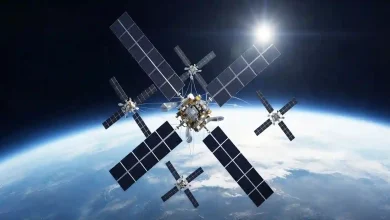
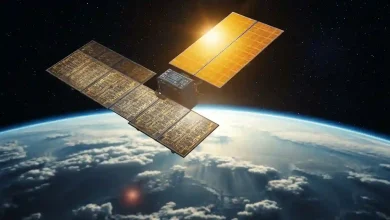
The MOI-1A spacecraft developed by TakeMe2Space represents a masterclass in small-satellite systems optimization. Weighing under 50 kilograms, the microsatellite balances restrictive size, weight, power, and thermal (SWaP-T) budgets against the heavy processing loads typically reserved for terrestrial server racks. The core airframe is configured with high-performance payload bays, dual solar arrays delivering continuous bus wattage, three-axis reaction wheel stabilization, and precision star trackers to ensure high-accuracy sensor pointing during operational imaging passes.
Operating electronics in the harsh vacuum of space presents significant operational challenges. Without ambient atmosphere to facilitate convective cooling, advanced processing chips generate intense thermal concentrations that can rapidly cause thermal throttling or destructive runaway. The engineering team behind MOI-1A designed a proprietary passive thermal conductivity architecture, routing heat away from dense integrated circuits toward structural radiator plates facing deep space.
Furthermore, radiation tolerance is paramount. Galactic cosmic rays and solar proton events can induce single-event upsets (SEUs) or permanent latch-up conditions in silicon wafers. While conventional aerospace programs rely on radiation-hardened components fabricated on decade-old, low-speed process nodes, TakeMe2Space leverages modern commercial-off-the-shelf (COTS) processors augmented with radiation-tolerant software watchdogs, triple-modular redundancy, and autonomous power-cycling systems.
Nvidia Orin NX Edge-Computing in Microgravity Environments
At the beating heart of MOI-1A lies the Nvidia Jetson Orin NX System-on-Module (SoM). Engineered specifically for high-efficiency robotic and edge applications, the Orin NX silicon integrates deep learning accelerators alongside specialized graphic computing units capable of executing up to 100 trillion operations per second (TOPS) of AI performance. Embedding this grade of compute within a microsatellite platform closes the gap between orbital hardware and modern advanced Nvidia hardware deployed across high-density terrestrial environments.
Bringing this computational capability into vacuum requires specialized software compilation. The onboard runtime environment executes containerized neural networks that ingest camera payloads in real time via low-latency interconnects. The algorithms run rapid inference models designed to perform semantic segmentation, identifying ship hulls, forest fires, urban infrastructure changes, and atmospheric conditions instantly.
The efficiency curve of the Orin NX—delivering substantial tensor throughput while drawing between 10 and 25 watts of electrical power—makes it ideal for microsatellites reliant on photovoltaic arrays and lithium-ion batteries. In orbit, every milliwatt counts. The onboard computer dynamically scales clock speeds based on sensor activity and solar angle, ensuring the payload maximizes compute cycles while flying across illuminated swaths of the planet.
SpaceX Transporter Rideshare Integration and Deployment Profile
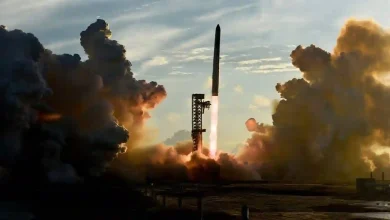
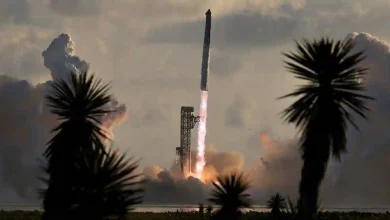
MOI-1A is slated to reach Sun-synchronous orbit (SSO) as part of SpaceX’s Transporter-18 rideshare mission. SpaceX’s dedicated smallsat rideshare model has fundamentally reshaped the economics of orbital access, driving launch costs down to accessible tiers for agile startups. By standardizing deployment rings and deployment sequencing, Falcon 9 has become the industry standard workhorse for modern rideshare missions to SSO.
Sun-synchronous orbits are uniquely suited for Earth observation platforms. In an SSO configuration, the satellite passes over any given point of the Earth’s surface at the exact same local mean solar time. This ensures consistent sun lighting across successive imaging cycles, allowing the onboard Nvidia Orin NX edge processor to compare newly captured terrain with previously saved baseline images under identical shadow angles, massively improving automated machine vision accuracy.
The integration phase involves stringent vibration testing, acoustic chamber qualification, and electromagnetic compatibility assessments to guarantee MOI-1A does not pose a hazard to co-passengers on the payload dispenser. The mission builds on the maturation of the global commercial space launch market, where reliable, regular flight cadence empowers startups to rapidly iterate their space hardware generations.
Solving the Downlink Bottleneck: Edge Intelligence vs. Raw Telemetry
The traditional Earth observation lifecycle is hampered by immense operational friction. When a conventional satellite snaps a multispectral scene over a coastline, the resulting data package frequently measures dozens of gigabytes. If the scene is 70% obscured by atmospheric cloud cover, the terrestrial ground network still spends valuable downlink minutes downloading useless moisture data. Once downlinked, terrestrial operations centers route the data to centralized servers, where analysts run automated scripts or manually inspect frames.
This workflow routinely produces intelligence latency ranging from 90 minutes to upwards of 24 hours. In tactical military, humanitarian crisis, or environmental disaster contexts, an eight-hour latency renders data largely historical rather than operational. The orbital computing satellite paradigm obliterates this delay.
By running edge pipelines directly above the planet, MOI-1A automatically identifies cloud interference, extracts meaningful pixels, tags targets of interest, and generates vector-based intelligence packets. These structured alerts can be routed via inter-satellite relay networks or brief S-band downlinks straight to field commanders or relief coordinators in fractions of a minute, circumventing the need for ground-based hyperscale data processing facilities.
Architecture Comparison: Edge Processing vs. Conventional Satellites
To conceptualize the systemic differences between traditional observation craft and an orbital computing satellite like MOI-1A, the architectural dynamics can be examined across core operating vectors:
| Feature / Metric | Conventional Earth Observation Satellites | MOI-1A Orbital Computing Architecture |
|---|---|---|
| Processing Location | Terrestrial Ground Cloud Centers | In-Situ Onboard Edge Silicon (Nvidia Orin NX) |
| Telemetry Downlink Payload | Full Raw Multispectral Image Rasters (10-50 GB) | Filtered Metadata, Coordinates, Alert Packets (< 5 MB) |
| Intelligence Latency | 2 to 24 Hours Post-Capture | Sub-Minute to Under 10 Minutes |
| Ground Station Dependency | Massive High-Bandwidth Tracking Dishes (X/Ka-band) | Standard Commercial Antennas / Relay Links |
| Cloud Cover Handling | Downloads clouds, processed manually post-hoc | Real-time scene discarding or masking on-orbit |
| Compute Power Draw | Negligible Flight Bus (Sub-5W legacy processors) | 10W – 25W Dynamic Inference Load |
| Spacecraft Mass Class | 250 kg to 2,000+ kg | Micro-class (Sub-50 kg) |
Operational Use Cases: Disaster Response, Maritime Tracking, and Defense
The strategic deployment of an orbital computing satellite unlocks critical operational advantages across multiple industries where seconds dictate survival and capital preservation. In disaster management scenarios—such as flash floods, forest fires, earthquake devastation, or cyclonic landfalls—time is the most critical variable. When a wildfire breaks out, MOI-1A can process thermal infrared imagery in orbit, isolate active fire perimeters, compute flame front velocity vectors, and deliver pinpoint coordinate streams straight to emergency first responders before traditional earth monitoring networks have even scheduled their data dumps.
In the maritime domain, illicit fishing, transshipment violations, and maritime security threats require instantaneous detection. Ships intentionally deactivate their Automatic Identification System (AIS) transponders when carrying out clandestine maneuvers. A high-resolution imaging satellite equipped with edge AI can run optical object-detection neural networks across expansive maritime corridors, pinpoint dark vessels, calculate their speed and heading, and correlate the visuals against global maritime registries, enabling rapid coast guard interdiction.
For defense, sovereign borders and contested waters require continuous situational surveillance. Real-time satellite analytics remove the fog of war by detecting armor buildups, missile battery deployments, or airbase expansions within seconds of visual acquisition. Similar to how contemporary satellite defense systems demand hardened data resilience, orbital edge compute protects sovereign states from communications jamming, because critical data analysis happens in space independent of terrestrial downlinks.
India’s Rapidly Expanding NewSpace Ecosystem
TakeMe2Space’s initiative reflects a broader transformation taking place across India’s space-tech sector. Following historic regulatory overhauls spearheaded by the Indian government and the operational empowerment of IN-SPACe (Indian National Space Promotion and Authorization Centre), private space companies in India have surged beyond simple components manufacturing into cutting-edge systems design and space application delivery.
Historically steered by the Indian Space Research Organisation (ISRO), India’s space economy has opened its doors to nimble venture-backed innovators. These companies are building small satellite launch vehicles, high-resolution optical constellations, propulsion systems, and software platforms. TakeMe2Space’s pivot toward orbital compute positions India as a direct contender in the next generation of space infrastructure alongside established US and European competitors.
The growth of Indian space startups aligns with international momentum seen across commercial space ventures globally, where capital investment is increasingly allocated to downstream intelligence services rather than purely to rocket hulls. As Indian startups demonstrate software excellence, cloud architecture, and cost-effective smallsat manufacturing, they establish an attractive commercial proposition for international clients seeking turnkey orbital intelligence.
The Future of Orbital Compute Clouds and Autonomous Constellations
The successful deployment of MOI-1A will mark just the inaugural step toward a vastly more complex, interconnected orbital compute architecture. Aerospace visionaries project that the next decade will witness the rise of distributed orbital clouds—swarms of satellites interconnected via optical inter-satellite laser links (ISLs) acting as floating data centers in low Earth orbit. As access to space scales through next-generation rocket platforms, deploying heavy computational payloads will become dramatically cheaper.
Under this emergent architecture, raw data will not simply be processed on the spacecraft that acquired it; it will be distributed across an orbital computational mesh. If one satellite lacks the battery reserves to run complex machine learning models because it is traveling through Earth’s shadow, it can route raw data across laser links to an adjacent satellite positioned in full solar illumination. This creates a resilient, decentralized compute grid operating above national jurisdictions, immune to localized terrestrial disruptions, and capable of autonomous mission orchestration.
TakeMe2Space’s MOI-1A mission serves as a critical technological proof-of-concept for this future. By demonstrating that high-performance consumer-derived AI chips like the Nvidia Orin NX can reliably survive launch stresses, vacuum thermal profiles, and cosmic radiation, the startup proves that the barrier between terrestrial software capabilities and spaceflight platforms has officially dissolved. Space is no longer merely a vantage point for viewing the Earth; it is transforming into an intelligent, autonomous compute layer operating at the edge of the planet.