Lionel Messi’s 1 Historic Hat-Trick Creates Incredible World Cup Record Moment
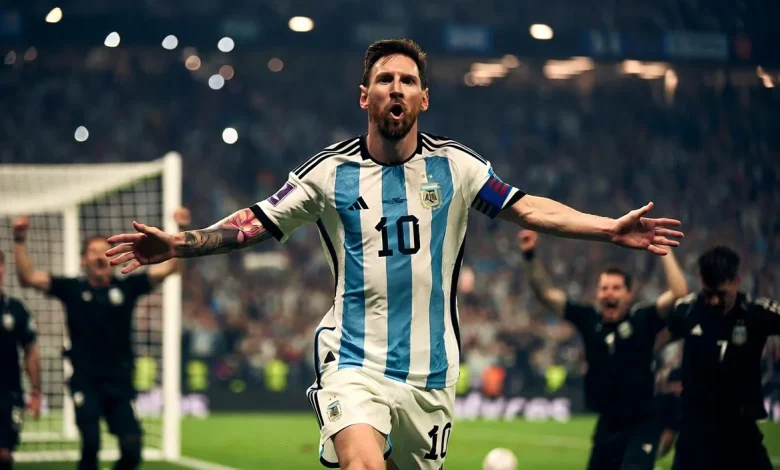
Lionel Messi silenced all questions about his fitness, his age, and his ability to carry a nation on Tuesday night, delivering a performance of a lifetime at Arrowhead Stadium. Entering the match under a cloud of physical uncertainty due to a lingering hamstring injury suffered during his Major League Soccer campaign, the 38-year-old maestro—who turns 39 next week—showed the world why his genius remains untouched by time. With an unforgettable, emotionally charged hat-trick, Messi guided defending champions Argentina to a dominant 3-0 victory over Algeria in their Group J opener, drawing level with Germany’s Miroslav Klose for the most goals in Men’s World Cup history at 16.
The match was not just a display of footballing mastery; it was a deeply personal and historical milestone. Exactly twenty years to the day after making his World Cup debut and scoring against Serbia and Montenegro on June 16, 2006, the Rosario-born icon walked onto the pitch in Kansas City to earn his historic appearance in a sixth different World Cup tournament. In doing so, he became the first player to ever participate in six editions of the men’s tournament. By the time he was substituted to a deafening standing ovation from 69,045 fans, any doubts about his physical capacity or Argentina’s title defense had vanished into the Missouri night sky.
Lionel Messi’s Historic Night in Kansas City
The atmosphere inside Arrowhead Stadium was nothing short of electric. Heavily tilted toward the three-time World Cup champions, a sea of light blue and white jerseys filled the historic venue, fulfilling a decades-long dream of soccer pioneers who envisioned the sport commanding such massive, passionate crowds in the United States. Argentina began their title defense under massive pressure. Unlike their disastrous opening match against Saudi Arabia four years ago in Qatar—which they eventually overcame to lift the trophy—Scaloni’s men wanted to establish authority immediately.
Facing a structured and resilient Algerian side known as Les Fennecs, Argentina needed their captain to spark the attack. Algeria came into the tournament with a defensive blueprint designed to choke space in the final third. Yet, Messi’s spatial awareness and movement continually shattered their tactical lines. His performance was a masterclass in modern forward play, proving that intelligence, positioning, and clinical execution can bypass even the most physical defensive schemes.
Silencing the Doubters: Overcoming the Hamstring Concern
Prior to kickoff, the global sports media was fixated on one major storyline: Messi’s left hamstring. Having missed several critical matches and played limited minutes during the domestic MLS season, there were legitimate fears that his body might finally be yielding to the grueling demands of international football. Detractors argued that relying on an almost 39-year-old forward to spearhead a World Cup defense was a high-risk strategy, especially in a tournament that demands peak physical conditioning.
However, from the opening whistle, those concerns were comprehensively dismantled. Messi did not merely drift through the game; he actively dictated its tempo. His quick-turn acceleration, precise dribbling in tight pockets, and relentless pressing off the ball proved that his physical preparation had been meticulous. The minor hamstring injury that had clouded his tournament buildup was revealed to be a footnote rather than a defining narrative, replaced instead by a story of unparalleled athletic endurance.
The Context of Messi’s Physical Struggles Ahead of 2026
Managing the physical load of an elite athlete in his late thirties requires an extraordinary level of synergy between club and country. The medical staffs at Inter Miami and the Argentine Football Association (AFA) worked in tandem for months leading up to the summer of 2026. A tailored training regime focusing on eccentric hamstring strengthening, soft-tissue recovery, and calculated rest intervals was put in place to ensure Messi reached Kansas City in peak condition.
Tactically, Lionel Scaloni also adjusted Argentina’s structural setup. By employing workhorse midfielders who cover immense ground, Scaloni created a system where Messi is liberated from defensive backtracking, allowing him to conserve energy for explosive offensive actions. This symbiosis of high-level sports science and tactical intelligence was on full display against Algeria, showcasing how modern football can extend the peak years of its greatest legends.
Anatomy of a Masterclass: The Three Goals Against Algeria
The tactical breakdown of Argentina’s 3-0 victory reveals a side operating in complete harmony, with Messi acting as the ultimate conductor. Algeria’s defensive shape, anchored by a low block, initially looked difficult to penetrate. They restricted passing lanes and attempted to physicalize the game. However, Argentina’s patience and technical superiority eventually tore the Algerian game plan apart, culminating in Messi’s first-ever World Cup hat-trick.
The Emotional Opener: A Teammate’s Feed and Unfiltered Tears
The breakthrough came in the 17th minute. Rodrigo De Paul, playing with the familiarity of a long-time national teammate, spotted Messi making a sharp diagonal run between the Algerian center-backs. De Paul delivered a perfectly weighted, nifty pass into the box. With a single touch, Messi controlled the ball, shifted his weight, and coolly slotted it past the Algerian goalkeeper Luca Zidane into the corner of the net.
What followed was one of the most emotional moments of Messi’s storied career. Instead of his trademark double-point to the heavens, Messi pulled the front of his sweat-soaked blue-and-white jersey over his eyes, visibly weeping as his teammates rushed to embrace him. It was a rare, vulnerable display from a player who usually maintains complete composure on the pitch. After the match, Messi cryptically addressed the raw emotion: ‘My tears after the first goal? I’ve had some tough days. It wasn’t related to football. And those feelings were because of that. I thank my teammates, the coaching staff and the delegation for helping me.’
The Rebound and the Strike: Equalizing Klose’s Historic Tally
If the first goal was defined by emotion, the second was defined by pure, opportunistic instinct. Early in the second half, in the 60th minute, a powerful shot from the edge of the area was parried away by Zidane. Anticipating the rebound before anyone else in the box, Messi pounced on the loose ball, tapping it home to double Argentina’s lead and move past Brazilian legend Ronaldo on the all-time scoring list.
The historic moment arrived in the 76th minute. Receiving a short pass on the right flank, Messi cut inside onto his favored left foot. Despite being closed down by two Algerian defenders, he unleashed a crisp, low strike that flew past the diving goalkeeper and nestled inside the near post. Arrowhead Stadium erupted into pure pandemonium. With that strike, his 16th World Cup goal, Messi tied Germany’s Miroslav Klose at the absolute summit of World Cup goal-scoring history. Moments later, Scaloni subbed his captain out, allowing the 69,045 fans to bestow a rapturous standing ovation upon the living legend.
Charting the Greats: World Cup All-Time Goal Scorers
Messi’s achievement places him in the most exclusive tier of footballing history. To truly appreciate the scale of this milestone, we must analyze how his numbers compare against the other legendary goal-scorers of the tournament. The historical data, which is detailed extensively on the official FIFA World Cup platform, highlights the evolution of the tournament’s greatest marksmen.
| Rank | Player | National Team | World Cup Goals | Appearances | Status |
|---|---|---|---|---|---|
| 1 | Miroslav Klose | Germany | 16 | 24 | Retired |
| 1 | Lionel Messi | Argentina | 16 | 27 | Active |
| 3 | Ronaldo Nazário | Brazil | 15 | 19 | Retired |
| 4 | Gerd Müller | West Germany | 14 | 13 | Retired |
| 4 | Kylian Mbappé | France | 14 | 15 | Active |
| 6 | Just Fontaine | France | 13 | 6 | Retired |
| 7 | Pelé | Brazil | 12 | 14 | Retired |
While Miroslav Klose compiled his record across four tournaments with a remarkably clinical, penalty-box-centric style, Messi has reached this peak as a playmaker-forward over six editions. This contrast underscores Messi’s multi-faceted influence on the pitch, combining elite playmaking with historic goal-scoring volume.
The Psychological Weight: Unraveling Messi’s Post-Match Tears
Behind the glittering statistics lies the human element of a sports icon. Messi’s post-match admission regarding his tears highlighted a side of the superstar that fans rarely see. The immense pressure of being Lionel Messi is not confined to the 90 minutes on the pitch. Dealing with off-the-pitch personal struggles, all while knowing that millions of people are looking to you to deliver national glory, creates a psychological burden that is almost unfathomable.
His teammates’ reactions after his emotional first goal spoke volumes about the unity within the Argentine squad. They did not just celebrate a goal; they protected their captain, forming a tight circle around him to offer a moment of privacy amidst the flashing cameras of the global media. This emotional resilience and deep-rooted support network within the squad could prove to be Argentina’s most potent weapon as they progress through the grueling tournament bracket.
The Battle for World Cup Supremacy: Messi vs. Mbappé vs. Haaland
The 2026 World Cup is shaping up to be an epic generational battle. Just hours before Messi’s masterclass in Kansas City, other global stars made their own statements. Kylian Mbappé scored twice in France’s 3-1 victory over Senegal, bringing his personal World Cup tally to 14 goals and solidifying his position as the primary threat to both Klose and Messi’s records. Meanwhile, Erling Haaland announced his arrival on the world stage with a clinical brace in Norway’s 4-1 victory over Iraq.
This fierce competition adds an extra layer of intrigue to the tournament. With the tournament’s expanded format providing more matches, Klose’s record is highly likely to be broken in the coming weeks. Interestingly, Klose himself recently voiced his support for Messi, stating in an interview that he would be thrilled to see the Argentine genius inherit his crown, praising his footballing intelligence and longevity.
Chasing the Three-Peat: Argentina’s Quest for Back-to-Back Glory
With three points secured and a massive boost in goal difference, Argentina has placed one foot firmly in the knockout stages. Their upcoming Group J fixtures against Austria and Jordan will offer further opportunities for Scaloni to rotate his squad and for Messi to claim sole possession of the all-time scoring record. Yet, the ultimate objective remains far loftier than individual milestones: securing consecutive World Cup titles.
Only two nations in football history have ever managed to defend their World Cup crown—Italy in 1938 and Brazil in 1962. If Argentina can repeat their Qatar triumph here in North America, they will cement their status as one of the greatest dynasties in sports history. With a fully fit, highly motivated Lionel Messi leading a deeply united squad, the dream of a historic consecutive title feels more realistic than ever.
Conclusion: A 39-Year-Old Genius Redefining Soccer Longevity
Ultimately, Messi’s performance against Algeria was a vivid reminder that true greatness transcends age. At an age when most footballers have long since hung up their boots or transitioned to less competitive leagues, Messi continues to operate at the absolute zenith of the sport. His ability to overcome physical setbacks, manage immense psychological pressure, and deliver a historic hat-trick in a World Cup opener is testament to his peerless dedication.
As the tournament unfolds, the world will continue to watch in awe. Whether he ultimately breaks Klose’s record in the next game or guides Argentina to another golden trophy, one thing is certain: we are privileged to witness the final, majestic chapters of a career that will never be replicated. Lionel Messi has answered every question, leaving only admiration in his wake.