3 Key Takeaways: Janeese Lewis George Leads DC Mayoral Primary Results
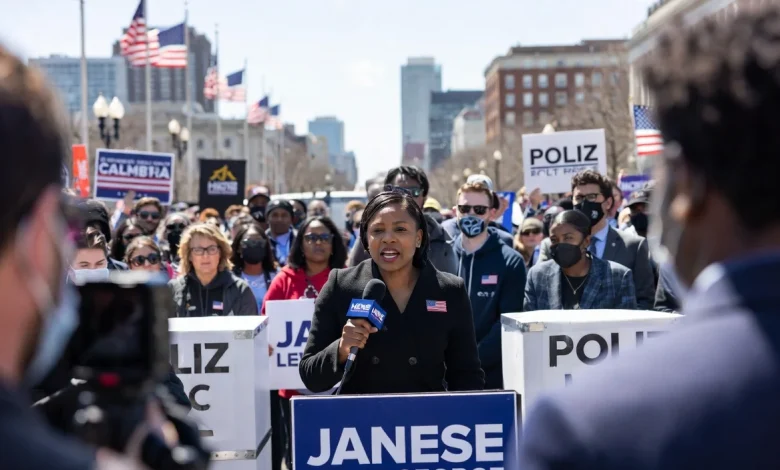
Janeese Lewis George has built a commanding lead in the historic 2026 Washington, D.C. Democratic mayoral primary, signaling a potentially seismic shift in the political landscape of the nation’s capital. With approximately two-thirds of the expected vote counted, the Ward 4 Councilmember holds 53% of first-place votes, establishing a formidable advantage over her chief rival, former At-Large City Councilmember Kenyan McDuffie, who sits at 37%. The remaining votes are scattered among five other Democratic candidates, representing a fragmented field that has struggled to pierce the dominant duopoly of the frontrunners. As election workers continue to process mail-in and provisional ballots, the key question remaining is whether Lewis George can maintain her absolute majority to avoid the district’s newly implemented ranked-choice voting tabulation.
The Political Shift: Janeese Lewis George Captures Early Lead
The 2026 Democratic primary represents a watershed moment for Washington, D.C.. For the first time in twelve years, the city’s highest office is wide open following the retirement of incumbent Mayor Muriel Bowser, who decided not to seek a fourth term. Bowser’s departure has set off an intense ideological struggle for the future direction of the city’s governance. Janeese Lewis George, representing the progressive and democratic socialist wings of the party, has seized this political opening to mount a robust grassroots campaign centered on socioeconomic equity, tenant protections, and public investment.
As the first-round votes were released by the D.C. Board of Elections, the depth of Lewis George’s support became immediately clear. She has established a double-digit lead that spans almost every ward in the city, showing remarkable strength among working-class voters, younger residents, and progressive advocates. Her performance has stunned some establishment figures who believed a more moderate, business-friendly candidate would capture the consensus of the electorate in a time of economic transition and public safety concerns. If her lead holds and she secures the mayoralty, Janeese Lewis George will become the first self-described democratic socialist to lead the nation’s capital, fundamentally altering the city’s policy priorities.
Ranked-Choice Voting: The Mechanics and Uncertainty of the Election
This election marks the historic debut of ranked-choice voting (RCV) in Washington, D.C., a major structural change approved by voters to ensure the winning candidate commands broad consensus. Under this system, voters are permitted to rank up to five candidates in order of preference. If a candidate secures an outright majority—more than 50%—of the first-choice votes, they are declared the winner immediately. However, if no single candidate achieves this absolute majority, the election enters an automated redistribution phase.
In the tabulation phase, the candidate with the fewest first-place votes is eliminated. The ballots cast for that eliminated candidate are then reallocated to those voters’ designated second choices. This process of elimination and reallocation repeats sequentially until one candidate crosses the 50% threshold. While Janeese Lewis George currently holds 53% of the first-choice votes, the substantial volume of uncounted mail-in ballots leaves a narrow mathematical window in which her share could dip below the 50% mark, triggering the automated tabulation process.
Understanding the Threshold: Will the Race Go to Tabulation?
Whether the race ultimately triggers a ranked-choice tabulation depends entirely on the partisan and geographic distribution of the remaining uncounted ballots. Historically, mail-in ballots in the District can skew progressively, but they can also mirror broader municipal splits. The D.C. Board of Elections has emphasized that processing mail-in ballots received on or after Election Day requires extensive verification, meaning a final, certified result may take several days to materialize.
Political analysts note that even if the race drops below the 50% threshold and moves to RCV tabulation, Kenyan McDuffie faces an incredibly steep uphill battle. For McDuffie to overtake Lewis George, he would need to capture an overwhelming majority of the second- and third-choice preferences from voters who originally backed the five lower-performing candidates. Given the ideological diversity of the minor candidates—ranging from outsider business advocates to minor progressive reformers—such a monolithic transfer of support remains highly unlikely, cementing Lewis George’s dominant position.
A Clash of Visions: The Progressive Agenda vs. the Moderate Establishment
The primary campaign has served as a referendum on the ideological identity of the D.C. Democratic Party. On one side of this divide is the progressive coalition, which argues that a decade of centrist leadership under Mayor Bowser has exacerbated racial disparities, accelerated gentrification, and left working-class families behind. Janeese Lewis George has positioned herself as the champion of this coalition, advocating for systemic reforms to the city’s housing, education, and labor policies.
Conversely, the moderate establishment has coalesced around Kenyan McDuffie, portraying his campaign as the pragmatically sound and fiscally responsible alternative. McDuffie has warned that the aggressive policies proposed by Lewis George could destabilize the city’s fragile commercial real estate market, stifle economic growth, and alienate the business community. This clash of visions has defined debates, public forums, and heavily funded advertising campaigns from external political action committees.
The Socialist Surge: Following the Playbook of Zohran Mamdani
Janeese Lewis George’s campaign has drawn frequent and deliberate comparisons to New York City Mayor Zohran Mamdani, who achieved a stunning victory on a democratic socialist platform. Mamdani’s success in New York proved that an unabashedly left-wing municipal agenda could mobilize a powerful coalition of young, working-class, and minority voters to defeat establishment candidates. Lewis George has actively embraced this blueprint, using it to demonstrate that democratic socialism is not merely an academic theory but a viable governing philosophy for major American cities.
By framing municipal issues through the lens of economic and social justice, Lewis George has successfully tapped into the deep-seated anxieties of residents facing skyrocketing housing costs and displacement. Her campaign’s policy proposals—such as universal childcare, municipal social housing, and publicly funded grocery stores in underserved areas—mirror the ambitious, government-led solutions championed by Mamdani’s administration in New York.
The Centrist Alternative: Kenyan McDuffie’s Business-Backed Campaign
Kenyan McDuffie has positioned himself as a seasoned public servant capable of managing the complex administrative apparatus of the District without resorting to ideological extremes. As a former prosecutor and veteran city councilmember, McDuffie has long cultivated ties with Washington’s commercial elite, real estate developers, and hospitality industry leaders. His platform emphasizes targeted public-private partnerships, economic diversification, and fiscal guardrails to preserve the city’s bond rating.
Throughout the campaign, McDuffie has sought to paint Lewis George’s proposals as fiscally unsustainable, arguing that her plans would necessitate substantial tax hikes on businesses and high-income residents. He has warned that such measures could trigger capital flight and worsen the city’s commercial vacancies. Supported by organizations like Opportunity DC, McDuffie’s campaign represented the final, concerted effort of the city’s traditional establishment to maintain control of the executive branch in the post-Bowser era.
Key Issues in the Capital: Public Safety, Housing, and Childcare
The electoral contest has focused heavily on the immediate, tangible crises affecting District residents. Chief among these concerns are the interconnected issues of public safety, housing affordability, and the rising cost of living. Both candidates have offered vastly different diagnostic assessments and policy remedies for these systemic challenges, giving voters a stark and definitive choice.
Affordability and Childcare Commitments
Janeese Lewis George has made affordability the absolute cornerstone of her campaign, proposing sweeping interventions in the local economy. Her headline policy is a comprehensive universal childcare plan, designed to ensure that no family in Washington, D.C., is forced to spend more than 7% of their household income on early childhood education. To support this initiative, she has pledged to raise the salaries of early childhood educators to match the pay scale of public school teachers, thereby stabilizing a vital sector of the city’s workforce.
On housing, Lewis George has advocated for aggressive rent control expansion, robust down-payment assistance programs, and the creation of a municipal social housing developer to construct deeply affordable, mixed-income housing units directly. Additionally, she has addressed the stark disparity in food access between wealthy and low-income wards. Pointing out that Ward 7 has only three full-service grocery stores for over 90,000 residents compared to 17 in Ward 3, Lewis George has proposed investing public dollars to establish publicly owned grocery stores if private retailers refuse to open locations in underserved neighborhoods.
Public Safety Debates: Curfews and Federal Overreach Concerns
Public safety has emerged as the most contentious flashpoint of the entire mayoral race. The District has faced highly publicized debates over rising crime rates, youth involvement in criminal activity, and the implementation of youth curfews. Kenyan McDuffie has taken a firm, traditional stance on law enforcement, arguing that the city government must treat “teen takeovers” and juvenile crime as immediate emergencies. He criticized Lewis George for her votes against permanent youth curfews, accusing her of prioritizing ideological purity over the physical safety of D.C. residents.
Lewis George has defended her public safety record by framing the issue around systemic prevention, community-based intervention, and civil rights. While she initially supported temporary curfews, she withdrew her support after the deployment of uncoordinated federal law enforcement agencies in the city. She argued that allowing unaccountable federal agents—who are not trained in de-escalation or bound by municipal oversight—to enforce curfews risks creating dangerous situations for Black youth. Instead, Lewis George advocates for expanding mental health crisis response teams, increasing funding for violence interrupters, and focusing on long-term youth engagement strategies.
The National Spotlight: Federal Home Rule and the Shadow of Trump
As the federal capital, Washington, D.C.’s municipal elections inevitably attract national scrutiny and carry unique geopolitical stakes. The 2026 race has been further complicated by external political dynamics, specifically the hostile posture of the federal administration. A week prior to the primary, President Donald Trump waded directly into the local contest, expressing strong opposition to Lewis George’s candidacy and threatening a federal takeover of the city’s administration if a democratic socialist is elected.
Trump’s remarks sparked immediate condemnation from both frontrunners, who united in their defense of D.C.’s Home Rule and self-governance. Lewis George stated that she would not allow fear of the federal executive to dictate the city’s progressive policy path, while McDuffie pledged to fight “tooth and nail” against any federal overreach or attempts to strip the District of its democratic rights. Nevertheless, the threat of federal interference remains a critical consideration for voters, who must weigh which candidate is best equipped to protect the city’s autonomy while navigating a highly polarized national environment.
Election Data Summary: First-Choice Vote Percentages
The following table provides a comprehensive overview of the mayoral candidates, their ideological alignments, key support networks, and their first-choice vote shares based on the preliminary results with approximately two-thirds of the expected vote counted.
| Candidate | Political Platform & Ideological Alignment | Key Support & Coalition Partners | First-Choice Vote Share (66% Counted) |
|---|---|---|---|
| Janeese Lewis George | Democratic Socialist; focused on social housing, universal childcare, and progressive tax reform. | Democratic Socialists of America (DSA), Working Families Party, local tenant unions, and progressive advocates. | 53% |
| Kenyan McDuffie | Centrist Democrat; focused on economic diversification, pro-business growth, and public safety. | Mayor Muriel Bowser, Opportunity DC, local realtors, and business associations. | 37% |
| Vincent Orange | Moderate Democrat; focused on traditional civic improvement and economic development. | Local business leaders and civic associations. | 4% |
| Gary Goodweather | Centrist Independent; Johns Hopkins graduate focusing on financial pragmatism. | Fringe business coalitions and veteran groups. | 3% |
| Others (Combined) | Various minor candidates (including Rini Sampath, Ernest Johnson, and Hope Solomon). | Grassroots local supporters and community activists. | 3% |
As the counting of mail-in and provisional ballots continues, Washington, D.C., stands on the precipice of a dramatic transformation. If Janeese Lewis George’s lead remains above the 50% threshold, her decisive victory will not only avoid a ranked-choice tabulation but will also send a clear, powerful signal that the progressive movement has found a new, high-profile stronghold in the nation’s capital.