Brazil vs Morocco: Vinícius Rescues 1-1 Draw in Cup Opener
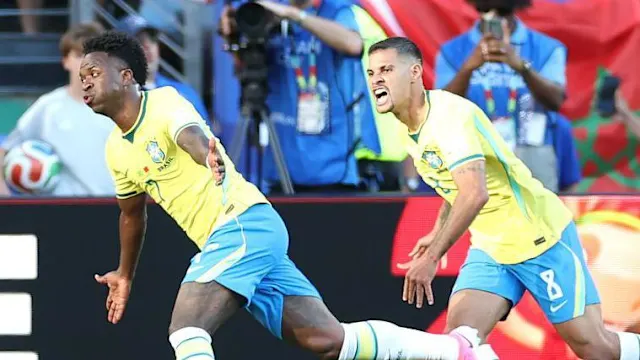
Brazil began its quest for a sixth World Cup title with a highly competitive 1-1 draw against Morocco on Saturday in a pulsating Group C matchup at the MetLife Stadium in East Rutherford, New Jersey. In front of a raucous, sold-out crowd of 80,663 spectators, the heavyweights of South American and North African football clashed in what was widely regarded as the premier matchup of the opening round. Real Madrid’s talismanic winger Vinícius Júnior saved the day for the Seleção, scoring a brilliant equalizer in the 32nd minute to cancel out an early opener from Morocco’s rising star Ismael Saibari.
The highly charged atmosphere inside the New York New Jersey Stadium was thick with expectation, though the sweltering 88-degree Fahrenheit (31-degree Celsius) heat tested the stamina of both squads. Brazil, playing under the stewardship of Italian tactician Carlo Ancelotti—making his debut as the nation’s first foreign World Cup manager—struggled to find their footing in the opening stages. Morocco, who made history in 2022 as the first African team to reach a World Cup semifinal, proved that their previous achievements were no fluke. They dominated the early exchanges, exploiting space in the midfield and unsettling the five-time world champions before Brazil’s individual quality restored parity.
Tactical Lineups and Pre-Match Strategy
Carlo Ancelotti opted for an offensive-minded 4-3-3 formation, missing the mercurial talent of Neymar, who remained sidelined while recovering from a torn right calf. In Neymar’s absence, the attacking responsibilities fell on the shoulders of Vinícius Júnior, Raphinha, and Igor Thiago. However, it was Brazil’s midfield structure that drew immediate scrutiny. The veteran pairing of Casemiro and Bruno Guimarães struggled to establish control over the middle third, leaving the defense vulnerable to Morocco’s lightning-fast transitional play.
Morocco, led by their tactical brain trust, set up in a highly disciplined and energetic system designed to disrupt Brazil’s passing lanes. A key component of their strategy was the integration of teenage midfield sensation Ayyoub Bouaddi, whose physical presence and calm distribution belied his young age. Flanked by the creative engine of Brahim Díaz and the industriousness of Ismael Saibari, the Moroccan midfield repeatedly sliced through Brazil’s lines, isolating the center-back pairing of Roger Ibañez and Marquinhos.
Morocco’s Opening Salvo: Saibari Makes History
The Atlas Lions made a sparkling start to the match, patiently working the ball down the wings and posing an early threat through the overlapping runs of Achraf Hakimi. Brazil looked surprisingly disjointed, failing to win second balls and turning possession over in dangerous areas. Brazil’s first real opportunity came in the 14th minute when Igor Thiago rose to meet a cross, but his header drifted wide of the post. It was a rare moment of promise in an otherwise lackluster opening phase for the Seleção.
In the 21st minute, Morocco’s early dominance was rewarded with a beautifully constructed goal. Brahim Díaz picked up the ball in a central pocket of space and delivered an exquisitely weighted through-ball that split the Brazilian defense wide open. Ismael Saibari, who came into the tournament on the heels of a prolific 15-goal domestic season with Dutch giants PSV Eindhoven, timed his run to perfection. He latched onto the pass and coolly lofted the ball over an onrushing Alisson Becker to give the African champions a fully deserved lead. The goal sparked wild celebrations among the Moroccan contingent and made Morocco the first North African nation to score against a South American side in World Cup history.
Vinícius Júnior Delivers a Moment of Magic
Conceding the opener sent shockwaves through the yellow-clad Brazilian fans, who became temporarily subdued in the stands. Under pressure, Brazil needed their talisman to step up, and Vinícius Júnior did not disappoint. In the 32nd minute, against the run of play, the Real Madrid superstar produced a moment of individual genius that reminded the world why he is considered an elite footballer.
Receiving the ball from Bruno Guimarães deep on the left flank, Vinícius was met by two Moroccan defenders. Displaying exceptional footwork, he exchanged quick passes with Guimarães to create a sliver of space. He then cut sharply inside onto his preferred right foot and unleashed a blistering, swerving shot that rocketed into the top corner of the net, completely out of the reach of the diving Yassine Bounou. It was Vinícius’s 10th international goal for his country, a crucial strike that restored parity and shifted the momentum of the game. Interestingly, according to official tournament stats, this was the first international match in which Vinícius scored where Brazil failed to secure a victory, ending a run of eight consecutive wins when he found the net.
Second-Half Adjustments and Midfield Stabilization
With the score locked at 1-1 at halftime, Carlo Ancelotti made decisive adjustments to address his team’s defensive frailties. The Italian manager made the bold decision to hook the struggling Casemiro at the break, bringing on Danilo and Fabinho to inject more defensive steel and structure into the midfield. This tactical shift bore immediate fruit, as Brazil took control of the ball and restricted Morocco’s counter-attacking avenues.
The second half was a much tighter affair, characterized by aggressive high-pressing and physical duels. While Brazil dominated possession (finishing with 54 percent compared to Morocco’s 46 percent), the Moroccan defense, anchored by Romain Saïss and goalkeeper Yassine Bounou, remained resolute. Brazil attempted to break the deadlock by introducing Matheus Cunha, but the forward struggled to find space against Morocco’s low block. The Atlas Lions continued to carry a threat on the counter, utilizing the immense work rate of Achraf Hakimi and Bilal El Khannouss, though clear-cut chances remained at a premium for both sides.
Stoppage-Time Drama and Alisson’s Heroics
As the match entered a lengthy ten-minute stoppage-time period due to physical play and tactical fouls, the intensity reached a fever pitch. In the 99th minute, Morocco came agonizingly close to snatching a historic victory. Midfielder Neil El Aynaoui unleashed a powerful, dipping shot from long range that caught Alisson Becker off guard. The Brazilian goalkeeper spilled the initial shot, and as the ball trickled toward the goal line, Alisson reacted with world-class reflexes.
Scurrying backward while on the turf, Alisson managed to use his right hand to block a goal-bound follow-up effort from Ayoube Amaimouni. The spectacular double-save preserved the draw for Brazil and highlighted the slim margins separating victory and defeat at this level. At the other end, Yassine Bounou made a late save of his own, denying a curling effort from Raphinha to ensure that both teams walked away with a share of the points.
Statistical Summary and Performance Metrics
A closer look at the advanced match metrics reveals a highly balanced contest that was truly a game of two halves. Morocco’s direct play and transitions dominated the first half, resulting in an expected goals (xG) rating of 1.28 compared to Brazil’s 0.86. However, Brazil’s tactical adjustments in the second half limited Morocco to just two shots, allowing the South Americans to claw back control.
The following table provides a detailed breakdown of the key statistics from this epic World Cup group-stage clash:
| Metric | Brazil | Morocco |
|---|---|---|
| Goals | 1 | 1 |
| Shots (On Target) | 13 (5) | 14 (6) |
| Possession | 54% | 46% |
| Expected Goals (xG) | 1.27 | 1.47 |
| Corners | 4 | 2 |
| Fouls Committed | 12 | 15 |
| Yellow Cards | 2 (Casemiro, Ibañez) | 0 |
The statistical split underlines Morocco’s threat in the final third, particularly during the first 45 minutes where they registered more shots and drew four fouls in advanced areas. Brazil, meanwhile, dominated the aerial duels, winning six out of seven, which helped insulate their defense during set-pieces. Both teams played with high intensity, but the disciplined defensive organization on display prevented a late winner.
World Cup Group C Outlook and Implications
The draw leaves Group C in an incredibly tight position, with both teams level on points and goal difference. Currently, Morocco holds the top spot due to a slight edge in FIFA’s fair play tiebreaker, having received no yellow cards compared to Brazil’s two. The tournament is shaping up to be an intense, crowded race that lacks a clear front-runner, with every single point and goal differential carrying massive weight in the quest to qualify for the knockout rounds.
Brazil will travel to Philadelphia to face Haiti on Friday, where they will be heavily favored to secure their first victory of the campaign. They will then close out their Group C journey against Scotland in Miami Gardens, Florida. On the other hand, Morocco faces a challenging fixture against Scotland in Foxborough, Massachusetts, before wrapping up the group stage against Haiti in Atlanta, Georgia. For football governing bodies, coordinating these massive matches across various North American cities remains a logistical marvel. Ensuring smooth communication and data access is vital, especially when resolving international logistical bottlenecks, similar to how the United States navigates global health information gaps to streamline massive public events.
Historical Milestones and the Unbeaten Streak
Despite failing to secure a win, Brazil managed to extend one of the most remarkable records in sports history. The Seleção are now unbeaten in their last 21 World Cup opening matches, a streak that spans 92 years. Since suffering a 3-1 defeat to Spain in their opening match of the 1934 tournament, Brazil has recorded 17 wins and 4 draws in their openers. This incredible consistency highlights why Brazil remains the standard-bearer of global football.
For Morocco, the result is further validation of their status among the global football elite. Their disciplined defensive performance and tactical versatility demonstrated that their historic 2022 run was not a temporary phenomenon, but the result of sustained structural development. The tournament’s official match data, compiled by FIFA, confirms that Morocco remains one of the most efficient counter-attacking teams in modern football.
Global Perspectives and Economic Impact
The World Cup in the United States, Canada, and Mexico has already driven massive economic growth across the host nations. MetLife Stadium, which is slated to host the highly anticipated World Cup final, saw an unprecedented surge in economic activity, from local tourism to transport infrastructure. For instance, on matchday, transport costs from Times Square to the stadium surged dramatically, reflecting the immense global interest. This economic boom aligns with wider financial trends in the host country. Just as Wall Street has seen strategic reallocations, such as when BlackRock upgraded U.S. stocks to overweight to capitalize on domestic growth, the commercial success of the World Cup highlights the financial power of sporting events.
As international fans travel across North American borders, the seamless cooperation between nations stands in stark contrast to the global trade disputes and political conflicts that often dominate headlines. Even during times when international policies face scrutiny—such as when court rulings declared that certain global import tariffs were illegal—sporting events like the World Cup serve as a powerful reminder of global unity and peaceful competition.
Post-Match Reactions from the Camps
Following the final whistle, both camps expressed mixed emotions about the result. In his post-match interview, Vinícius Júnior admitted that the team needs to elevate their performance. “We started on a really bad note,” Vinícius said through a translator. “For certain, we got to hold on to the ball. We have to move better.” His comments reflect the high standards expected of the Seleção, who are desperate to secure their first world title since 2002.
On the other hand, Carlo Ancelotti defended his starting lineup while acknowledging the need for improvement. “We have to reassess what we did in the first half… we cannot lose heart. This is the first match of the World Cup,” Ancelotti stated. He pushed back against criticism of his tactical selection, adding, “The starting XI was well thought of. I will not take any criticism about the players that started the match.” With key fixtures on the horizon, both teams have valuable lessons to implement as they march deeper into this historic tournament.