5 Incredible Moments: Vozinha Halts Spain in Cape Verde’s Epic World Cup Debut Draw
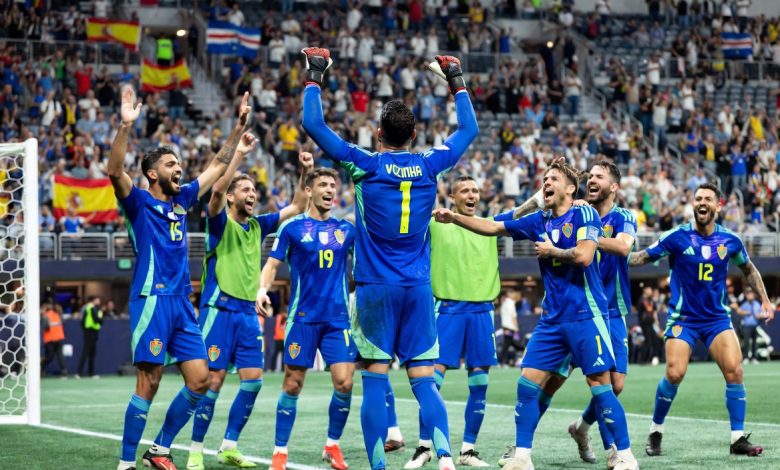
Vozinha became the ultimate symbol of resilience and determination as Cape Verde pulled off one of the greatest upsets in FIFA World Cup history by holding reigning European champions Spain to a goalless draw. The veteran goalkeeper’s performance during the match on Monday afternoon in Atlanta was a masterpiece of reflexes, timing, and pure heart. In front of a stunned crowd at the Mercedes-Benz Stadium, the 40-year-old shot-stopper stood like a giant against a barrage of Spanish attacks, confirming that the World Cup debutants from an island nation of just over 500,000 people were not there merely to make up the numbers.
Before the match began, very few pundits gave Cape Verde any realistic chance of surviving against a star-studded Spanish side. Spain, boasting global superstars like Pedri, Gavi, Ferran Torres, and Rodri, entered the 2026 FIFA World Cup as one of the clear favorites to lift the trophy. However, football is a game of passion, tactical discipline, and individual heroism. Over the course of ninety grueling minutes, Cape Verde proved that names on paper mean very little once the whistle blows. Led by their legendary captain and goalkeeper, the Blue Sharks constructed a defensive masterclass that will be studied for generations.
An Epic Draw: Spain Meets Their Match in Atlanta
Entering the Mercedes-Benz Stadium on Monday afternoon, the contrast between the two teams could not have been more striking. Spain arrived with a squad constructed of Champions League winners, La Liga champions, and generational talents valued in the hundreds of millions of euros. Cape Verde, meanwhile, was making its historic first appearance at a World Cup finals, with many of its squad members playing in lower-tier leagues across Europe and Africa. The script seemed written for a comfortable Spanish victory to kickstart their campaign in Group H.
Instead, Spain met an immovable force. Luis de la Fuente’s men dominated the ball from the first whistle, establishing an overwhelming share of possession. Yet, as the minutes ticked by, Spain’s tiki-taka passing patterns became increasingly predictable against a intensely organized Blue Sharks defensive unit. The crowd in Atlanta, initially expecting a flurry of Spanish goals, slowly shifted their support toward the heroic underdogs, sensing that something extraordinary was unfolding on the pitch.
The 39th Minute Scramble: Deconstructing the Double Save
At one point toward the end of the first half of the match between Spain and Cape Verde on Monday afternoon, it became apparent that Vozinha, the Cape Verde goalkeeper, was up for the challenge of facing one of the most talented, successful teams in the world. The defining moment of the first half—and arguably the entire match—arrived in the 39th minute. Spain, seeking a breakthrough, looped a pass down the left side, carving open the Cape Verdean defense for the first time. Seconds later, Spain had a wide-open chance directly in front of the net, with only Vozinha standing in their way.
In a split-second decision, Vozinha dove at the feet of Spain’s Ferran Torres. Torres, attempting to lift the ball over the onrushing keeper, kicked the ball off the crossbar, triggering a mad scramble in the box as the ball popped high into the air. Spain’s Mikel Oyarzabal was perfectly positioned for the rebound, attempting to head the ball into the seemingly empty net. However, showing physics-defying agility, Vozinha hopped up off the turf, leapt into the air again, and pushed the ball safely out of play over the crossbar. It was a double save of the highest caliber, demonstrating not just technical skill but an extraordinary refusal to be beaten.
Who is Vozinha? The 40-Year-Old Legend of Cape Verde
To those unfamiliar with African football, the name Josimar José Évora Dias—better known as Vozinha—might have been a surprise. But to the people of Cape Verde, he is a living legend. Born in the port city of Mindelo on the island of São Vicente, Vozinha has been the bedrock of the national team since making his debut in 2012. At 40 years old, he has lived through the entire modern evolution of Cape Verdean football, representing his country at multiple Africa Cup of Nations (AFCON) tournaments, including their historic quarter-final run in 2013.
Vozinha’s journey to the grandest stage in football is a story of sheer perseverance. He did not turn professional until the age of 25 when he signed for Angolan side Progresso do Sambizanga. Over the next decade and a half, his club career took him across several countries, including Portugal, Cyprus, and Saudi Arabia, before he settled at Portuguese second-division club Chaves. Despite his modest club pedigree, his performances for the “Blue Sharks” have always been of international caliber. His 91 national team caps make him one of the most decorated players in the history of his nation.
Tactical Masterclass: How Cape Verde Built a Wall
Cape Verde’s historic point was not merely the result of luck; it was a tactical masterpiece designed by coach Bubista. Knowing the immense technical quality of the Spanish midfielders, Cape Verde did not attempt to fight for possession. Instead, they conceded the ball, retreated into a highly disciplined structure, and dared Spain to break them down. This strategy required immense physical conditioning and absolute concentration, as any minor defensive lapse would have been punished by the European champions.
The defensive discipline is highlighted by the post-match statistics. Cape Verde completed a staggering 45 clearances and recorded 16 interceptions, constantly disrupting Spain’s rhythm in the final third. Goalkeeper Vozinha ended the match with seven saves, six of which were from shots taken inside the penalty area, earning him a near-perfect Sofascore rating of 9.7.
| Match Statistic | Spain | Cape Verde |
|---|---|---|
| Score | 0 | 0 |
| Total Shots | 27 | 3 |
| Shots on Target | 7 | 1 |
| Possession Percentage | 75% | 25% |
| Passes Attempted (Completed) | 728 (655) | 242 (165) |
| Crosses (Accurate) | 36 (6) | 4 (1) |
| Clearances | 8 | 45 |
| Interceptions | 6 | 16 |
| Goalkeeper Saves | 1 | 7 |
| Sofascore MVP Rating | Pedri (9.1) | Vozinha (9.7) |
The Five-Man Low Block
The core of Cape Verde’s defensive strategy was a compact five-man low block. By deploying three central defenders flanked by two highly disciplined wing-backs, Bubista effectively neutralized the spaces that Spain’s creative midfielders, such as Pedri and Gavi, typically exploit. Whenever Spain tried to play vertical passes through the center of the pitch, they found themselves crowded out by a sea of blue jerseys. Pico Lopes, who plays his club football for Shamrock Rovers, delivered an extraordinary defensive display alongside Logan Costa, making several crucial blocks in the dying embers of the match.
Neutralizing Spain’s 36 Crosses
Frustrated by their inability to penetrate through the middle, Spain resorted to utilizing the flanks, sending in a total of 36 crosses throughout the match. Real Madrid’s left-back Marc Cucurella was particularly active, attempting multiple deliveries into the box. However, Cape Verde’s defenders dominated the aerial battles, winning the vast majority of first and second balls in their own penalty box. On the rare occasions that a Spanish player did connect with a cross, Vozinha was perfectly positioned to claim the high ball or tip it away from danger.
Spain’s Wasted Opportunities and Offensive Struggles
Spain’s performance in Atlanta will undoubtedly raise serious questions back home. Coach Luis de la Fuente made the controversial decision to rest teenage sensation Lamine Yamal and winger Nico Williams from the starting lineup, hoping to preserve them for tougher group games. This decision backfired spectacularly, as Spain’s starting attack looked devoid of the verticality, pace, and unpredictable dribbling that has made them the most feared team in Europe.
Without Yamal and Williams on the pitch, Spain’s attacking movements were slow and ponderous. They struggled to create high-quality chances, often settling for low-probability long-range efforts or desperate crosses. When genuine goalscoring opportunities did arise, Spain’s forwards showed a surprising lack of composure in front of the goal, wasting the few clear-cut openings they managed to carve out.
Ferran Torres and the Crossbar Nightmare
Ferran Torres had a night to forget in Atlanta. Starting on the right wing, the Barcelona forward had Spain’s best opportunities to break the deadlock. Apart from the 39th-minute chance where he hit the crossbar, Torres missed another golden opportunity shortly before halftime. After a clever pass from Pedri found him unmarked inside the box, Torres fired his shot directly into the arms of Vozinha. His frustration was visible, reflecting a wider sense of disbelief among the Spanish squad as their offensive efforts continually fell flat.
Mikel Oyarzabal’s Denied Header
Mikel Oyarzabal was tasked with leading the line as Spain’s central striker, but he found himself locked in a physical battle with Cape Verde’s robust center-backs. His most notable contribution was the instinctive header following Torres’ strike off the crossbar. Oyarzabal did everything right, directing his header on target with pace. However, he ran into an inspired Vozinha, whose quick recovery save denied him what would have been a crucial opening goal. Oyarzabal was eventually substituted in the second half, having failed to convert any of his five shot attempts.
The Impact of Lamine Yamal and Spain’s Substitutions
With twenty minutes remaining and the scoreline still locked at 0-0, Luis de la Fuente finally turned to his bench, introducing Lamine Yamal in a desperate search for a winner. The 18-year-old Barcelona phenom instantly changed the dynamics of the game. Operating on the right wing, Yamal’s speed, agility, and elite dribbling created immediate panic in the Cape Verdean defense.
Despite playing for just 19 minutes, Yamal completed five successful dribbles—more than any other player on the pitch during the entire match. His presence forced Cape Verde to drop even deeper, committing multiple defenders to double-team the teenager whenever he received the ball. Yet, despite Yamal’s best efforts, the Blue Sharks stood firm. The defensive unit, marshaled brilliantly by Vozinha, refused to buckle under the late pressure, securing a historic point as the referee blew the final whistle.
The Emotional Aftermath: Why Vozinha Cried at Full-Time
The emotional weight of the moment became even clearer in the post-match interviews. As reported by The Guardian, Vozinha broke down in tears of resilience and joy at the final whistle, mobbed by his teammates and coaching staff. Behind those tears was a deeply personal story of sacrifice, family, and the harsh realities faced by many African footballers.
Vozinha revealed that his mother was unable to travel to the United States to watch him play in Cape Verde’s World Cup debut. Due to the strict visa regulations—which require citizens from certain nations to post a returnable bond of up to $15,000 in addition to the standard visa fees—his family could not raise the necessary funds in time. Furthermore, Vozinha dedicated the performance to his late grandparents, who had raised him in Mindelo but did not live to see his ultimate triumph on the world stage. “I have worked my whole life for this moment,” a tearful Vozinha said. “This is for everyone in Cape Verde. I was named player of the match, but this belongs to all of my teammates”.
Group H Implications and What Lies Ahead
The 0-0 draw has completely blown Group H wide open. Spain, widely expected to top the group with maximum points, now find themselves under immense pressure heading into their second match against Uruguay. Luis de la Fuente will have to quickly address his team’s offensive shortcomings and re-evaluate his selection policy, as another slip-up could put their qualification for the knockout rounds of the expanded 48-team tournament in serious jeopardy.
For Cape Verde, this single point feels like a victory. The historic draw has sent shockwaves through the global football community, proving that the gap between football’s traditional elite and emerging nations continues to shrink. Armed with defensive discipline, tactical clarity, and a world-class goalkeeper in Vozinha, the Blue Sharks can look forward to their upcoming group fixtures with absolute belief. Their journey in the 2026 FIFA World Cup has only just begun, and they have already etched their names into the tournament’s folklore.