Trump Secretly Switched Planes to Avoid Iranian Threat 2026
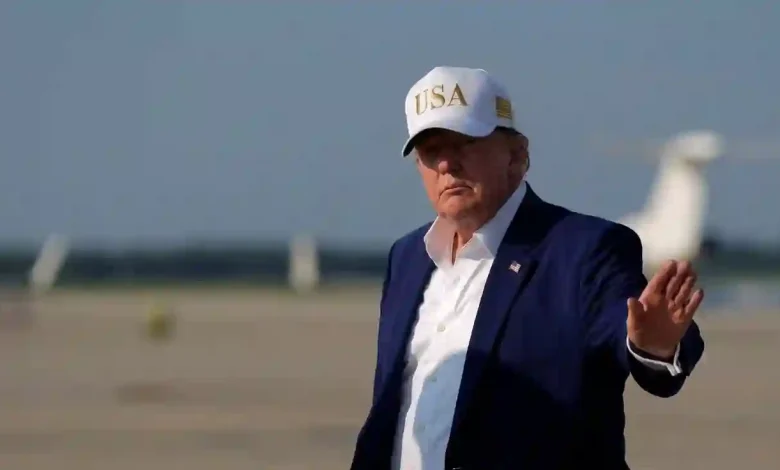
Table of Contents
Trump was returning from a highly charged, high-stakes NATO summit on July 8 when a covert, multi-layered security operation took place on the tarmac of Ankara\’s Esenboğa Airport in Turkey. To the public eye, the departure of the American delegation was proceeding exactly as planned. Air Force One, the iconic blue-and-white Boeing VC-25A, sat gleaming under the Turkish sun, surrounded by standard security cordons, military personnel, and diplomatic convoys. However, behind closed doors, a frantic scramble was underway. High-level intelligence agencies, including the CIA and the Defense Intelligence Agency (DIA), had just intercepted credible, active signals indicating a direct threat to the President\’s life from Iranian intelligence operatives. Fearing that Air Force One\’s well-known flight path and unmistakable radar signature made it an immediate target, security officials decided that a standard departure was out of the question.
To neutralize this threat, the Secret Service executed a highly unorthodox decoy maneuver. The President boarded Air Force One in the traditional manner, walking up the staircase in full view of airport staff, onlookers, and local security teams. Once inside the aircraft, however, he did not prepare for takeoff. Instead, under the cover of a routine catering resupply operation, Trump was moved from Air Force One to an adjacent, less conspicuous transport aircraft with the unexpected assistance of a mobile catering truck. The truck, which appeared to be performing standard food services, acted as a mobile tunnel, allowing the President to transfer between planes completely shielded from any external surveillance, telephoto lenses, or drone threats. This tactical deception was designed to ensure that anyone monitoring the airport or tracking the transponder signals of Air Force One would believe the President was still aboard the flagship vessel, while he was actually being prepared for departure on an entirely different flight deck.
Trump: The Secret Ankara Transfer: What Happened on July 8
The operational details of the Ankara swap reveal the intense level of coordination required to pull off such a high-stakes diversion. According to reports from the Washington Post, the swap occurred during a tightly controlled window when the tarmac was busy with support vehicles. Esenboğa Airport, while secure, is a massive facility with numerous vantage points, making physical concealment a paramount concern. Secret Service advance teams worked closely with a select group of trusted Turkish air traffic controllers and airfield security officers to ensure that the transponder signatures and flight logs did not immediately reflect the change in aircraft.
By utilizing the catering truck as a physical barrier and transit tunnel, security details bypassed both visual and electronic surveillance. This tactic exploited a common gap in airfield monitoring, where service vehicles are treated as background noise rather than tactical assets. Once safely inside the secondary aircraft, the President\’s security envelope remained airtight. The decoy Air Force One departed on its scheduled path, broadcasting its standard diplomatic callsign to draw any potential threat indicators away from the President\’s actual route, demonstrating the lengths to which modern protection details must go to ensure safety in volatile regions.
Trump: Anatomy of a Geopolitical Threat: Why Iran Targets the President
Understanding the gravity of this security operation requires looking closely at the deep-seated hostilities between Washington and Tehran. For years, Iran has vowed revenge for the January 2020 targeted airstrike that killed Qasem Soleimani, the powerful leader of the Islamic Revolutionary Guard Corps (IRGC) Quds Force. Since that moment, US intelligence agencies have tracked multiple active plots aimed at former and current high-ranking American officials. Recently, Trump\’s public warnings on Iran have highlighted the extreme volatility of these relations, warning of severe consequences if any harm were to come to American leadership.
This threat landscape has dramatically worsened as regional proxy conflicts threaten to boil over into an escalating 2026 Iran war. Iranian intelligence agencies have significantly upgraded their surveillance capabilities, leveraging global network assets, commercial satellite tracking, and cyber espionage to monitor the movements of Western leaders. In Turkey, which shares a border with Iran and has historically been a complex operational ground for regional spies, the threat of an asymmetric attack—whether via a surface-to-air missile, a loitering munition, or an inside saboteur—was deemed unacceptably high. This forced the operational commanders to prioritize deception over tradition, leading to the decision to abandon standard Air Force One protocols in favor of a clandestine shell game.
Trump: From Ankara to London: The UK Stopover and the Qatari Jet
Following the successful decoy takeoff from Ankara, the operation transitioned to its second phase in the United Kingdom. The decoy Air Force One and the President\’s actual transport plane both made their way across European airspace under tight military escort. Upon arrival in the UK, the President was observed disembarking Air Force One, maintaining the illusion of a standard journey for the benefit of global media and any hostile intelligence networks tracking the event. However, rather than re-boarding the flagship VC-25A for the long flight across the Atlantic, the President transitioned to a newer, highly advanced Boeing jet—a luxurious aircraft originally gifted by the Qatari royal family.
This Qatari-gifted aircraft, a Boeing 747-8 configured with state-of-the-art military-grade defenses, offered several crucial advantages over the older Air Force One models. It is equipped with advanced electronic countermeasures, radar-jamming systems, and directional infrared countermeasures (DIRCM) designed to blind heat-seeking missiles. With an imminent war with Iran looming large in the minds of defense planners, utilizing a fresh aircraft with a different transponder profile and cutting-edge defense suites provided an invaluable layer of protection. This switch in the UK effectively severed the tracking chain, leaving potential adversaries completely blind as the President traversed the Atlantic.
Trump: Operational Security and Decoy Tactics in VIP Transport
Operational security (OPSEC) in the modern era relies heavily on the principle of unexpected variability. Historically, presidential travel relied on overwhelming force—escort fighter jets, massive motorcades, and heavy physical security. However, as modern air-defense systems and shoulder-fired missiles (MANPADS) have become more advanced and widely distributed, physical force is no longer sufficient. Decoy operations, electronic cloaking, and unexpected logistical changes have become the cornerstone of modern VIP protection. The Ankara transfer is a textbook example of utilizing \’low-tech\’ solutions to defeat \’high-tech\’ surveillance.
By using a catering truck, the Secret Service exploited a blind spot in standard airport security. While radar, satellites, and long-range cameras focus on the aircraft doors and runways, routine service vehicles move largely unnoticed. However, executing such an operation is immensely complex, requiring precise coordination between flight crews, ground personnel, and foreign airport authorities. Furthermore, the financial and logistical strain of operating multiple heavy Boeing aircraft across international borders is staggering, contributing to the soaring costs of the conflict and placing a heavy burden on military transportation budgets.
| Flight Stage | Location | Aircraft Employed | Security Decoy & Countermeasures |
|---|---|---|---|
| Stage 1: Departure | Ankara, Turkey (Esenboğa Airport) | Boeing VC-25A (Air Force One) | Covert transfer to decoy flight via modified catering truck |
| Stage 2: Stopover | United Kingdom (Secure Airbase) | Transition to Qatari-gifted Boeing Jet | Visual disembarkation decoy; transponder swap for trans-Atlantic flight |
| Stage 3: Arrival | Washington D.C., USA (Joint Base Andrews) | Qatari-gifted Boeing Jet | Direct secure transit with military fighter jet escorts and jammed signals |
Trump: The Silence from the Cockpit: Trump\’s Interaction with Press
During the long trans-Atlantic journey back to the United States aboard the Qatari-gifted aircraft, the President maintained a remarkably calm demeanor. He invited the traveling press corps into his private cabin for an informal briefing, discussing domestic policy, economic metrics, and international trade relations. Despite the intense speculation and the dramatic events that had occurred just hours earlier in Turkey, he did not mention a single detail about the aircraft switch. Reporters noted that he was highly engaging and focused, completely hiding the tension of the security crisis.
This disciplined silence was crucial. Revealing that a threat had forced a change in travel plans while still airborne would have signaled vulnerability and confirmed to hostile actors that their surveillance or threat posture had successfully disrupted American presidential travel. Furthermore, with ongoing airstrikes in the region dominating global news cycles, maintaining an image of absolute control and stability was paramount. The President’s ability to conduct business as usual under such extreme circumstances demonstrates the rigorous training and planning that underpins modern executive operations.
Trump: The Role of Turkey and NATO Allies in VIP Security
The cooperation of international allies was a critical element in the success of this high-risk maneuver. Esenboğa Airport in Ankara is a highly secured facility, but any deviation from standard flight operations requires immediate clearance from Turkish civilian and military aviation authorities. Turkey, a key NATO member occupying a strategic position between Europe, the Middle East, and Asia, found itself in a delicate position. Ankara must balance its commitments to its Western allies with its complex diplomatic and economic ties to neighboring Iran.
The seamless execution of the decoy swap suggests that Turkish intelligence and defense officials worked hand-in-hand with the US Secret Service to secure the airfield and ensure the President\’s safety. This coordination is vital, as Turkey’s airspace sits adjacent to critical global transit corridors and sensitive maritime choke points. Safeguarding these corridors requires constant vigilance and robust regional security cooperation, particularly when transnational threat actors seek to exploit gaps in local security frameworks to target high-ranking Western officials.
Trump: International Repercussions and Diplomatic Fallout
The long-term international repercussions of this incident are likely to be profound. The fact that the President of the United States was forced to resort to decoy aircraft and secret transfers to escape a NATO ally\’s capital safely is a stark reminder of the erosion of global stability. It highlights the growing audacity of Iranian intelligence networks, which appear willing to plan and potentially execute high-profile attacks on NATO soil. This will undoubtedly lead to a hardening of the US diplomatic posture.
With the ongoing diplomatic deadlock between Tehran and Washington showing no signs of easing, this close call will likely fuel demands for harsher economic sanctions, increased military deployments, and potentially pre-emptive strikes against threat networks. Intelligence sharing among NATO allies will also undergo a thorough review to identify how Iranian operatives were able to establish such a credible threat profile in Turkey, leading to tighter security protocols at airports worldwide.
Trump: Conclusion: A New Normal for Global Presidential Security
Ultimately, the secret plane swap of July 8 is a watershed moment in the history of presidential transportation. It serves as a stark warning that the traditional symbols of American power, such as Air Force One, are no longer immune to the complex, asymmetric threats of the 21st century. As drone technology, cyber warfare, and advanced missile tracking continue to proliferate, the methods used to protect global leaders must evolve in tandem. By combining cutting-edge technology with creative, low-tech deception, security agencies successfully navigated a high-threat crisis, ensuring that the Commander-in-Chief returned home safely to continue leading the nation through turbulent global waters.