US military helicopter disables Cargo Vessel Violating Iran Blockade 2026
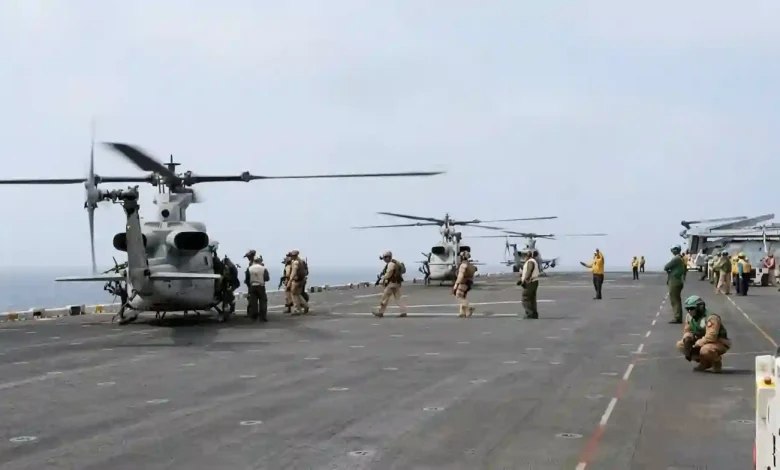
Table of Contents
US military helicopter disables the steering gear of the Panama-flagged cargo ship M/V Vela Nova in the Gulf of Oman, signaling a intense surge in the escalating military operations in the Gulf of Oman. The action, confirmed on Tuesday, August 11, 2026, by U.S. Central Command (CENTCOM), involved an MH-60 helicopter firing two AGM-114 Hellfire missiles directly into the vessel’s engine room. The strike was executed after the civilian crew of the container ship repeatedly ignored warnings from American forces. CENTCOM confirmed that the vessel is no longer heading toward Iran, marking a highly critical escalation of the American naval blockade of Iranian ports.
This engagement occurred amidst a prolonged conflict that has reshaped international maritime routes since early February 2026. The M/V Vela Nova, a 30-year-old container ship measuring 13,248 deadweight tonnage (dwt), was hit approximately 71 nautical miles off the coast of Pakistan. Following the strike, a minor fire broke out in the steering compartment but was quickly extinguished. The 17 crew members on board safely evacuated and were accounted for, and the vessel remains “not under command” and drifting in the Gulf of Oman. This incident represents the third commercial vessel forcibly disabled by U.S. forces since the Port Blockade was reinstated on July 14, 2026.
Detailed Chronology of the M/V Vela Nova Interdiction
The interdiction of the M/V Vela Nova was the result of days of maritime tracking and reconnaissance. According to maritime intelligence data, the vessel departed from the Nhava Sheva Port near Mumbai, India, with an official manifest listing its destination as Jebel Ali in the United Arab Emirates. However, intelligence analysts tracking regional shipping patterns noticed that the ship’s course deviated sharply toward the Iranian coastline, in direct violation of the active blockade rules. Investigative agencies pointed out that the ship had recently been moored alongside other vessels known to participate in the transshipment of Iranian goods, which triggered immediate suspicion among allied monitoring forces.
As the vessel approached the eastern boundaries of the Gulf of Oman on Tuesday morning, U.S. Navy warships operating under CENTCOM’s regional command established radio contact. They issued consecutive warnings in English and maritime emergency frequencies, directing the cargo ship to change course or face military intervention. The civilian crew of the Panama-flagged container ship declined to comply, maintaining its speed and heading. Consequently, the command authorized the launch of an armed MH-60 helicopter to intercept the non-compliant ship and neutralize its propulsion without sinking the vessel.
Tactical Precision: Why the MH-60 Employed Hellfire Missiles
Employing an airborne platform like the MH-60 Seahawk equipped with laser-guided AGM-114 Hellfire missiles was a deliberate tactical decision designed to manage escalation. Facing tensions surrounding the Strait of Hormuz, U.S. forces sought to enforce the blockade without causing a catastrophic sinking or massive loss of civilian life. The Hellfire missile, renowned for its surgical precision, allowed the helicopter crew to target the ship’s rudder and steering machinery specifically. By striking the mechanical components rather than the hull below the waterline, the U.S. military effectively neutralized the vessel’s capabilities while preserving its overall structural buoyancy.
This kinetic approach represents a significant evolution in maritime interdiction. Traditionally, blockades are enforced through physical boarding, warning shots, or naval blockades that force vessels to turn back. However, when dealing with non-compliant crews who refuse to stop, precision missile strikes provide a rapid, low-risk alternative for the blockading force. It eliminates the need to put Navy boarding teams in danger of entering a hostile vessel, while delivering an immediate and undeniable physical halt to the targeted ship’s journey.
The Growing Scale of the Reinstated U.S. Blockade
The strike on the M/V Vela Nova highlights the immense scale of the U.S. naval operation, which enforces strict maritime blockades designed to isolate Iran from global trade networks. Since the blockade was reinstated on July 14, 2026, U.S. forces have redirected 55 commercial vessels trying to run the blockade, disabled three non-compliant ships, and boarded two others. These statistics reflect an incredibly high level of vigilance and determination by the U.S. Navy and allied forces operating in the Middle East.
During the first phase of the blockade, which ran from April 13 to June 18, 2026, U.S. forces disabled nine ships and redirected over 140 commercial vessels. The resumption of this policy in mid-July demonstrates that the United States is unwilling to accept any compromise on maritime enforcement. Every ship attempting to enter or depart Iranian ports is treated as a potential violator, regardless of its registered flag state or the nature of its commercial cargo.
Strategic Bottlenecks: The Battle for the Strait of Hormuz
The ongoing maritime crisis has turned the strategic waterways of the Middle East into highly militarized zones, bringing global commerce to a near-halt. The Strait of Hormuz, which previously served as the passage for more than 20% of the world’s daily oil supply, has seen its traffic plummet. The security vacuum created by the hostilities in the Middle East has forced the vast majority of commercial tankers and bulk carriers to bypass the region entirely, opting for much longer journeys around the African continent.
Iran has maintained a firm stance, refusing to reopen the Strait of Hormuz unless the U.S. meets its demands. Mohsen Rezaei, secretary of Iran’s Supreme National Security Council, stated that the passage will remain closed as long as the U.S. blockade continues. Tehran’s conditions include the unfreezing of all blocked Iranian assets and an end to the war throughout the region, including Gaza and Lebanon. This complete lack of diplomatic flexibility ensures that the maritime corridor will remain extremely dangerous for commercial shipping.
Economic and Energy Market Consequences
The economic impact of the blockade and the subsequent strikes has been swift and severe, triggering a diplomatic fallout that spans across international capitals. Immediately following the targeting of the Vela Nova, global oil benchmarks reacted, with Brent crude climbing to over $88 per barrel. Analysts warn that if the blockade continues to intensify, oil prices could easily breach the $90 threshold, putting massive pressure on Western economies already struggling with inflation and energy supply disruptions.
The strike also exacerbates the broader shipping crisis, which has seen insurance premiums for vessels transiting the Middle East reach historic highs. Many shipping registries and maritime insurers are advising vessels to completely avoid the Gulf of Oman and the Red Sea. The targeting of a Panama-flagged container ship like the Vela Nova—owned by a Liberian company and operated by a Turkish firm—shows that no merchant ship is safe from the reaching consequences of this geopolitical conflict.
Diplomatic Gridlock and Prospects of a Ceasefire
Diplomatic efforts to resolve the crisis have hit a complete wall. Mediators from Qatar and Oman have held continuous meetings in Doha and Muscat, hoping to negotiate a compromise that would allow for safe passage through the Strait of Hormuz in exchange for some relief from the maritime blockade. However, the political gap between Washington and Tehran appears virtually insurmountable under current conditions. Tehran demands full compliance with its regional terms, while Washington maintains that the blockade will remain in full effect until Iran halts all hostile activities in the region.
This political gridlock is further complicated by the rhetoric coming from the U.S. administration. President Donald Trump told reporters on Tuesday that the United States has achieved total control over the Strait of Hormuz, claiming that “we own it” and that Iranian forces no longer hold sway over the strategic waterway. This uncompromising stance suggests that the military enforcement will continue unabated, leaving commercial shippers and regional nations caught in the crosshairs of a protracted and highly volatile conflict.
Summary of Key Developments in the U.S. Maritime Blockade
Below is an analytical overview of the current status of the U.S. maritime blockade on Iranian ports, emphasizing key metrics and the latest developments as of August 2026:
| Metric / Category | Details of the Blockade & Vela Nova Incident |
|---|---|
| Target Vessel | M/V Vela Nova (Panama-flagged, 13,248 dwt container ship) |
| Engagement Date | Tuesday, August 11, 2026 |
| Intervention Method | U.S. Navy MH-60 helicopter firing 2x Hellfire missiles into the engine room |
| Vessel Status | Steering gear disabled; vessel “not under command” and drifting; crew of 17 safe |
| Redirected Vessels (Phase 2) | 55 commercial ships redirected since July 14, 2026 |
| Disabled Vessels (Phase 2) | 3 commercial ships disabled (including M/V Vela Nova) |
| Boarded Vessels (Phase 2) | 2 commercial ships boarded for compliance |
| Geopolitical Impact | Brent crude up to $88.91/bbl; Strait of Hormuz remains closed by Tehran |
The tactical interdiction of the M/V Vela Nova proves that the U.S. military is fully prepared to use precision firepower to maintain its blockade. As long as negotiations remain stalled and both sides hold their hardline positions, the strategic waterways of the Middle East will remain a dangerous theater of active military engagements.