Rikers Island World Cup watch parties highlight jail reform paradox 2026

Table of Contents
Rikers Island World Cup watch parties have emerged as a surprising and highly discussed contrast to the chronic instability plaguing New York City’s largest correctional facility. While offices, public parks, and bars across the globe have popped up with lively crowds for Wednesday’s high-stakes semifinal match, one of the most unusual gathering spots was deep within the confines of the sprawling, 400-acre jail complex. Historically, Rikers Island is far better known for its operational crises, persistent overcrowding, and systemic violence than for playing host to uplifting community social events. Yet, against all odds, the facility has embarked on a bold behavior-incentive initiative, hosting structured watch parties since the tournament kicked off last month.
This initiative represents a localized effort to inject a sense of normalcy and human dignity into an environment otherwise characterized by acute stress and isolation. However, the celebratory atmosphere of Wednesday’s semifinal viewing stands in stark contrast to the grim operational realities documented by federal oversight. Only a day prior to the watch party, a newly appointed federal remediation manager submitted a blistering reform plan detailing severe dysfunction, including active fires, chemical smoke, and unsecured brawls. This split reality raises deep questions about the effectiveness of programmatic reforms in the face of deep-seated systemic collapse.
Introduction: A Tale of Two Realities on Rikers Island
The juxtaposition of sports-fueled joy and institutional chaos on Rikers Island captures the core of the ongoing debate surrounding New York City’s correctional system. On one hand, administrators point to the watch parties as evidence that progressive, humanizing reforms can foster a safer jail environment. On the other hand, civil rights advocates and federal monitors argue that such programs, while well-intentioned, are merely cosmetic band-aids on a bleeding wound. While soccer fans across the five boroughs and around the world are buying high-stakes tickets to international World Cup matches, Rikers inmates are utilizing their interest in the beautiful game as a rare escape from a harsh daily routine.
This dual narrative highlights a complex administrative strategy: using global cultural phenomena to manage behavior while simultaneously battling structural decay. The contrast was on full display this week, as cheers inside a decorated gymnasium echoed just days after inspectors witnessed horrifying scenes of neglect in housing units nearby. To fully comprehend this paradox, one must examine both the mechanics of this incentive program and the damning evidence of administrative failures that continue to invite federal intervention.
The Mechanics of the Good Behavior Reward System
To qualify for attendance at these exclusive watch parties, inmates must navigate a highly strict set of behavioral parameters. Specifically, the Department of Correction (DOC) requires participants to have remained entirely incident-free for at least 30 consecutive days. In a facility where physical clashes, contraband trading, and verbal disputes are daily occurrences, maintaining a clean record for a month is a formidable challenge. The program is designed to leverage inmates’ passion for the sport, encouraging self-regulation and peer-to-peer accountability.
The scale of the initiative is surprisingly vast. Correction officials revealed that the jail has hosted approximately 90 watch parties since the World Cup tournament commenced last month. Out of the roughly 6,600 individuals incarcerated on Rikers Island, about 4,500 have met the requirements and participated in the viewings. By tying a highly coveted privilege directly to behavior, the administration hopes to reduce the overall baseline of violence in the housing units, showing that cooperative behavior yields tangible, positive experiences.
A Surreal Scene: Balloons, Tan Uniforms, and Soccer Fever
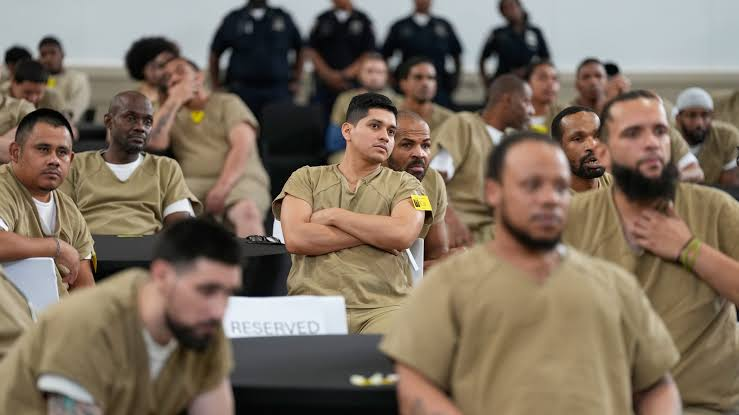
Inside the gymnasium of the complex’s main intake center, the environment on Wednesday was temporarily transformed. Over 100 inmates dressed in standard tan uniforms took their seats at tables arranged in front of a massive projection screen. The space, which typically serves as a high-stress transition zone, was decorated with colorful balloon towers topped by soccer-ball-themed balloons. For a few hours, the ambient noise of clanging steel doors and shouted commands was replaced by the commentary of Wednesday’s semifinal match between England and Argentina.
The atmosphere was electric as inmates cheered, debated strategies, and collectively reacted to every near-miss and goal. The shared passion for the sport bridged cultural and social divides within the jail population, with some inmates recalling Cape Verde’s historic run to the World Cup knockout stage as proof that underdogs can defy expectations on the global stage. For these men, the tournament was not just entertainment; it was a psychological lifeline back to the outside world.
Behind the Screen: Commissioner Richards and Mayor Mamdani’s Perspectives
Correction Commissioner Stanley Richards, who himself spent time incarcerated at Rikers Island earlier in his life, has been a vocal champion of the initiative. “Programs like this equal safety in our jail,” Richards stated during the event, emphasizing that acknowledgment of inmates’ humanity is key to reducing institutional hostility. By creating environments where incarcerated individuals feel seen, heard, and valued, the department aims to dismantle the adversarial relationship between staff and detainees.
Adding political weight to the event, New York City Mayor Zohran Mamdani paid a short visit to the watch party. Mamdani, a progressive Democrat whose rise is tied to recent political shifts in the democratic primaries across New York, sat with inmates and engaged in lively conversations about the tournament’s outcomes. Mamdani emphasized that these individuals remain New Yorkers who will eventually return to their communities. His appearance underscores the administration’s broader alignment with progressive criminal justice reform, though his presence also draws attention to the ongoing legislative battles and ongoing legislative races in New York districts that heavily focus on the future of the jail complex itself.
The Grim Counterweight: Nicholas Deml’s Damning Remediation Report
However, the festive cheer of the gymnasium stood in stark, almost painful contrast to a critical document filed just 24 hours earlier. On Tuesday, Nicholas Deml, the federally appointed remediation manager and former Vermont corrections chief, submitted a comprehensive reform plan to the supervising federal judge. Deml was appointed earlier this year to address rampant constitutional violations and systemic mismanagement that local leaders have repeatedly failed to resolve. His report paint a deeply distressing picture of daily life on Rikers Island.
This ongoing legal battle over federal receivership and court-mandated intervention highlights the depth of the crisis. The level of institutional accountability demanded by the federal court brings to mind other high-stakes legal proceedings in the city, such as the major federal trial set for August in Brooklyn. Deml’s detailed findings serve as a legal warning that programmatic successes like watch parties cannot overshadow severe operational hazards that threaten the lives of both staff and inmates.
Toxic Smoke and Blaring Alarms: The Singer Enhanced Supervision Housing Incident
One of the most alarming accounts in Deml’s remediation report describes an inspection of the Singer Enhanced Supervision Housing unit. Upon entering the facility, inspectors found the entire housing unit filled with thick, chemically-scented smoke resulting from fires set by prisoners. The sensory overload was disorienting: fire alarms blared loudly, bouncing off the concrete walls, while incarcerated individuals pounded frantically on their cell doors, calling out for help. Other prisoners sat helplessly, shackled directly to restraint desks amid the toxic fumes.
Perhaps the most chilling aspect of the account was the reaction of the staff on duty. According to the report, an officer simply shrugged her shoulders when surveyed about the scene, suggesting that this life-threatening chaos was merely a routine occurrence. This profound apathy and normalization of danger highlight a culture of institutional resignation. Such severe systemic breakdowns represent a tragic departure from the highly organized, celebratory atmosphere of high-profile public events across New York City, revealing the deep segregation between the city’s public-facing triumphs and its hidden carceral crises.
Abandoned Posts and Jailhouse Brawls: Systematic Security Failures
The remediation report further details an incident where prisoners managed to stream through an unsecured security door and initiate a massive, violent brawl. The primary catalyst for this dangerous security breach was a corrections officer who had completely abandoned his assigned post, leaving the door entirely unguarded and the housing unit unsupervised. Without staff presence to deter conflict or secure transition points, the situation rapidly escalated into physical violence.
This incident is emblematic of the staffing crises and lack of basic security protocols that have plagued Rikers Island for years. Staff absenteeism, high rates of injury, and low morale have frequently left critical housing areas understaffed or completely abandoned. When basic security controls fail, even the most innovative behavioral incentive programs lose their foundation, as the jail cannot guarantee the fundamental physical safety of its population.
Rikers Island Reform in Context: A Long History of Crisis and Closure Mandates
The push-and-pull between humanizing recreation and dangerous neglect is not a new dynamic for Rikers Island. Under a 2019 city law, the complex is legally mandated to close by 2027, to be replaced by a network of smaller, modern, borough-based jails. However, ballooning budgets, construction delays, and political friction have made meeting this deadline increasingly unlikely. Mayor Mamdani’s administration has had to navigate these shifting deadlines while attempting to keep the existing, deteriorating facility operational and safe.
For many observers, watching the city try to stabilize Rikers Island is as agonizingly dramatic as watching a legendary athletic struggle. The high stakes and unpredictable outcomes of this administrative battle bring to mind historic moments like when England beat Croatia, or highly contested, strategic battles such as the famous England vs. Ghana matches. In both arenas, minor errors in strategy or execution can lead to monumental, systemic defeats.
How Sports and Humanization Programs Impact Correctional Safety
From a criminological standpoint, programs like the World Cup watch parties are grounded in sound behavioral theory. Carceral institutions that rely solely on punitive measures often experience higher rates of violence, as sensory deprivation and constant stress breed hostility. Introducing bright colors, shared enthusiasm, and structured, positive social interactions helps to lower cortisol levels and de-escalate tension across the entire population.
Furthermore, these programs provide correction officers with non-violent leverage. When inmates have a highly valued privilege to lose, they are far more likely to self-police and resolve internal conflicts before they escalate to physical brawls. Commissioner Richards’ assertion that “humanity seen, heard, and valued” equals safety is supported by decades of sociological research indicating that treating incarcerated individuals with basic dignity dramatically reduces institutional misconduct.
A Comparative View: Good Behavior Incentives vs. Operational Chaos
The operational landscape of Rikers Island is currently split into two distinct realities. To understand the depth of this divide, it is helpful to contrast the programmatic milestones with the severe operational failures documented by the federal remediation manager.
| Programmatic Milestones (The Watch Parties) | Operational Failures (The Remediation Report) |
|---|---|
| Over 4,500 unique inmates participated | Inmates locked in cells filled with toxic chemical smoke |
| 90+ structured watch parties successfully hosted | Alarms blaring with inmates screaming for assistance |
| 30-day incident-free behavior requirement met | Unsecured doors allowing violent brawls to occur |
| In-person visits from the Mayor and Commissioner | Guards abandoning active posts and shrugging off fires |
This table illustrates the profound friction inside the facility. It shows that while localized administrative efforts can create isolated pockets of peace, they exist inside a larger, highly unstable infrastructure that continues to threaten basic human rights.
Conclusion: The Fragile Balance Between Joy and Crisis
Ultimately, the World Cup watch parties at Rikers Island stand as a testament to the resilient human spirit of the incarcerated population and the creative efforts of progressive administrators. For a few fleeting hours, a gymnasium decorated with balloons became a sanctuary of shared passion, proving that soccer can bring light to even the darkest corners of the municipal system. This initiative shows that when given the opportunity, the vast majority of inmates are eager to choose cooperation and peace over conflict.
However, the city cannot allow these brief moments of joy to obscure the damning findings of Nicholas Deml’s federal remediation report. A jail facility where guards abandon posts, fires go ignored, and toxic smoke fills housing units is a facility in active, systemic crisis. Until New York City addresses these fundamental staffing, administrative, and structural failures, the beautiful game can only offer a temporary distraction from a deeply ugly reality.