Impeachment Protest Leads to Air Force Major’s Capitol Arrest
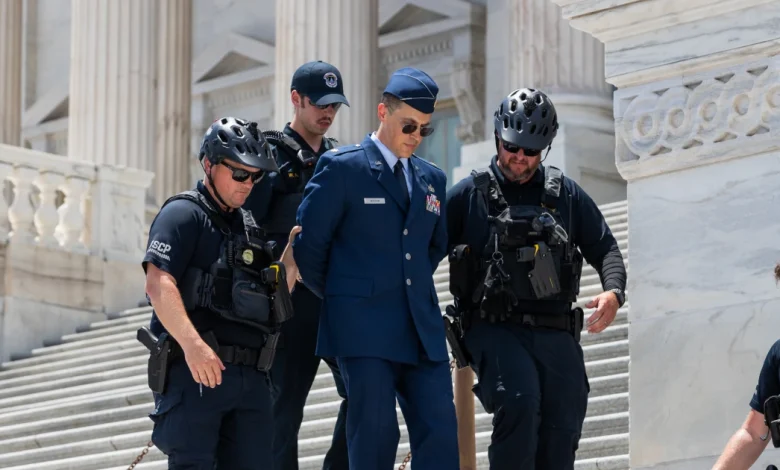
Table of Contents
Impeachment demands on the steps of the United States Capitol culminated in the historic and dramatic arrest of an active-duty Air Force officer on Wednesday afternoon, sending shockwaves through both the military and political establishments. Major Jason Watson, a highly decorated logistics readiness officer with approximately 17 to 20 years of military service, was taken into custody by the U.S. Capitol Police while wearing his service dress uniform. The arresting officers charged Major Watson under District of Columbia Code Section 22-1307 for crowding, obstructing, and incommoding, after he engaged in a peaceful but unsanctioned demonstration on the House of Representatives steps.
The high-stakes arrest took place on July 1, 2026, immediately following a press conference organized by the Removal Coalition—a grassroots advocacy group dedicated to the constitutional removal of President Donald Trump and Vice President JD Vance from office. The event drew nationwide attention, not only because of Major Watson’s active-duty status, but also because of the participation of prominent figures, including Representative Al Green, a Democrat from Texas who has consistently championed articles of impeachment, and Jessica Denson, the founder of the Removal Coalition.
Air Force:The Protest and the Removal Coalition Press Conference
Prior to his arrest, Major Watson stood before members of the national media and a crowd of pro-democracy activists to deliver a searing indictment of the Trump-Vance administration. Watson’s participation marked a monumental shift in active-duty dissent, as he became the first active-duty service member in modern history to stand on the steps of Congress to publicly call for the impeachment and removal of his own Commander-in-Chief.
Air Force:The Assembly and Key Figures
The demonstration, which commenced in the early afternoon, was carefully choreographed by the Removal Coalition. Standing alongside Jessica Denson, constitutional scholar Bruce Fein, and members of About Face Veterans, Major Watson expressed deep frustration with what he described as a failure of congressional oversight. Watson specifically praised Representative Al Green as the only member of Congress possessing the “courage and conviction” to continually force votes on articles of impeachment. Watson stated that if the rest of Congress followed Representative Green’s example, the entire Trump administration could be constitutionally removed.
“For the past 18 months, we the people have allowed the highest levels of the executive branch of the federal government to violate our Constitution and their oath to it with impunity,” Major Watson declared. He accused the administration of committing “innumerable” impeachable offenses, pointing to unilateral executive actions and foreign policy decisions that he argued bypass congressional authority. These contentions emerge during a highly charged political atmosphere where the executive branch has repeatedly faced structural challenges; for instance, some of the administration’s actions have been contested in federal courts, as seen when grants halted by the Trump administration were deemed unconstitutional, illustrating ongoing constitutional friction.
Air Force:The Transition to the Capitol Steps
Following the formal press conference, the demonstration transitioned directly to the physical steps of the House of Representatives. Escorted initially by Representative Al Green, Major Watson walked halfway up the steps to the chained railing, holding a placard that read, “IMPEACH, CONVICT, REMOVE”. Under long-standing security rules, members of the public are strictly prohibited from demonstrating on the Capitol steps unless accompanied by a sitting member of Congress.
According to Capitol Police, Representative Green left the immediate area shortly after escorting Major Watson to the steps. Once the congressman departed, Major Watson was left demonstrating alone, which technically transitioned his protest into an illegal public assembly. Video footage captured by Jessica Denson showed Capitol Police officers approaching the stoic major on multiple occasions, issuing lawful orders to discontinue the demonstration or face arrest. Watson remained silent and motionless, nodding slightly but refusing to abandon his post. After several warnings, Watson calmly placed his sign down, complied with the officers, and was escorted away in handcuffs as onlookers chanted slogans protesting the arrest.
Air Force:Underlying Legal Basis: Why Was He Arrested?
The swift arrest of Major Watson raises complex questions regarding civil protest on federal property. The U.S. Capitol Police issued a detailed statement clarifying that the arrest was not based on the political content of Watson’s speech, but rather on the specific physical location and regulatory boundaries of the protest.
Air Force:DC Code 22-1307 Explained
District of Columbia Code Section 22-1307, which covers “Crowding, Obstructing, and Incommoding,” is a standard legal mechanism used by Capitol Police to manage demonstrations that block access, disrupt official business, or occur in restricted zones. The law makes it unlawful for individuals or groups to assemble in a manner that obstructs the free passage of others through public spaces, corridors, or on the entrances and steps of federal buildings. Under the statute, officers must first provide a clear warning and a lawful order to disperse before initiating an arrest. Because Major Watson refused to comply with multiple direct orders to step down from the House steps, he was formally charged under this provision.
Air Force:The Role of Congressional Escorts
The rules governing the Capitol grounds differentiate between demonstrations by the general public and activities involving members of Congress. A Member of Congress possesses the constitutional authority to escort individuals onto various parts of the Capitol, including the steps, for legislative or communicative purposes. However, this legal “shield” is temporary and highly dependent on the physical presence of the lawmaker. Once Representative Al Green left the steps, the legal exception expired, leaving Major Watson subject to the standard restrictions applied to all private citizens. Capitol Police emphasized that there are numerous designated areas on the Capitol grounds where public demonstrations are entirely legal and permitted, but the steps of the House are strictly off-limits for unsupervised protesting.
Air Force:The Constitutional and Military Clash: Article 88 and Free Speech
While the civil charge of incommoding is a misdemeanor, the military ramifications for Major Watson are far more severe. As an active-duty officer, Major Watson is bound by the Uniform Code of Military Justice (UCMJ), which imposes strict limitations on political activities, speech, and demonstrations by active-duty personnel.
The UCMJ and Article 88
Of primary concern is Article 88 of the UCMJ, which explicitly prohibits commissioned officers from using “contemptuous words against the President, the Vice President, Congress, the Secretary of Defense,” and other high-ranking officials. The purpose of Article 88 is to maintain the strict civilian control of the military and prevent military officers from engaging in political or partisan attacks that could undermine the stability of the government. By publicly demanding the impeachment and removal of both President Trump and Vice President Vance while wearing his official service dress uniform, Major Watson stands in direct peril of violating this foundational military law, which carries the potential for court-martial, dismissal from the service, and forfeiture of all pay and allowances.
Free Speech Rights of Active-Duty Personnel
Department of Defense (DoD) Directive 1344.10 outlines the political activities permitted and prohibited for members of the Armed Forces. Under these guidelines, active-duty service members may express personal political opinions, vote, and make monetary contributions to political campaigns. However, they are strictly prohibited from participating in partisan political campaigns, rallies, or demonstrations while in uniform, or acting in a manner that associates the Department of Defense with a particular political stance or candidate. Because Major Watson demonstrated in full uniform and openly called for the removal of the administration, military legal experts suggest that he has committed multiple violations of both UCMJ articles and DoD directives, challenging the boundaries of free speech within the armed forces.
A Broad Critique of the Trump-Vance Administration Policies
In his address, Major Watson clarified that his protest was not driven by partisan alignment but rather by a commitment to constitutional fidelity. He emphasized that he is “not a Democrat” and was motivated entirely by what he described as executive overreach that threatens the nation’s democratic structures. Watson highlighted several specific actions of the Trump administration that he deemed unconstitutional, particularly in the realm of national security and international relations.
Specifically, Major Watson pointed to the administration’s unilateral military strikes in Iran and Venezuela, which he argued directly violated the War Powers Act. He contended that these unauthorized military interventions had tragic consequences, resulting in the deaths of 13 American service members. This foreign policy critique comes at a time of severe international tensions, such as when President Donald Trump reviews Iran’s peace offer deeply skeptical, indicating how volatile global military strategies have become under the current executive leadership.
Furthermore, Watson criticized what he described as “brazen lawfare” waged by the executive branch against journalists, political opponents, and judicial institutions. He also raised concerns over the administration’s efforts to alter birthright citizenship and what he called the “violent weaponization” of the Department of Homeland Security. These critiques mirror larger legal disputes over executive authority, parallel to past instances where federal courts stepped in, such as when tariffs were deemed illegal and courts struck down Trump’s global import taxes, demonstrating a pattern of judicial checks on executive actions.
Political and Public Reactions to the Arrest
The public reaction to Major Watson’s arrest has been deeply polarized, reflecting the broader division within the country. Supporters of the major have hailed him as a patriotic hero who risked his distinguished career to defend the Constitution, while critics have condemned his actions as a dangerous breach of military discipline and a threat to civilian-military relations.
Representative Chrissy Houlahan, a Democrat from Pennsylvania and herself an Air Force veteran, expressed complex sentiments regarding the situation. While acknowledging the strict rules governing military conduct, she noted the profound level of conviction required for an officer of Watson’s rank to take such a public stand. Meanwhile, the Removal Coalition launched a defense fund to assist Major Watson with his legal fees, which rapidly raised tens of thousands of dollars within hours of his arrest.
Conversely, conservative lawmakers and military traditionalists have called for swift and decisive military discipline. They argue that allowing an active-duty officer to publicly campaign for the removal of the President while in uniform sets a dangerous precedent that could lead to the politicization of the entire military officer corps. Legal experts from the Department of Defense have indicated that the Air Force is actively investigating the incident and will determine the appropriate administrative or judicial actions in the coming days.
What Lies Ahead for Major Jason Watson’s Military Career?
Prior to his arrest, Major Watson possessed a highly decorated military career spanning nearly two decades. An Air Force spokesperson confirmed that Watson, who enlisted in 2005 and later commissioned, has received at least 19 awards and seven decorations. He was currently serving as a logistics readiness officer stationed in Poland and was on authorized leave in the United States at the time of the protest.
The potential consequences for Major Watson are severe. The Air Force has several options at its disposal, ranging from administrative actions to a formal court-martial. Administrative measures could include a Letter of Reprimand, a promotion ban, or an administrative separation from the military under conditions other than honorable, which would jeopardize his military pension and medical benefits. If the Air Force decides to pursue a court-martial under the UCMJ, Watson could face federal military charges that carry prison time and a dishonorable discharge, effectively ending his military career in disgrace. Watson’s legal defense team is expected to argue that his actions were protected under the First Amendment and driven by a duty to uphold his constitutional oath, setting the stage for a landmark legal battle.
Comparing the Legal Dimensions of Watson’s Arrest
To better understand the complex legal landscape surrounding Major Watson’s actions, the following table compares the civil charges he faces in Washington, D.C., with the potential military offenses under the Uniform Code of Military Justice (UCMJ).
| Legal Forum | Specific Charge / Rule | Governing Body | Maximum Potential Penalty | Core Legal Focus |
|---|---|---|---|---|
| Civil Court (D.C.) | D.C. Code § 22-1307 (Crowding, Obstructing, Incommoding) | U.S. Capitol Police / District Court | Misdemeanor fine and/or up to 90 days in jail | Physical obstruction and unauthorized protest on Capitol steps. |
| Military Justice (UCMJ) | Article 88 (Contempt toward officials) | U.S. Air Force / Court-Martial | Dismissal, forfeiture of pay, and up to 1 year of confinement | Using contemptuous words against the President or other civil authorities. |
| Military Justice (UCMJ) | Article 92 (Failure to obey order or regulation) | U.S. Air Force / Court-Martial | Bad-conduct discharge, forfeiture of pay, and up to 2 years of confinement | Violating DoD Directive 1344.10 by engaging in political activity in uniform. |
| Military justice (UCMJ) | Article 134 (General Article / Discredit to the service) | U.S. Air Force / Court-Martial | Dishonorable discharge, forfeiture, and confinement | Conduct of a nature to bring discredit upon the armed forces. |
As this unprecedented case progresses through both civil and military legal channels, it will undoubtedly serve as a touchstone for discussions regarding the constitutional rights of military personnel, the boundaries of peaceful civil disobedience, and the enduring principle of civilian control over the United States military.