Tucker Carlson Quits Republican Party Over Trump’s Iran War 2026
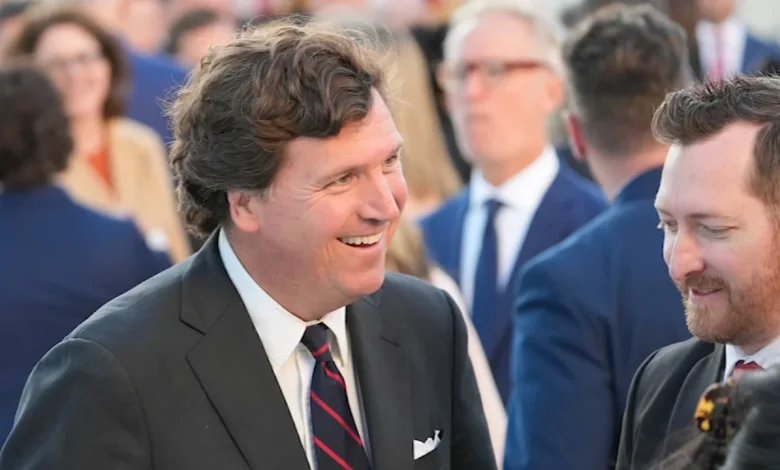
Tucker Carlson, the highly influential conservative political commentator and podcast host, has officially announced his departure from the Republican Party, signaling a massive ideological fracture in the modern populist movement. Speaking on a recent episode of the independent podcast “Can’t Be Censored,” Carlson expressed profound disillusionment with the modern conservative establishment—a fallout that has been rapidly accelerating since President Donald Trump’s decision to launch a military campaign against Iran in February 2026. This dramatic break marks a historic realignment within conservative media, ending a thirty-five-year tenure during which Carlson served as one of the GOP’s most vocal and formidable defenders. According to a political report published by Axios, the split highlights growing fractures within the broad MAGA coalition that Trump built, as foreign policy and voter representation become irreconcilable flashpoints.
Tucker : The Catalyst of Disillusionment: The February War with Iran
Carlson’s departure from the GOP is not a sudden whim but the culmination of months of simmering hostility over foreign policy. The definitive breaking point occurred in February 2026, when President Donald Trump authorized direct military action against Iran, dragging the United States into a highly volatile conflict in the Middle East. For years, Carlson has advocated for an “America First” foreign policy centered on non-interventionism, arguing that foreign military campaigns deplete American resources, cost American lives, and distract from urgent domestic issues. When Trump chose to escalate tensions into an active war, Carlson viewed the decision as a direct betrayal of the populist mandate that swept Trump back into the White House. The conflict shattered Carlson’s trust in the administration’s commitment to avoiding endless foreign entanglements, transforming his quiet skepticism into public, adversarial opposition.
Tucker: The Apology and the “Misleading People” Confession
The depth of Carlson’s sense of betrayal became raw and visible in April 2026 during a deeply personal episode of his political commentary program, The Tucker Carlson Show. Joined by his brother Buckley Carlson, a former Trump speechwriter, Tucker issued an extraordinary public apology to his audience. He confessed to feeling tormented by his active role in helping Trump reclaim the presidency during the 2024 campaign. “I want to say I’m sorry for misleading people,” Carlson admitted, clarifying that his endorsement was not an intentional deception but a mistake for which he now takes full personal responsibility. The confession shocked the media landscape, signaling that the rift between the commentator and the president had transcended standard political disagreements, entering the realm of personal conscience and moral duty.
Tucker :Inside the “Can’t Be Censored” Interview: Declaring the Split
The formalization of this split occurred late last week during Carlson’s appearance on the Canadian interview program “Can’t Be Censored,” hosted by Travis Dhanraj and Karman Wong. In a wide-ranging, raw conversation, Carlson made his position unmistakable. “There’s no chance I would support the Republican Party,” he asserted, specifically looking ahead to the upcoming November midterm elections. When pressed on his alternative, Carlson was quick to clarify that his rejection of the GOP did not mean a turn toward the left. “Not gonna support the Democratic Party,” he added immediately, concluding, “I don’t know what I’m going to do.” This admission of political homelessness reflects a growing sentiment among populist voters who find themselves alienated by both major political establishments.
| Timeline Period | Stance on Donald Trump | Key Foreign Policy Alignment | GOP Affiliation Status |
|---|---|---|---|
| Pre-2016 Era | Highly skeptical; privately critical of Trump’s character. | Traditional non-interventionism, opposing standard neoconservative actions. | Loyal Republican defender and mainstream television pundit. |
| 2016–2020 (First Term) | Strong supporter; defended “America First” populist policies on Fox News. | Advocated against conflict with Iran; pushed for domestic focus. | Key ideological champion for the Republican base. |
| 2024 Election Cycle | Unconditional support; called Trump’s survival “divine intervention” at the RNC. | Promoted the promise of “no new wars” under a second Trump term. | Active campaign surrogate and high-profile party cheerleader. |
| Early 2026 (Iran War) | Severe rift; apologized publicly for “misleading” voters to support Trump. | Condemned the February strikes on Iran as a betrayal of populist values. | Publicly critical; expressed deep moral and political torment. |
| June 2026 (Present) | Complete estrangement; denounced the administration’s foreign policy. | Accuses the party of acting on behalf of Israel and corporate donors. | Declares “I’m out” and rejects both major political parties. |
Tucker :“I’m Out”: The Rejection of Both Major Establishments
By declaring “I’m out,” Carlson has rejected the foundational binary framework of modern American politics. For decades, conservative media figures have operated under the assumption that even an imperfect Republican Party is preferable to the alternative. Carlson has completely discarded this logic, arguing that when a party ceases to represent its own voters, citizens, and national interest, it no longer has a right to exist or command loyalty. His rejection of the Democratic Party simultaneously ensures he remains firmly on the populist right, albeit as an independent outsider. This double rejection highlights the systemic failure of the two-party system to address the anxieties of a highly skeptical and war-weary electorate that feels ignored by Washington elites.
Tucker :A History of Tactical Alliances: Tucker Carlson and Donald Trump
To fully understand the gravity of this fracture, one must look back at the volatile history of the alliance between Carlson and Trump. Historically, Carlson’s view of Trump has fluctuated between deep private skepticism and public alignment. Prior to Trump’s political rise, Carlson had expressed standard conservative doubts about his character. However, as Trump’s populist agenda gained traction, Carlson became one of his most prominent defenders on Fox News, shaping the intellectual framework of the MAGA movement. Even after Carlson was fired from Fox News in 2023, he continued to leverage his massive independent podcast audience to champion Trump’s campaign. The relationship appeared ironclad, but it was always built on a shared opposition to the neoconservative establishment—a foundation that crumbled when Trump adopted the very interventionist policies they had mutually criticized.
Tucker :The 2024 Campaign Trail and Divine Intervention
The height of Carlson’s support for Trump was on display throughout the 2024 presidential campaign. At the Republican National Convention in July 2024, Carlson delivered a passionate speech, famously describing Trump as a “wonderful person” and claiming that his survival of an assassination attempt in Butler, Pennsylvania, was a matter of “divine intervention.” Carlson actively campaigned for Trump, speaking at high-profile rallies just days before election night and portraying Trump as the final bulwark against systemic national decline. This deep, public, and emotional investment is precisely why the subsequent policy divergence over Iran has been so devastating for Carlson. The contrast between the divine intervention rhetoric of 2024 and the torment of 2026 illustrates the volatile nature of populist alignments built on high expectations.
The Accusations of Foreign Influence and Treason
Carlson’s critique of the Iran war extends beyond standard strategic disagreements; he has leveled devastating moral accusations against GOP leadership. He has repeatedly characterized the military campaign as a disaster orchestrated at the behest of foreign interests, specifically pointing to the influence of the Israeli government and neoconservative donors. In his “Can’t Be Censored” interview, Carlson argued that party leaders are “making decisions on the basis of other criteria… what’s best for this company, what’s best for Israel, what’s best for our donors.” He did not mince words in his condemnation: “That’s not just, like, they are off in the wrong direction—like, that is unacceptable, that’s treasonous, it’s immoral, it can’t continue.” By framing the party’s foreign policy as treasonous, Carlson has effectively burned any remaining bridges with GOP leadership.
Prioritizing Donors and Israel Over American Citizens
This charge of prioritizing special interests over American citizens strikes at the heart of the populist critique of the state. Carlson argues that the primary duty of any government is to protect and serve its own people. In his view, committing American forces to a highly volatile conflict in the Middle East serves no tangible domestic benefit and directly violates the “America First” doctrine. He contends that the Republican Party has succumbed to the same neoconservative forces, defense contractors, and wealthy donors that dominated the party during the George W. Bush era. This regression to old-guard interventionism, according to Carlson, represents a betrayal of the working-class voters who trusted the GOP to dismantle the permanent Washington war machine.
The Far-Reaching Political Implications of Carlson’s Departure
The political fallout of Carlson’s departure is poised to reverberate across the conservative landscape ahead of the critical November midterm elections. Carlson is not merely a commentator; he is an ideological bellwether for millions of voters who distrust traditional media and political institutions. When a figure of his stature declares “I’m out,” it provides intellectual permission for his massive audience to follow suit. This defection threatens to suppress voter turnout among a key segment of the Republican base—the highly motivated, non-interventionist populist block. If these voters choose to stay home or write in independent candidates, the GOP could face devastating losses in tight congressional races, jeopardizing their legislative agenda.
Fracturing the MAGA Coalition Before the Midterms
Carlson’s exit has exposed deep, existing fault lines within the broader MAGA coalition. While some elements of the movement remain fiercely loyal to Trump regardless of his policy decisions, others share Carlson’s profound aversion to foreign military interventions. This divide is already manifesting among other prominent populist figures and lawmakers, such as Representative Marjorie Taylor Greene and Joe Kent, who have expressed similar reservations regarding the escalation of the war in Iran. The unity that once characterized the post-2024 Republican Party is giving way to intense internal debate over foreign policy, civil liberties, and the influence of establishment donors, leaving the party vulnerable at a moment when electoral unity is paramount.
The Threat of a Third-Party or Independent Movement
Political analysts are closely watching to see how Carlson’s newly declared independence will manifest. Some, including journalist Jason Zengerle, suggest that Carlson is strategically positioning himself for a future in electoral politics. By breaking with Trump early over a war that may prove highly unpopular and economically destabilizing, Carlson positions himself as a prophet of restraint. Whether or not he harbors personal presidential ambitions, his departure from the GOP fuels speculation about the potential for a viable populist third-party movement. In an era of historic dissatisfaction with both major parties, an independent coalition led by a communicator with Carlson’s reach could fundamentally disrupt the traditional electoral map.
Analyzing the Conservative Media Realignment
Finally, Carlson’s move highlights a broader realignment within conservative media itself. For decades, conservative outlets functioned as unofficial communications arms of the Republican Party. Carlson’s career transition—from prime-time Fox News host to independent podcaster—freed him from corporate oversight and party-line discipline. This freedom allows him to challenge party orthodoxy in ways that would be impossible on a cable news network. His departure from the GOP demonstrates that the most influential voices in modern conservatism are no longer bound to the party itself. This shift toward independent, subscriber-funded media models is reshaping how political narratives are formed, leaving political parties with far less control over their own bases.