F/A-18 Hornet crash in Washington State Sparks Wildfire
F/A-18 Hornet crash events represent highly complex aviation mishaps, and the recent accident in Washington State highlights both the extreme risks of military flight training and the remarkable efficiency of modern ejection systems. On Saturday, June 13, 2026, a supersonic F/A-18 Hornet tactical fighter jet crashed into a mountainous ridge in Yakima County, Washington, sparking a fast-moving wildland brush fire and triggering emergency campground evacuations. The pilot, who was the sole occupant of the high-performance combat aircraft, successfully ejected before impact and was recovered with only minor injuries. The incident occurred during a routine regional training run, according to statements released by Marine Aircraft Group 11 and the 3rd Marine Aircraft Wing, which are headquartered at Marine Corps Air Station Miramar in San Diego, California. As federal investigators piece together the timeline of this high-profile aviation mishap, the dramatic events have put a spotlight on the logistical coordination of local sheriff’s departments, national forest fire crews, and search-and-rescue teams operating in the rugged terrain of the Pacific Northwest.
The Yakima County Incident(Crash): How the Crash Unfolded
The geographic backdrop of the crash added significant complexity to both the recovery of the pilot and the immediate response to the resulting wildfire. Yakima County, located in the south-central portion of Washington State, is characterized by its dramatic shifts from deep forested valleys to steep volcanic ridges. Rimrock Lake, a 2,546-acre reservoir situated along Highway 12 inside the Okanogan-Wenatchee National Forest, is a major recreational hub that was populated by weekend campers when the disaster struck. According to local law enforcement, the jet impacted a mountainous area near the lake, sending columns of thick black smoke into the clear summer sky.
Chronology of the June 13 Aviation Mishap
The timeline of the mishap began shortly before noon on Saturday. Witnesses along the shores of Rimrock Lake reported seeing multiple military jets buzzing over the water on routine low-altitude tactical maneuvers. According to local reports, including the CBS News coverage of the incident, onlookers noted that while previous aircraft passed overhead smoothly, one particular Hornet began emitting distinct ‘popping’ noises. Tina Liniger, a witness recreating near the lakeside, recalled that the noise was initially assumed to be standard aerodynamic sounds. However, moments later, the jet experienced a critical failure, prompting the pilot to initiate the ejection sequence. At approximately 12:15 p.m. local time, the Yakima County Sheriff’s Office received a flurry of emergency calls reporting that a military plane had crashed into a nearby mountain and that a parachute had been spotted descending into the canopy.
Pilot Ejection and Rescue Operations in Yakima County
The survival of the pilot is a testament to the sophisticated engineering of the Martin-Baker SJU-17 ejection seat, which is standard equipment in the Navy and Marine Corps F/A-18 fleet. Ejecting at high speeds and low altitudes presents extreme physical challenges, often subjecting pilots to forces exceeding 15 Gs, which can cause severe spinal compression, fractures, or temporary loss of consciousness. Fortunately, in this instance, the pilot parachuted clear of the disintegrating airframe and landed in a dense, but accessible, section of the forest.
A Yakima County Sheriff’s Department mountain pass deputy was dispatched immediately to the rugged coordinates. Navigating the steep logging roads and dense underbrush, the deputy successfully made contact with the downed Marine within an hour of the crash. The pilot, who suffered only minor cuts and bruising, was stabilized at the scene before being transported by emergency medical services to a local hospital for comprehensive evaluation. This rapid recovery reflects the high readiness of local emergency teams, who frequently handle remote rescues. Such operations in challenging terrains are reminiscent of search-and-rescue protocols utilized during other backcountry emergencies, such as high-altitude medical crises or incidents managed by Yellowstone National Park emergency services. When military operations intersect with public wilderness, local deputies are often the first line of defense before federal resources can arrive.
Wildfire Response: The Ignition of the Pine Tree Fire
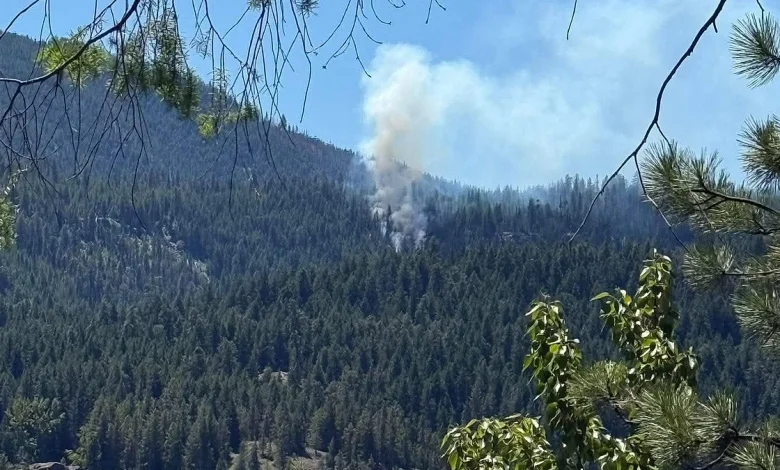
While the crash,pilot’s safety was quickly secured, the impact of the fuel-heavy fighter jet created an immediate secondary crisis. Upon crashing into the mountainside, the F/A-18 disintegrated, and its highly combustible JP-5 aviation fuel ignited a fast-moving wildland brush fire. Dubbed the ‘Pine Tree Fire’ by emergency dispatchers, the blaze immediately threatened the dry timber and parched undergrowth of the Okanogan-Wenatchee National Forest, which has been under heightened wildfire watch due to seasonal warming.
Evacuation of Campers and Road Closures
Because Rimrock Lake is an exceptionally popular destination for outdoor enthusiasts, dozens of established and dispersed campsites were occupied at the time of the crash. Fearing that the wind-driven flames could trap civilians, incident commanders from the Naches Fire Department acted swiftly. They ordered immediate evacuations for campgrounds along the south side of the reservoir, particularly near the Bear Creek cabin structures. To facilitate the entry of heavy firefighting equipment and prevent civilian vehicles from clogging the narrow mountain passes, authorities shut down the Forest Road 1200 system entirely, specifically closing access off Forest Road 1241. This prompt evacuation prevented any civilian injuries, though it disrupted the weekend plans of hundreds of recreationists who were told that the area should be avoided for the foreseeable future.
Tactical Suppression Efforts by Forest Service and Naches Fire
Containing a wildfire crash triggered by a high-energy aircraft crash requires specialized tactics. Standard wildland firefighting is complicated by the presence of hazardous materials from the military wreckage, including composite materials, hydrazine, and unexploded chaff or flare canisters. The Naches Fire Department, in close coordination with ground crews from the U.S. Forest Service’s Okanogan-Wenatchee National Forest, deployed multiple assets to the scene. This included at least one heavy fire engine and a fleet of water-dropping helicopters that executed precision water drops directly onto the active perimeter of the Pine Tree Fire.
By late Saturday afternoon, the fire was mapped at approximately two acres, with crews successfully protecting the vulnerable historic cabins at Bear Creek. Firefighters remained on the scene overnight to monitor hot spots, with mop-up operations scheduled to continue throughout Sunday morning to prevent any flare-ups under the afternoon sun. Managing such complex environmental emergencies in vast woodlands requires the same level of caution, rescue coordination, and multi-agency cooperation that public safety authorities utilize during an extreme wilderness search and rescue.
Technical and Tactical Analysis: The F/A-18 Hornet and MAG-11
The aircraft involved in the mishap is one of the most iconic workhorses of American naval aviation. The Boeing F/A-18 Hornet is a twin-engine, supersonic, all-weather multirole combat jet designed for aircraft carrier operations but extensively utilized by the U.S. Marine Corps from land bases for close air support, air defense, and tactical reconnaissance.
Marine Aircraft Group 11 and Miramar’s Role
The crashed fighter jet belonged to Marine Aircraft Group 11 (MAG-11), a subordinate unit of the 3rd Marine Aircraft Wing (3rd MAW). While MAG-11 is based at Marine Corps Air Station Miramar in San Diego, California—famous as the former home of the Navy’s ‘Top Gun’ school—its squadrons frequently deploy to the Pacific Northwest for low-altitude tactical navigation and mountain flying training. The rugged terrain of Washington State, particularly the Cascade Range and the Yakima Training Center, provides an ideal environment for simulating complex radar-evading flight paths and high-stress maneuvers that cannot be easily replicated over the flat desert training ranges of Southern California.
Geopolitical Readiness and Operational Airspace
Continuous, high-intensity training is critical for maintaining the operational readiness of Marine Corps aviators. Fleet pilots must maintain a rigorous schedule of flight hours, simulating combat maneuvers in all types of weather and topography. This training is directly tied to the broader strategic goals of the United States, as maintaining a highly trained tactical aviation force underpins global military operations and tactical readiness. However, pushing these sophisticated machines and their pilots to the absolute limit in mountainous terrains inherently increases the risk of mechanical failures or situational mishaps, requiring robust emergency procedures and highly trained search-and-rescue units ready to deploy at a moment’s notice.
Historical Safety Records and Pacific Northwest Military Air Mishaps
While military aviation remains statistically very safe due to redundant safety systems and rigorous maintenance schedules, the Pacific Northwest has witnessed several high-profile military crashes in recent years. Flying at transonic speeds through deep mountain valleys leaves little room for error if a mechanical malfunction or spatial disorientation occurs.
To put the June 13 incident into perspective, it is helpful to look at recent military air mishaps in the region. For instance, on October 15, 2024, a Navy EA-18G Growler—a specialized electronic warfare variant of the F/A-18 Super Hornet family—crashed east of Mount Rainier during a routine training mission. Unlike the recent non-fatal mishap, that crash resulted in the tragic deaths of both crew members and required a massive, multi-day search effort involving specialized Navy search aircraft and Army Special Forces units due to the high-altitude, snow-covered debris field.
The table below outlines a comparison of notable recent military aviation incidents in the region, illustrating the varied outcomes of these high-stakes operations:
| Incident Date | Aircraft Type | Location | Casualties / Injuries | Secondary Impact |
|---|---|---|---|---|
| June 13, 2026 | Marine Corps F/A-18 Hornet | Rimrock Lake, Yakima County, WA | 1 Pilot (Minor Injuries, Ejected Safely) | Ignited 2-acre Pine Tree Fire; campground evacuations |
| October 15, 2024 | Navy EA-18G Growler | East of Mount Rainier, WA | 2 Crew Members (Fatal) | Impact in remote, high-altitude terrain; extensive search effort |
| May 2026 | Navy Super Hornets / Growlers | Mountain Home AFB, ID | None (Mid-air collision recovery) | Aviation show incident; emergency landings executed |
Military Investigation and the Road to Determining Cause
With the pilot safely recovered and the Pine Tree Fire being brought under control by local and federal wildland crews, the focus of the United States Marine Corps has shifted to the official investigation. Marine Corps Air Station Miramar officials confirmed that a formal safety investigation board (SIB) and a mishap investigation board (MIB) will be convened.
These investigations are highly structured, multi-disciplinary efforts that typically take several months to complete. Investigators will recover the aircraft’s flight data recorders (often referred to as ‘black boxes’), analyze telemetry data transmitted to ground control during the flight, and interview the pilot regarding the cockpit displays and physical sensations experienced prior to the crash. Additionally, specialized teams will analyze the physical wreckage recovered from the mountainside to rule out or confirm structural fatigue, engine compressor stalls, or fuel system failures.
To preserve the integrity of the ongoing investigation, the Marine Corps has requested that civilians avoid the crash site, and the U.S. Forest Service has maintained strict temporary flight restrictions (TFR) over the Rimrock Lake airspace to prevent drone interference. The findings of this investigation will ultimately be used to update maintenance protocols, pilot training manuals, and equipment standards across the entire Department of the Navy, ensuring that the lessons learned from this non-fatal mishap prevent future tragedies in the skies.