Los Angeles mayoral election 2026: Bass & Raman in runoff
- The Shift in Power: Raman Overtakes Pratt
- Karen Bass’s Re-election Platform and Strategy
- Nithya Raman’s Progressive Ground Game
- The Role of the Democratic Socialists of America in Local Governance
- Spencer Pratt’s Wildfire-Focused Campaign and Its Aftermath
- The Political Debate: Law Enforcement and Homelessness
- Comparing the Candidates: Profiles, Positions, and Coalitions
- The Slow Ballot Counting Process in California Elections
- National Implications: Centrist vs. Progressive Democratic Struggle
The Shift in Power: Raman Overtakes Pratt
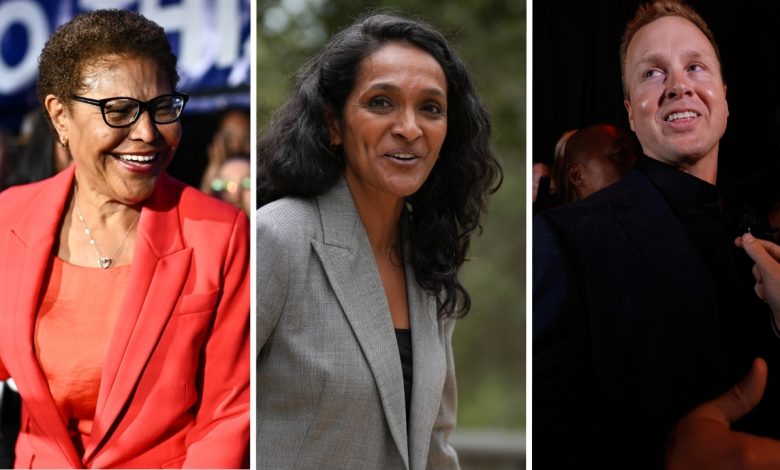
The transition from the primary election night to the final projection was a suspenseful narrative of shifting dynamics. On the evening of June 2, 2026, initial returns placed former reality television star Spencer Pratt in second place, holding a comfortable six-percentage-point lead over City Council member Nithya Raman. Pratt’s campaign, which benefited from high name recognition and an insurgent conservative message, seemed poised to disrupt the heavily Democratic landscape of Los Angeles politics. Many political commentators initially predicted a standard Democrat-versus-Republican general election, offering a classic ideological contrast.
However, as the Los Angeles County Registrar-Recorder continued to process a massive volume of vote-by-mail ballots, Raman steadily eroded Pratt’s lead. Historically, progressive candidates in California tend to perform better in late-counted mail-in ballots, which are often submitted by younger voters, renters, and grassroots organizers who hold onto their ballots until the final days of the election. By the weekend, Raman had overtaken Pratt by a fraction of a percent, and by Monday, June 8, 2026, her lead had expanded to nearly three percentage points. The Associated Press and major networks projected that Raman had successfully secured her spot in the November runoff, finishing with approximately 28.5% of the vote compared to Pratt’s 25.8%, while incumbent Mayor Karen Bass led the field with 34.3%.
Karen Bass’s Re-election Platform and Strategy
Incumbent Mayor Karen Bass enters the runoff phase of the 2026 Los Angeles mayoral election as the first-place finisher, but without the absolute majority needed to avoid a runoff. Having served as mayor since her landmark victory in 2022, Bass has built her campaign on a platform of pragmatic governance, centering her efforts on resolving the city’s persistent homelessness crisis through her ‘Inside Safe’ initiative. Her administration has focused on moving thousands of unhoused Angelenos from street encampments into temporary and permanent housing, a policy she argues has brought order and compassion to a complex humanitarian issue.
In addition to homelessness, Bass’s re-election strategy relies heavily on establishing herself as a champion of public safety and economic stability. Her campaign has actively advocated for expanding the Los Angeles Police Department (LAPD) to address staffing shortages, a position that positions her as a moderate pragmatist in contrast to the city’s farther-left factions. Bass’s strategist, Douglas Herman, immediately set the tone for the general election matchup by taking aim at Raman’s progressive policies, stating that a campaign against an opponent who opposes hiring more police officers and supports encampments near schools is a contest they look forward to winning. Bass seeks to build a broad coalition of moderate Democrats, business leaders, labor unions, and minority communities to secure a second term.
Nithya Raman’s Progressive Ground Game
Nithya Raman’s advancement to the mayoral runoff is a testament to an exceptionally effective, last-minute campaign strategy. Entering the race just hours before the filing deadline in February 2026—after initially endorsing Bass for re-election—Raman faced a steep uphill battle. She had only 115 days to assemble a campaign staff, raise significant capital, and mobilize voters across a sprawling metropolis of nearly four million people. Despite these structural challenges, Raman leveraged her deep roots in grassroots progressive organizing and her high profile as an urban planner and City Council member to mount a formidable challenge.
Raman’s strategy focused heavily on targeting renters, working-class families, and younger Angelenos who feel increasingly marginalized by the city’s rising cost of living. Her campaign platform emphasized aggressive tenant protections, the rapid construction of social and affordable housing, and a transition toward community-based emergency response models instead of traditional policing. By framing the election as a choice between a corporate-backed political establishment and a movement dedicated to working people, Raman successfully galvanized a passionate army of volunteers. This ground game proved decisive in the primary’s final days, as volunteers knocked on thousands of doors and made countless phone calls to ensure late-ballots were cast and counted.
The Role of the Democratic Socialists of America in Local Governance
Nithya Raman’s political identity is deeply intertwined with the Democratic Socialists of America (DSA), an organization that has rapidly expanded its influence within Los Angeles municipal government over the past several years. Raman first shocked the local political establishment in 2020 by defeating an incumbent city council member with robust DSA backing. Her victory signaled a paradigm shift in a city historically dominated by moderate, business-friendly Democrats. Raman’s advancement to the mayoral runoff represents a significant localized test for the hard-left’s future in the Democratic Party, showing that democratic socialist ideas have moved from the political fringe to the very center of major metropolitan governance.
Within City Hall, the growing presence of DSA-aligned council members has fundamentally altered policy debates surrounding rent control, police funding, and municipal services. Critics, including moderate Democrats and business coalitions, argue that the DSA’s policies are economically unfeasible and contribute to a decline in public safety and business investment. Conversely, supporters contend that these progressive policies are the only viable antidote to decades of systemic inequality, skyrocketing housing costs, and structural neglect. The upcoming head-to-head matchup between Bass and Raman will serve as a referendum on which ideological direction Los Angeles voters wish to pursue as they grapple with these compounding challenges.
Spencer Pratt’s Wildfire-Focused Campaign and Its Aftermath
The most unexpected element of the primary was undoubtedly the insurgent candidacy of Spencer Pratt. A former reality television star famous for his role on MTV’s The Hills, Pratt ran a populist campaign as a registered Republican. Pratt’s entire campaign emerged from the trauma of the devastating California wildfires, which destroyed his Pacific Palisades home the previous year. Utilizing his substantial social media presence, Pratt launched a scathing critique of Mayor Bass’s emergency management, infrastructure oversight, and the city’s general response to natural disasters.
Pratt managed to consolidate much of the city’s conservative and moderate-leaning base, who felt alienated by the dominant progressive consensus in Los Angeles. By combining anti-establishment rhetoric with high-energy public appearances, he positioned himself as a champion for frustrated homeowners and taxpayers demanding accountability. While critics dismissed his candidacy as a publicity stunt, his strong initial second-place standing on election night proved that his message resonated with a substantial portion of the electorate. Although he was ultimately eliminated as mail-in ballots favored Raman, Pratt’s 25.8% of the vote represents a powerful conservative and moderate voting bloc that both remaining candidates must now court ahead of the November election.
The Political Debate: Law Enforcement and Homelessness
As the runoff campaign begins, the core policy disagreements between Karen Bass and Nithya Raman are expected to center around two of the most critical issues facing Los Angeles: law enforcement and homelessness. The debate over policing is particularly sharp. Mayor Bass has consistently pushed to expand the LAPD’s ranks, arguing that a robust police force is essential for keeping neighborhoods safe and responding effectively to rising retail theft and violent crime. Raman, on the other hand, has advocated for shifting resources from traditional law enforcement toward specialized mental health professionals and social workers to handle non-violent calls, particularly those involving unhoused individuals.
The candidates also present contrasting visions for addressing the housing crisis. While both acknowledge the severity of the situation, Bass’s approach centers on moving people quickly from encampments into motels and temporary housing through centralized initiatives. Raman argues that the city must address the root causes of homelessness by implementing stricter rent controls, preventing unjust evictions, and prioritizing the construction of permanent social housing owned and operated by the public. This debate highlights a fundamental philosophical disagreement: Bass favors rapid, administrative interventions to clean up public spaces, while Raman advocates for structural, long-term economic reforms to protect vulnerable residents.
Comparing the Candidates: Profiles, Positions, and Coalitions
To understand the high-stakes dynamics of this mayoral race, it is helpful to analyze the candidates’ contrasting backgrounds, core policy priorities, and primary bases of support. The general election will demand that both candidates appeal to voters beyond their core constituencies, particularly the moderate and conservative voters who supported Spencer Pratt in the primary.
| Candidate | Party & Ideological Alignment | Core Policy Priorities | Primary Vote Share | Key Coalitions & Support Base |
|---|---|---|---|---|
| Karen Bass | Moderate/Liberal Democrat (Incumbent) | Inside Safe homelessness program, LAPD recruitment, local job creation, business support | 34.3% | Democratic establishment, labor unions, business organizations, moderate homeowners |
| Nithya Raman | Progressive Democrat (DSA-Backed) | Tenant protections, social housing construction, alternative emergency response, rent control | 28.5% | Grassroots progressive groups, younger voters, renters, democratic socialist organizations |
| Spencer Pratt (Eliminated) | Populist Republican (Insurgent) | Wildfire recovery, infrastructure reform, anti-establishment accountability, tax reduction | 25.8% | Conservative voters, Pacific Palisades homeowners, anti-incumbent taxpayers, social media base |
The Slow Ballot Counting Process in California Elections
The prolonged period between primary election night and the final projection of the runoff candidates has once again put a national spotlight on California’s unique and slow electoral process. Under California law, mail-in ballots are accepted as long as they are postmarked by Election Day and arrive within seven days. This thorough approach is designed to maximize voter participation and ensure that every legal vote is counted. However, the meticulous signature verification process and manual handling of millions of ballots countywide inevitably mean that close races remain undecided for days, or even weeks, after the polls close.
This delay has increasingly become a target for political controversy and misinformation. While election experts maintain that the slow count is a feature of a robust, secure, and voter-friendly system, critics have used the lack of immediate results to sow doubt about election integrity. During the counting process, national figures and local campaigns alike expressed frustration, highlighting the need for transparent communication from election officials. As Los Angeles prepares for the general election on November 3, 2026, both the Bass and Raman campaigns are already preparing for another potential multi-day counting period, emphasizing the importance of securing a decisive margin on election night itself.
National Implications: Centrist vs. Progressive Democratic Struggle
The showdown between Karen Bass and Nithya Raman in Los Angeles is far more than a local municipal contest; it is a microcosm of the larger battle currently raging within the national Democratic Party. This regional battleground reflects broader ideological debates seen in general election postmortems and future ambitions within the national Democratic coalition. As urban centers across the United States face mounting challenges related to housing affordability, public safety, and economic inequality, the division between centrist-establishment Democrats and the progressive, democratic socialist wing has become increasingly pronounced.
National observers will watch the Los Angeles mayoral runoff closely to gauge which message resonates more effectively with diverse, urban electorates. A victory for Karen Bass would signal that urban voters still prefer experienced, moderate leadership focused on incremental, pragmatic solutions and maintaining strong relations with the business community and law enforcement. Conversely, a victory for Nithya Raman would represent a monumental triumph for the progressive movement, demonstrating that a message of structural economic reform, tenant empowerment, and alternative policing can win in one of the country’s largest and most complex metropolitan areas. The outcome in November will undoubtedly shape campaign strategies and policy platforms for Democratic candidates nationwide for years to come.