Collins and Platner Win Maine Primaries in Wild Senate Setup
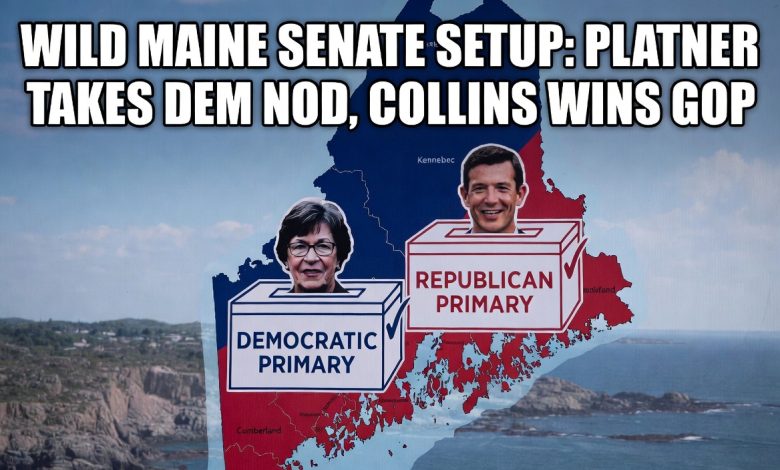
Collins and Graham Platner secured decisive primary victories on Tuesday, setting up what promises to be one of the most volatile, expensive, and closely watched U.S. Senate battles of the 2026 midterm election cycle. Republican Senator Susan Collins, who has represented the Pine Tree State since her historic first election in 1996, easily sailed to renomination without facing an opponent on her party’s ballot. Meanwhile, her newly minted Democratic challenger, political newcomer Graham Platner, won a commanding victory on the Democratic side despite a late-stage flurry of explosive personal scandals. The outcome marks the official beginning of a general election campaign that will serve as a battleground over the future of the Democratic Party and a referendum on moderate conservatism in New England.
Collins and Platner Secure Primaries
The results of the primary elections on Tuesday confirm the long-anticipated match-up between the state’s senior senator and a brash, populist newcomer. This race has immediate national implications, as control of the United States Senate could very well hinge on whether Maine voters choose to stick with the familiarity of a veteran lawmaker or take a massive gamble on an anti-establishment outsider. This dynamic creates a dramatic contrast: Collins, with decades of legislative experience, versus Platner, an oyster farmer and Marine veteran who has built his campaign on deep-seated frustration with corporate politics.
While the primary voting went according to expectations, the political theater surrounding the race is already reaching a boiling point. Almost immediately after the race was called, the campaign pivoted to the general election. This is not going to be a polite debate over policy; it is already shaping up to be a brutal character study and a clash of ideological extremes that will draw hundreds of millions of dollars in national funding.
The Predictable Primary Results in Maine
For political analysts, the Tuesday primary numbers contained few surprises, though the underlying stories of the two campaigns are remarkably different. While Susan Collins had a smooth path to the general election, the Democratic primary was a story of a collapsing establishment campaign and a grassroots populist surge that could not be stopped by conventional political machinery.
Susan Collins Unopposed on the Republican Ballot
Collins ran entirely unopposed for the Republican nomination. This lack of opposition underscores her enduring dominance within the state’s GOP, even as national partisan divides have grown increasingly polarized. Collins has historically positioned herself as a bipartisan moderate capable of delivering federal funding and resources to Maine, a strategy that has kept her in office for nearly three decades despite the state’s general lean toward Democratic presidential candidates. Her campaign has built a formidable war chest, anticipating the fierce challenge that lay ahead, and Tuesday’s quiet victory allowed her team to conserve resources and focus entirely on building general election infrastructure.
Graham Platner Dominates Despite Governor Janet Mills’ Presence
Platner easily captured the Democratic nomination, securing approximately 75% of the primary vote. This commanding victory occurred despite the fact that two-term Democratic Governor Janet Mills, who had been heavily recruited by national Democrats—including Senate Minority Leader Chuck Schumer—remained on the ballot. Mills suspended active campaigning in April 2026 after struggling to gain fundraising traction or match Platner’s high-energy, progressive momentum in the polls. Despite her official suspension, Mills received roughly 19% of the vote on Tuesday. Her lingering presence on the ballot acted as a protest vote for moderate Democrats who remain deeply alarmed by Platner’s severe personal controversies. However, the overwhelming majority of Democratic primary voters chose to rally behind Platner’s populist message, signaling a massive rejection of the party’s establishment wing.
Who is Graham Platner? From Marine and Oyster Farmer to Senate Nominee
To understand his meteoric political rise, one must look at the biography of Graham Platner, whose background as an outsider has both propelled his populist message and loaded his candidacy with unprecedented political risk. Born in Blue Hill, Maine, in 1984, Platner enlisted in the United States Marine Corps immediately after graduating from high school. He served eight years of military service, which included three combat tours in Iraq. He later joined the Maryland Army National Guard, serving a fourth combat tour in Afghanistan. Following his military career, he worked briefly as a security contractor for the State Department in Kabul before returning to his home state to seek peace and isolation.
In 2018, Platner began working on a small oyster farm in the coastal town of Sullivan, eventually taking over the operation in 2020. This transition from combat veteran to working-class mariner became the cornerstone of his political identity. Running as an economic populist and a progressive outsider, Platner launched his Senate campaign in August 2025, quickly securing endorsements from high-profile progressive leaders such as Senators Bernie Sanders, Elizabeth Warren, and Chris Murphy. His platform focuses heavily on issues that resonate deeply with working-class Mainers: housing affordability, universal single-payer healthcare, expanding labor unions, reducing the political power of billionaires, and ending what he terms “pointless” foreign wars. This anti-war sentiment is deeply personal for Platner, who has spoken openly about his struggles with post-traumatic stress disorder (PTSD) and his disillusionment with American foreign policy.
A Growing Web of Scandals: Platner’s Controversial Background
Despite his ideological appeal, Platner enters the general election carrying an incredibly heavy amount of personal and political baggage. Critics from both the Republican and Democratic establishments have raised serious concerns about his fitness for office, pointing to a series of scandals that would have easily sunk a traditional candidate. In the weeks leading up to the primary, Platner’s campaign was hit by a barrage of highly damaging revelations regarding his past behavior, digital footprints, and personal relationships.
Resurfaced Reddit Posts and Controversial Comments
The first major blow to Platner’s campaign came when political opponents and journalists unearthed a series of deleted Reddit posts written by Platner years before he launched his candidacy. In these posts, Platner used homophobic and anti-LGBTQ+ slurs, made highly crude jokes denigrating gay men, and wrote aggressive comments suggesting that victims of sexual assault should “take some responsibility for themselves” to avoid dangerous situations. Additionally, the posts contained comments calling police officers bastards, describing rural Maine voters as “stupid” and “racist,” and advocating for violent political action, writing that “an armed working class is a requirement for economic justice”. While Platner has since admitted to writing these posts and apologized, calling them “indefensible” products of a dark, post-military struggle with alcohol and mental health, the comments have alienated many moderate voters and progressive advocacy groups.
The Nazi Tattoo and Personal Relationship Allegations
Beyond his online footprint, Platner has faced intense scrutiny over a controversial tattoo on his chest that resembled a Nazi symbol. Platner defended the ink as a Norse pagan design that he obtained during a period of heavy drinking and post-military trauma, and he has since had the tattoo completely covered up and expressed deep regret. However, the controversy deepened in late spring when a New York Times investigation detailed allegations of toxic and physically threatening behavior from an ex-girlfriend. Furthermore, explicit text messages that Platner sent to other women after his 2023 marriage to Amy Gertner were leaked to the media. While Platner strongly denied any physical abuse, and the ex-girlfriend later publicly stated that the New York Times had “twisted” her story, the accumulated headlines have created an atmosphere of intense skepticism around his character. This has led some national Democrats to fear that nominating Platner is a political self-own that could hand Susan Collins an easy path to victory.
Susan Collins’ Resilience and Strategic Campaign Platform
Collins has built her entire political legacy on surviving tough political environments, and she is preparing to deploy her standard, battle-tested playbook to ward off Platner’s populist challenge. Throughout her nearly thirty years in the Senate, Collins has carefully cultivated a brand as an independent, moderate Republican who puts Maine first. Her campaign will undoubtedly emphasize her senior position on key Senate committees, her ability to secure critical federal funding for Maine’s infrastructure, maritime, and defense industries, and her record of constituent services. Collins will likely frame herself as a steady, reliable hand in contrast to Platner’s chaotic and unpredictable nature.
However, Collins is not without her own significant political vulnerabilities. In recent years, Maine has trended increasingly Democratic in federal elections, and progressives have long targeted Collins for her crucial votes on Republican priorities. In particular, her decision to cast the deciding vote in favor of confirming Supreme Court Justice Brett Kavanaugh in 2018 remains a highly polarizing issue that continues to anger Maine’s progressive base. Platner seized on this immediately in his victory speech, signaling that the Kavanaugh vote will remain a central pillar of the Democratic strategy to paint Collins as a rubber stamp for national Republican leadership.
The General Election Battleground: What Lies Ahead
The general election between Collins and Platner is set to be a clash of two diametrically opposed visions for Maine and the nation. Platner started the campaign with an aggressive, defiant victory speech in Blue Hill, Maine, signaling that he has no intention of playing defense on his scandals. Instead, he intends to lean heavily into a narrative of redemption, second chances, and economic justice. He has accused the media and the political establishment of obsessing over his past mistakes while ignoring the material struggles of working-class Mainers who cannot afford housing, healthcare, or childcare. By framing the election as a battle between the working class and an entrenched political oligarchy, Platner hopes to bypass traditional media narratives and connect directly with voters who feel left behind by the modern economy.
Collins’ campaign, conversely, is expected to wage a highly disciplined campaign focused on Platner’s volatile temperament and controversial record. Republicans will likely paint Platner as an unstable, radical extremist whose past comments on police, rural voters, and women make him completely unfit to represent Maine in the world’s most deliberate legislative body. The race will test whether Platner’s economic populist appeal can overcome the deep concerns regarding his personal conduct, or if Collins’ cautious, moderate brand still holds sway over Maine’s famously independent electorate.
Comparison of the Candidates: Collins vs. Platner
To understand the choices facing Maine voters in November, it is helpful to directly compare the backgrounds, platforms, and political strategies of the two nominees. The table below outlines the core differences between Susan Collins and Graham Platner as they begin the general election campaign.
| Category | Susan Collins (R) | Graham Platner (D) |
|---|---|---|
| Political Experience | U.S. Senator representing Maine since 1997; first elected in 1996. Former state and federal administrator. | First-time political candidate; currently serves as Chair of the Sullivan Planning Board. |
| Professional Background | Career public servant, congressional staffer, and administrative director. | Marine Corps veteran (three combat tours in Iraq), Army National Guard veteran (Afghanistan), and local oyster farmer. |
| Core Platform Pillars | Bipartisanship, moderate conservatism, securing federal funding for Maine industries, and senior committee leadership. | Economic populism, Medicare for All, housing affordability, strengthening labor unions, taxing billionaires, and anti-war foreign policy. |
| Key Endorsements | Mainstream Republican groups, traditional business coalitions, and moderate political action committees. | Progressive U.S. Senators Bernie Sanders, Elizabeth Warren, and Chris Murphy. |
| Major Vulnerabilities | Controversial votes on conservative judicial nominees (e.g., Brett Kavanaugh) and perceived alignment with national GOP leaders. | Extensive personal scandals, including offensive Reddit posts, Norse/Nazi tattoo controversy, and allegations regarding past relationships. |
| Campaign Strategy | Emphasizing legislative experience, political stability, constituent services, and bipartisan effectiveness. | Fierce anti-establishment populism, appeals to working-class voters, and framing the race as a fight against political oligarchy. |
Why the Maine Senate Race Will Determine Senate Control
The stakes of this election extend far beyond the borders of Maine. With the U.S. Senate closely divided, the battle between Collins and Platner is one of only a handful of races nationwide that will determine which party holds the majority in the next Congress. National Democrats view Collins’ seat as one of their absolute best opportunities to flip a Republican-held seat, especially given Maine’s tendency to vote Democratic in presidential elections. However, the nomination of a highly controversial candidate like Platner has thrown those calculations into complete disarray, making the race a high-stakes gamble for national progressive groups.
If Platner can pull off an upset victory, it will provide a powerful proof of concept for progressive populism, demonstrating that an economic message focused on the material needs of the working class can overcome personal scandals and win in rural, independent-minded states. Conversely, if Collins secures a sixth term, it will reinforce her status as one of the most resilient political survivors in modern American history, proving once again that her carefully crafted brand of moderate, independent representation remains a powerful force in Maine politics. As both candidates transition from their primary victories to the grueling general election trail, the eyes of the entire country will remain fixed on Maine.