Artificial intelligence race with China: US Forces Allies to Align 2026
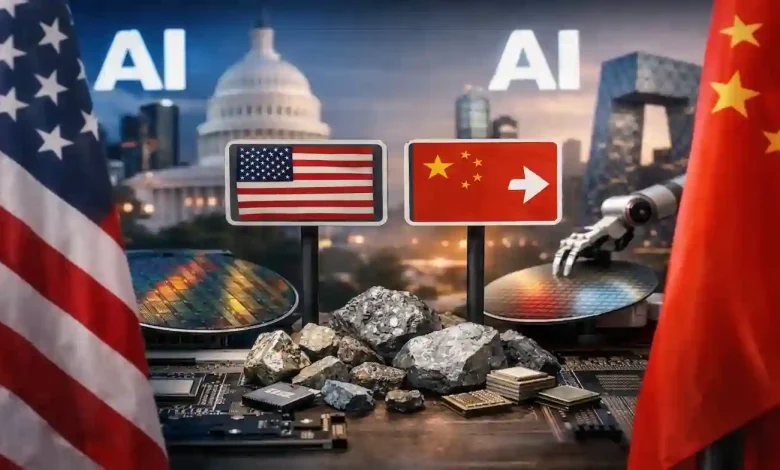
Table of Contents
Artificial intelligence race with China has entered a high-stakes, zero-sum era as Washington prepares to deliver a blunt ultimatum to partner nations across the globe. According to an internal State Department draft reviewed by Reuters, the United States is readying a formal warning to dozens of countries: align with the American-led artificial intelligence coalition, or risk being completely shut out. This coercive diplomatic maneuver signals a dramatic escalation in the tech-centric Cold War, forcing international partners to choose between Washington’s burgeoning “Pax Silica” framework and Beijing’s competing multilateral initiatives. By demanding exclusive allegiance, the U.S. aims to consolidate critical supply chains and starve China of the global resources, data, and partnerships required to achieve technology dominance.
In this comprehensive investigation, we explore the deep geopolitical and economic rifts of this technology split:
- The Pax Silica Coalition vs. WAICO: A Tale of Two Blocs
- The Catalyst of Tension: Kazakhstan’s Strategic Ambivalence
- “To Be Part of Everything is to Be Part of Nothing”
- Geopolitical Impacts on Global Technology Ecosystems
- Market Repercussions: Semiconductors, Infrastructure, and Valuations
- The Split in Generative AI: Closed vs. Open-Weight Paradigms
- Diplomatic Fallout and China’s Sovereign Tech Strategy
- Multilateral Tech Collaboration in Jeopardy
- The Path Forward: Can Nations Remain Non-Aligned?
The Pax Silica Coalition vs. WAICO: A Tale of Two Blocs
The global technology landscape is fracturing into two distinct ideological and operational spheres. Washington introduced the Pax Silica initiative to secure the three pillars of modern tech hegemony: AI foundation models, advanced semiconductors, and the critical minerals required to manufacture high-end microchips. Since its inception, nearly two dozen core countries and the European Union have signed onto the Pax Silica Declaration. This framework provides members with access to joint investments, shared research opportunities, and coordinated export controls designed to restrict Chinese technological expansion. Close American allies, including Japan, Australia, the United Kingdom, and South Korea, have eagerly joined this bloc, viewing it as a vital protective umbrella.
Conversely, China has not remained passive. In July, Chinese President Xi Jinping officially launched the World Artificial Intelligence Cooperation Organization (WAICO), headquartered in Shanghai. WAICO is positioned as an open, inclusive, and decentralized alternative to Western unilateralism. Promoting “open-weight” technology as a direct challenge to American proprietary dominance, China has successfully attracted 29 initial signatory countries. This group includes Russia, Belarus, Serbia, Brazil, Pakistan, Indonesia, and over a dozen developing nations across Africa. Strikingly, no G7 nation has joined WAICO, cementing a clean geopolitical partition between the democratic West and the developing Global South.
Summary of Competing AI Alliances
| Feature | U.S.-Led Pax Silica Initiative | China-Led World AI Cooperation Org (WAICO) |
|---|---|---|
| Established | Late 2025 (Expanded 2026) | July 2026 |
| Headquarters | Washington, D.C., USA | Shanghai, China |
| Core Strategic Focus | Semiconductors, secure supply chains, critical minerals, proprietary models | Open-weight model distribution, digital sovereignty, decentralized infrastructure |
| Key Members | United States, Japan, Australia, UK, South Korea, EU | China, Russia, Belarus, Brazil, Pakistan, Indonesia |
| Stated Philosophy | Secure, democratic, and values-aligned AI governance | Inclusive, multipolar, and sovereign-driven global cooperation |
The Catalyst of Tension: Kazakhstan’s Strategic Ambivalence
The immediate trigger for the State Department’s diplomatic offensive was the Central Asian nation of Kazakhstan. Possessing massive, unexploited reserves of critical minerals essential for semiconductor manufacturing, Kazakhstan is a highly coveted partner for both superpowers. In June, the U.S. celebrated Kazakhstan’s accession as the first Central Asian signatory to the Pax Silica framework. However, shortly thereafter, Astana signed up for China’s WAICO initiative, attempting to maintain its traditional multi-vector foreign policy by participating in both camps.
This attempt at strategic ambivalence set off loud alarm bells in Washington. U.S. officials realized that if partners could freely join both blocs, the technology barriers, intellectual property guardrails, and export controls established under Pax Silica would be rendered useless. Kazakhstan’s double enlistment proved that a non-binding framework was insufficient to prevent technology leakage, leading directly to the formulation of the State Department’s strict, non-negotiable ultimatum.
“To Be Part of Everything is to Be Part of Nothing”
The draft letter prepared by the State Department is addressed to the 35 signatories of the “AI Opportunity Statement” signed in June. This statement represented a loose coalition of nations interested in aligning their digital development with Western standards. The language of the leaked draft is remarkably blunt, stripping away standard diplomatic euphemisms.
“To be part of everything is to be part of nothing. Signature of the Pax Silica Declaration is not merely a membership subscription, but a commitment,” the letter states with uncompromising clarity. The document goes on to state that membership in the Pax Silica coalition “cannot be held alongside membership in duplicative initiatives whose expectations conflict with our own,” pointing directly at China’s WAICO without explicitly naming the country. This shift marks a transition from open collaboration to strict tech-exclusivity.
Geopolitical Impacts on Global Technology Ecosystems
This forced alignment will fundamentally transform how sovereign nations formulate their domestic technology policies. For years, many mid-tier countries sought to balance their relationships, leveraging American cloud software while integrating affordable Chinese hardware and open-weight models. Under this new U.S. doctrine, this dual-use path is closed, forcing governments to choose their technology overlords. This escalation of unilateral international pressure tactics reflects Washington’s willingness to use its structural economic leverage to dictate domestic policy choices abroad.
While the geopolitical strategies of the Trump administration historical laid the groundwork for aggressive technological decoupling, this latest initiative codifies it into a formal bloc. Nations that hesitate to sign the exclusive commitment risk losing access to advanced hardware, international venture capital, and security-sharing programs, leaving them isolated in a rapidly advancing field.
Market Repercussions: Semiconductors, Infrastructure, and Valuations
The economic ramifications of a bifurcated AI sector will reverberate across stock exchanges, venture capital funds, and hardware supply chains. Tech companies inside Pax Silica-aligned territories will face immense compliance burdens, needing to audit every step of their supply chains to ensure no components or mineral sources originate from WAICO-aligned nations.
This division will directly impact the capital market valuations of leading chipmakers and hardware designers. For instance, market observers are watching Goldman Sachs’ outlook on Nvidia’s trajectory, as export restrictions and bloc-based blacklists limit the addressable market for advanced GPUs. Simultaneously, emerging sectors like commercial robotics and automation markets will experience high volatility as companies split their operations between Western proprietary standards and Eastern open hardware. Even long-term aerospace tech investments will feel the squeeze, as space-based computing and satellite monitoring data becomes restricted under military and national security guidelines.
The Split in Generative AI: Closed vs. Open-Weight Paradigms
At the software layer, the geopolitical split will widen the gulf between proprietary, closed-loop AI software and decentralized open-weight ecosystems. The United States holds a commanding lead in proprietary software, driven by the ongoing advancement of ChatGPT models by OpenAI and historic valuation milestones for leading generative AI developers such as Anthropic. These models require massive, proprietary cloud infrastructure hosted on servers strictly regulated by U.S. export controls.
To bypass these U.S.-controlled bottlenecks, China is aggressively championing open-weight AI models through the WAICO framework. Open-weight models allow developers globally to download model parameters, run them locally on existing hardware, and bypass Western proprietary clouds. This model is highly attractive to developing countries, which often lack the capital to build high-end cloud data centers or pay expensive licensing fees to Western tech giants. By threatening exclusion, the U.S. hopes to limit the global distribution of Chinese open-weight models, starving Beijing of the international datasets and user feedback loops required to train future iterations.
Diplomatic Fallout and China’s Sovereign Tech Strategy
China’s response to the leaked State Department draft was swift and highly critical. Foreign Ministry spokesperson Lin Jian denounced Washington’s block-building tactics, stating that “each country has the right to choose its partners based on its national conditions and development needs”. China’s diplomatic strategy focuses on presenting itself as the champion of digital sovereignty and multipolarity, accusing the U.S. of a “zero-sum geopolitical maneuver” designed to maintain unilateral dominance at the expense of global technological advancement.
This developing rift has become a focal point of discussion across global policy institutes and prediction platforms. On public prediction markets tracking policy outcomes, analysts are actively debating which of the 35 original signatories will capitulate to the State Department’s demands and which will opt to chart an independent path. The outcome of these diplomatic negotiations will dictate the geopolitical map of technology for the next several decades.
Multilateral Tech Collaboration in Jeopardy
Perhaps the most concerning casualty of this forced alignment is the collapse of global collaboration on artificial intelligence safety and ethics. Prior to this escalation, there were tentative, fragile attempts to establish global baselines on AI existential risk, cybersecurity, and the military deployment of autonomous systems.
With the world officially divided into competing, hostile camps, any hope for unified international standards is effectively dead. Instead, the global community faces a future of fragmented technical protocols, rival intellectual property standards, and conflicting safety benchmarks. A nation aligned with Pax Silica will operate under completely different ethical and legal constraints than one aligned with China’s WAICO, creating dangerous blind spots in global risk mitigation.
The Path Forward: Can Nations Remain Non-Aligned?
As the U.S. State Department prepares to dispatch the finalized letters, partner countries face a monumentally difficult choice. For highly integrated allies like Japan, Australia, and the UK, the choice is a foregone conclusion; they will remain firmly inside the American orbit. However, for developing nations, the calculation is fraught with danger.
Choosing Pax Silica ensures access to state-of-the-art silicon, Western capital markets, and security partnerships, but it requires shutting the door on affordable Chinese technology, infrastructure development, and valuable mineral export markets. Conversely, joining WAICO provides immediate access to open-weight models and Chinese development capital but invites severe, long-term economic isolation from the Western world. As the digital divide deepens, “technological non-alignment” is fast becoming an impossible dream, replaced by a rigid, block-based reality.




6 Comments