Unitree Stock Surges 460% on Shanghai STAR Market Debut
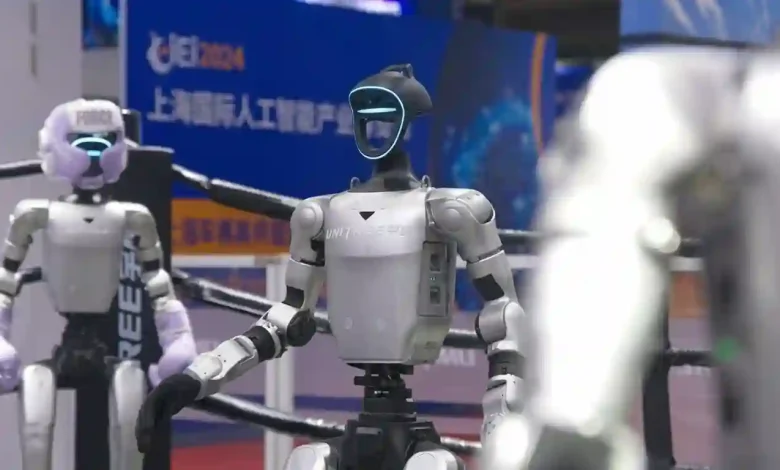
Table of Contents
Unitree, the groundbreaking Chinese humanoid robotics pioneer, made history on Wednesday, August 19, 2026, with a spectacular stock market debut that captured the global financial imagination. Trading under the ticker symbol 688836 on Shanghai’s tech-focused STAR Market, the Hangzhou-based innovator saw its shares rocket as much as 629% in the opening moments, jumping from an initial public offering (IPO) price of 150.8 yuan ($22) to an astonishing intraday high of 1,100 yuan ($163.23). Although the stock pared some of its initial historic gains, it closed the trading session up 460% at 845 yuan ($125.40), comfortably valuing the pure-play humanoid developer at over $50 billion.
This blowout performance highlights the intense, localized investor frenzy surrounding homegrown beneficiaries of the artificial intelligence (AI) and robotics sectors. As retail and institutional money continues to speculate on the future of physical intelligence, online sentiment and prediction markets such as Kalshi have shown growing excitement toward companies that can successfully merge deep learning with sophisticated physical mechanical hardware. The public subscription was oversubscribed a staggering 5,500 times by retail investors, leaving the vast majority of applicants empty-handed due to a microscopic winning lottery rate of approximately 0.018%.
Introduction to the Blockbuster IPO
The stellar trading debut of Unitree reflects a broader enthusiasm for artificial intelligence systems capable of interacting with the physical world. For years, investors have poured speculative capital into pure software firms, but the realization of physical robotic labor is driving a reallocation of capital. The company, officially registered as Yushu Technology Co, represents a new breed of tech startups that can swiftly go from experimental laboratories to heavy industrial manufacturing. Founded in 2016 by visionary engineer Wang Xingxing, the enterprise has quickly established itself as a premier developer of high-performance quadrupedal and bipedal systems, capturing attention with viral clips of its machines doing backflips, executing martial arts, and navigating difficult terrains.
According to Forbes financial analysts, the level of oversubscription seen in Unitree’s mainland debut reflects a profound domestic supply deficit in technology assets. Retail investors have flocked to the STAR Market as a haven of exponential growth, creating a dynamic where the initial valuation guidance provided by CITIC Securities was rapidly shattered. The pricing of 150.8 yuan per share was viewed by institutional funds as highly aggressive, yet the sheer velocity of modern capital bypassed traditional valuation models completely on day one.
The Dawn of the “Superman” Robot
Just two days before its blockbuster IPO, Unitree electrified tech enthusiasts by unveiling its new, high-speed humanoid machine, aptly dubbed “Superman.” Developed in an incredibly short span of just over three months, the “Superman” robot serves as a direct demonstration of the company’s agile manufacturing capabilities and engineering prowess. In a video released on Monday, the machine demonstrated a standing vertical jump of 2 meters (more than 6.5 feet) and clocked a jaw-dropping top running speed of 12.66 meters per second (28.3 miles per hour). This speed is particularly notable as it surpasses the peak velocity of the legendary men’s 100-meter world record holder, Usain Bolt, whose top speed reached approximately 27.78 miles per hour.
Engineering a bipedal robot capable of maintaining balance, managing joint temperatures, and delivering peak torque at such velocities is a massive challenge. Even with global macroeconomic headwinds and soaring energy costs affecting production facilities, Unitree’s engineering team utilized advanced ultra-lightweight carbon-fiber alloys and proprietary high-torque electric actuators to construct a robot with a leg length of 0.85 meters. The company has stated that the “Superman” model is still a work in progress, with plans to refine its control algorithms to achieve even faster and more stable locomotives over the coming months.
Financial Analysis: Valuation, Profits, and Market Dynamics
Unlike many of its global peers that remain in the capital-intensive prototype phase, Unitree has managed to achieve large-scale commercialization and profitability. In 2025, the company made waves by shipping over 5,500 pure humanoid robots (excluding wheeled and dual-arm varieties), capturing the top spot in global delivery volume. This operational scale translated into 278 million yuan (about $41 million) in net profit on revenue of 1.7 billion yuan ($252 million) for the previous fiscal year. However, with its post-IPO valuation hovering near $50 billion, Unitree is now trading at roughly 210 times its annual sales and well over 1,200 times its trailing earnings, drawing comparisons to the early valuation bubbles of the internet era.
While critics argue that these multiples are untethered from near-term cash flows, proponents believe that Unitree’s command of the market warrants a massive premium, especially considering the potential for AI models to exponentially scale productivity. While other global economies grapple with structural inflation and macroeconomic disruptions, China’s financial ecosystem has fully mobilized to back the industrialization of “embodied AI” — a strategy designed to offset demographic shifts and a shrinking labor pool.
| Company Name | Listing Status | Estimated / Market Valuation | Key Backers & Strategic Investors | 2025 Shipment Vol. (Est.) |
|---|---|---|---|---|
| Unitree Robotics | Public (STAR Market: 688836) | $50 Billion – $53 Billion | Tencent, Alibaba, DeepSeek, Xiaomi, CITIC | 5,500+ humanoid units |
| Figure AI | Private (Series C) | $39 Billion | Microsoft, OpenAI, NVIDIA, Parkway VC | Under 500 prototype units |
| 1X Technologies | Private | ~$10 Billion | OpenAI, Tiger Global, Samsung | Under 1,000 units |
| Agility Robotics | Private / Pending SPAC | ~$2.5 Billion | Amazon, SoftBank, Churchill Capital XI | Under 800 units |
| UBTech Robotics | Public (Hong Kong Stock Exchange) | ~$6 Billion | Tencent, BYD, various state funds | 1,500+ units |
Inside the Tech: Embodied AI and Global Domination
The technological landscape is witnessing a massive convergence of physical mechanics and generative models, a paradigm referred to as “embodied artificial intelligence.” Unitree has benefited enormously from this convergence, leveraging strategic partnerships with top-tier Chinese software ecosystems. The company’s strategic placement investors include DeepSeek, Tencent, Alibaba, and Xiaomi. These collaborations allow Unitree’s hardware to run state-of-the-art vision-language-action (VLA) models natively, facilitating advanced environmental perception and real-time path planning. While geopolitical rivalries pose continuous geopolitical stress tests on international cooperation, domestic Chinese entities have successfully pooled their talent, processing power, and supply chains to create vertically integrated robotics leaders.
According to industry research, China currently manufactures approximately 82% of all humanoid robot shipments globally. This immense industrial dominance is fueled by a comprehensive regional supply chain of micro-motors, reduction gears, and sensors. The city of Hangzhou, where Unitree is headquartered, has emerged as a premier hub for this ecosystem, allowing the company to source specialized parts at a fraction of the cost incurred by Western competitors. Consequently, while American developers like Figure AI and Apptronik are forced to pay premium prices for custom precision components, Unitree can rapidly iterate, build, and test machines like the “Superman” in mere months.
US-China Technological Warfare and Robotics Bans
The timing of Unitree’s monumental IPO cannot be decoupled from the raging technological and economic cold war between Washington and Beijing. Just last month, the United States government enacted a sweeping ban on the import of new foreign-made robotic systems, citing severe national security concerns. Washington policymakers expressed fears that connected Chinese humanoids and quadrupeds could transmit sensitive mapping data of critical infrastructure, commercial warehouses, and corporate facilities back to Beijing. This defensive maneuver has inadvertently supercharged the domestic market within China, as mainland institutional and retail investors seek out localized alternatives to protect against external political blockades.
Furthermore, general international instability and persistent shipping bottlenecks have introduced severe supply chain vulnerabilities for global electronics and advanced machinery. The restrictions placed on key industrial lanes mean that Western robotics firms face prolonged lead times for essential hardware elements, while Chinese manufacturers continue to scale production unhindered. This geopolitical bifurcation of technology means that instead of a unified global standards system, the robotics landscape is rapidly splitting into distinct Eastern and Western ecosystems, each vying for ideological and commercial dominance across neutral territories in Asia, Africa, and Latin America.
Future Outlook and Commercial Realities
Despite the euphoria surrounding Wednesday’s trading session, serious questions remain regarding the long-term commercialization pathway of high-performance humanoid systems. Viral videos of robots performing acrobatics, martial arts, or sprinting at Usain Bolt speeds are brilliant marketing vehicles, but they do not necessarily translate into immediate workplace efficiency. Investors must recognize that executing a backflip is mechanically impressive, but stocking a retail shelf, assembling a complex automotive component, or safely performing eldercare requires a level of reliability and safety that the current generation of AI models has yet to master. Unresolved geopolitical conflicts and trade wars could also limit Unitree’s ability to sell its products in lucrative North American and European markets.
Nonetheless, the growth trajectory of the global humanoid robotics sector is undeniable. Industry analysts project that the worldwide market for human-like robots could explode from approximately $2 billion in 2025 to a staggering $300 billion by 2035. Unitree plans to allocate the 6.1 billion yuan ($904 million) in net proceeds raised from the IPO across four primary pillars: accelerating intelligent robot model R&D, upgrading humanoid prototype capabilities, pioneering next-generation general-purpose products, and constructing a state-of-the-art smart robotics manufacturing base in Hangzhou. Even with rising financial costs for R&D talent and computational processing power, the company’s capital surplus positions it as a formidable force in the decade-long race for automated dominance.
Conclusion
Unitree’s blockbuster listing on the Shanghai STAR Market marks a watershed moment for the global robotics sector. By transitioning from a highly praised hardware startup into a publicly traded $50 billion corporate titan, the Hangzhou firm has proved that “embodied AI” is no longer a distant sci-fi dream but an active, heavily backed financial asset class. While the astronomical valuations and the political tensions between Eastern and Western trade blocs present unavoidable risks, the sheer technological velocity of machines like “Superman” indicates that our future will be run, danced, and jump-started by the silicon and steel creations of today.