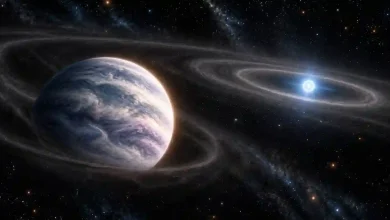
Green star discovery reveals white dwarf glowing chartreuse 2026

Table of Contents
Introduction to the Chartreuse Stellar Remnant
Green star discovery has captivated astrophysicists and observational astronomers worldwide after a landmark study identified a white dwarf displaying a ghostly shade of chartreuse. Designated as WD J1330+6435, this dense stellar remnant resides roughly 280 light-years from Earth in the constellation Draco. For centuries, the conventional astronomical canon held that true green stars were a physical impossibility due to the fundamental nature of thermal radiation and human visual perception. However, ground-based spectroscopic surveys led by researchers at the University of Warwick have confirmed that WD J1330+6435 breaks these long-held assumptions by accumulating heavy rocky planetary debris into its atmosphere. Similar to how robotic planetary exploration expands our knowledge of terrestrial planetary surfaces, such as recent Mars surface analysis from Curiosity Rover, studying polluted white dwarfs provides a direct window into the chemical building blocks of alien solar systems.
When Sun-like stars exhaust their nuclear fuel, they undergo dramatic evolutionary transformations. They expand into red giants, shed their outer layers into glowing planetary nebulae, and eventually collapse into compact cores known as white dwarfs. These stellar corpses retain immense mass compressed into a volume comparable to Earth, resulting in extreme surface gravities and intense thermal energy. Under normal stellar evolution, white dwarfs cool slowly over billions of years, gradually shifting in appearance from searing pale blue to neutral white and eventually dull orange or red. WD J1330+6435 disrupts this expected trajectory because its observed color is governed not primarily by surface temperature, but by heavy elemental contamination acquired from the destruction of its surrounding planetary system.
The Physics of Stellar Color and Why Green Stars Are Rare
To comprehend why the identification of a chartreuse white dwarf is so remarkable, one must examine the fundamental relationship between stellar temperature and light emission. Stars are traditionally classified as blackbody radiators—idealized physical objects that emit electromagnetic radiation across a continuous spectrum dictated almost entirely by their surface temperatures. The distribution of this thermal energy follows Planck’s law, with the peak wavelength of emission shifting toward shorter, higher-energy wavelengths as temperature increases, as described by Wien’s displacement law.
Blackbody Radiation and Human Visual Perception
Cooler stars with surface temperatures around 3,000 Kelvin emit the vast majority of their energy in the red and infrared portions of the spectrum, giving them a distinct reddish-orange appearance to human observers. Intermediate stars like our Sun, operating at approximately 5,800 Kelvin, peak near the green region of the visible spectrum. However, because a blackbody curve is broad, a Sun-like star simultaneously emits substantial amounts of red, yellow, green, and blue light. When these wavelengths enter the human eye, the three types of cone photoreceptors (L, M, and S) are stimulated simultaneously, causing the brain to perceive the combined light as bright white or pale yellow rather than green.
Hottest stars, whose temperatures exceed 10,000 to 20,000 Kelvin, radiate predominantly in the ultraviolet and blue regions, making them appear pale blue or blue-white. Because a smooth thermal radiation curve that peaks in the green part of the spectrum always includes generous amounts of red and blue light, standard blackbody emission cannot produce an isolated green star. Achieving a visible green hue requires a specialized physical mechanism capable of carving away the surrounding red and blue wavelengths while leaving the green photons uninhibited.
The Exceptional Spectrum of Planetary Pollution
The chartreuse appearance of WD J1330+6435 represents a rare breakdown of pure blackbody behavior. Instead of emitting a standard thermal continuum, the white dwarf’s light is filtered through an extremely dense, chemically contaminated atmosphere. The integration of modern observational technology and AI-powered space infrastructure has enabled astronomers to model these complex atmospheric interactions with unprecedented precision. When a dying star ingests the fragmented remains of its former planets, heavy metallic elements are deposited directly into the white dwarf’s outer envelope, creating vast absorption features that radically modify the light reaching space.
How White Dwarfs Devour Their Planetary Systems
The process that led to WD J1330+6435’s green glow began millions of years after the host star transitioned into its white dwarf phase. As the star shed its mass during the red giant phase, the gravitational dynamics of its surviving planetary system were severely disrupted. Outer gas giants or perturbed asteroids often shift orbits over long timescales, occasionally sending rocky planetesimals on highly eccentric trajectories that pass close to the white dwarf.
When a rocky planet or asteroid crosses the star’s tidal disruption radius—commonly known as the Roche limit—the immense gravitational gradients tear the body apart into dust and rubble. This material forms a circumstellar debris disk that gradually spirals inward, accreting onto the surface of the white dwarf. Advanced space observatories, including deep space imaging programs like the Nancy Grace Roman Space Telescope, continue to refine our understanding of how planetary debris disks interact with stellar environments across various galactic regions.
Spectroscopic Analysis: Unpacking the Elemental Signature
In the case of WD J1330+6435, the accreted planetary material was exceptionally rich in sodium. White dwarf atmospheres possess extreme surface gravities—hundreds of thousands of times greater than Earth’s—which creates immense atmospheric pressure. Under these ultra-dense conditions, sodium atoms exhibit an effect known as pressure broadening, where spectral absorption lines expand dramatically across wide wavelength bands.
The broad sodium absorption bands in WD J1330+6435 act as a powerful optical filter, absorbing significant quantities of yellow, orange, and red light from the star’s underlying thermal spectrum. With the longer wavelengths suppressed and shorter blue wavelengths naturally diminished due to the white dwarf’s relatively cool surface temperature, the surviving light transmitted through the atmosphere peaks sharply in the chartreuse green spectrum (~520 to 550 nanometers). Interestingly, white dwarf surveys conducted by the University of Warwick team also identified a complementary anomaly: WD J1011+2845, a white dwarf that appears salmon pink or red due to carbon dredged up from its core via deep convective currents. These discoveries expand the horizons of stellar research, echoing broader astrophysical inquiries into dark matter breakthroughs and cosmic composition.
Comparative Analysis of Stellar Color Phenomena
To highlight how planetary pollution and atmospheric structure alter stellar appearance, the table below compares standard blackbody stars with the uniquely polluted white dwarfs discovered in recent spectroscopic surveys.
| Star Name / Class | Primary Mechanism | Atmospheric Drivers | Observed Visual Color |
|---|---|---|---|
| Red Dwarf (M-Class) | Cool Blackbody Emission (~3,000 K) | Primarily Hydrogen / Helium | Orange-Red |
| Sun-like Star (G-Class) | Balanced Blackbody Emission (~5,800 K) | Standard Photospheric Abundances | Yellow-White |
| Hot Main Sequence (O-Class) | High-Energy Thermal Emission (>20,000 K) | Ionized Hydrogen / Helium | Pale Blue |
| White Dwarf (WD J1330+6435) | Pressure-Broadened Metal Absorption | Accreted Sodium-Rich Planetary Debris | Chartreuse Green |
| White Dwarf (WD J1011+2845) | Convective Carbon Dredge-up | Internal Carbon Transport to Surface | Salmon Pink / Red |
Future Implications for Exoplanetary Chemistry and Astronomy
The discovery that white dwarfs can exhibit exotic colors like chartreuse, pink, and purple opens fresh avenues for planetary archaeology. Because white dwarf atmospheres are normally composed of pure hydrogen or helium—due to heavier elements sinking rapidly under high gravity—the presence of metals like sodium, silicon, iron, and magnesium provides definitive proof of recent planetary ingestion. By analyzing the light from polluted white dwarfs, scientists can calculate the precise bulk chemical composition of demolished exoplanets, uncovering whether distant solar systems contained rocky worlds with crusts and mantles similar to Earth.
As space exploration expands, technological innovations developed for orbital analysis and deep-space tracking—such as autonomous space interceptors—help safeguard sensitive astronomical instrumentation from space debris. Simultaneously, complex data processing and spectroscopic modeling rely heavily on algorithmic computational breakthroughs, paralleling trends seen in AI transformation analysis across terrestrial industries.
The Broader Landscape of Space Exploration
The identification of WD J1330+6435 highlights how much remains to be discovered even among nearby stars. Researchers estimate that roughly 3 percent of cool white dwarfs may display unexpected visual hues due to varying combinations of planetary pollution and atmospheric convection. These findings remind us that the visual universe contains unexpected diversity when studied with high-precision instruments.
Furthermore, major scientific leaps often spur economic interest and investment across aerospace sectors, mirroring financial shifts reflected in fluctuating stock futures as technology markets respond to groundbreaking research. As survey telescopes continue mapping the Milky Way, astronomers anticipate uncovering additional polluted white dwarfs that will further illuminate the final stages of planetary system evolution.
Conclusion
The first identification of a green star marks a monumental step forward in our understanding of stellar physics and exoplanetary decay. WD J1330+6435 proves that while blackbody physics prevents normal stars from shining green, the cosmic process of a white dwarf devouring its own planetary system can create optical filters powerful enough to transform starlight into a vibrant chartreuse hue. This ghostly green beacon serves as a poignant reminder of the chaotic fates awaiting planetary systems—including our own—and provides a vivid new chapter in the ongoing exploration of the cosmos.