Space Weapons: US Space Force Officially Admits Orbital Arsenal 2026
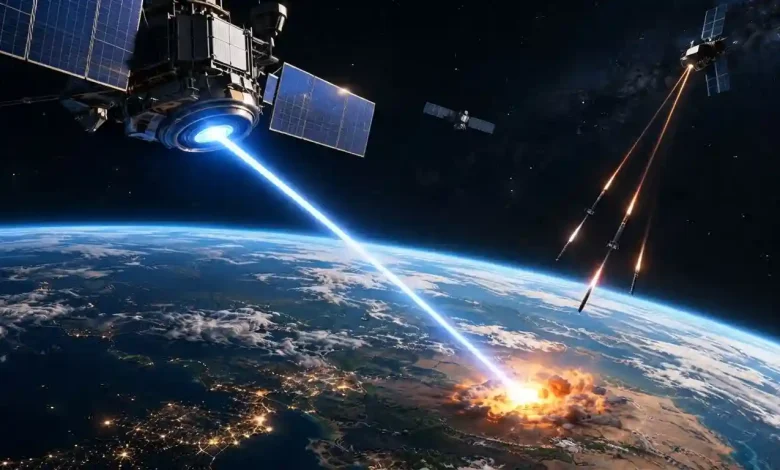
Table of Contents
Space weapons operated directly in Earth’s orbit have been officially confirmed by the United States military, marking a historic and irrevocable shift in modern defense posture and orbital warfare. In an unprecedented acknowledgment that alters decades of deliberate strategic ambiguity, high-ranking defense officials confirmed that the United States Space Force maintains and actively deploys combat systems operating above the atmosphere. Lieutenant General Douglas Schiess publicly verified that enlisted guardians currently operate on-orbit systems engineered explicitly to protect Allied assets and eliminate adversarial threats in space.
Orbital Revelation: Space Force Confirms Active Weapons
For decades, the weaponization of orbital space remained an open secret governed by classified budgets, subtle diplomatic warnings, and black-project developments. However, during an address detailing the strategic posture of Space Operations Command, Lieutenant General Douglas Schiess revealed that service personnel routinely “operate on-orbit weapons that can defend the Joint Force against space-enabled attacks.” This candid acknowledgment directly moves orbital systems out of the shadows of intelligence operations and into established military doctrine.
Military planners have long recognized that modern terrestrial combat relies entirely on space-based architecture. Communications, missile warning arrays, precision GPS guidance, and intelligence collection are tethered directly to orbital constellations. In recent months, developments surrounding the amazon leo satellite and other megaconstellations have exposed the severe vulnerability of high-density orbital tracks to state-sponsored jamming, kinetic interception, and cyber warfare.
Strategic Deterrence Against China and Russia
The Pentagon’s formal pivot toward transparent orbital capability is designed primarily as a mechanism for deterrence. For years, intelligence reports have tracked aggressive orbital maneuvers executed by both Beijing and Moscow. From high-altitude rendezvous-and-proximity operations (RPO) to terrestrial directed-energy dazzlers, strategic competitors have demonstrated the intent to disrupt Western dominance in the extraterrestrial domain.
Pentagon assessments have consistently highlighted the deployment of Russian inspector satellites capable of tailing sensitive reconnaissance spacecraft, alongside Chinese robotic arm satellites designed to grapple and de-orbit adversary hardware. Reflecting developments analyzed in recent coverage of the space us and china rivalry, the race to secure orbital supremacy has progressed from theoretical doctrine into operational mobilization. Space Force leadership emphasized that possessing offensive and active counter-space mechanisms is the only viable method to prevent adversaries from attempting preemptive strikes during a terrestrial crisis.
Operational Architecture: On-Orbit Defense Capabilities
While the exact technical specifications of these operational space weapons remain classified, defense experts identify several key vectors currently active within the Space Force toolkit. Counter-space weapons fall into soft-kill, mission-kill, and hard-kill categories. Unlike early Cold War concepts that relied on crude kinetic interceptors, modern space defense leverages precise electronic warfare pods, high-powered microwave (HPM) directed-energy platforms, and highly maneuverable escort satellites.
These capabilities were heavily previewed during broader defense initiatives, notably seen when aerospace advancements were tracked during commercial space launch test campaigns. Enlisted operators at bases such as Peterson Space Force Base and Schriever Space Force Base monitor hostile orbits continuously. In the event of an adversary satellite maneuvering to blind or ram an American asset, these on-orbit weapons can neutralize the threat via frequency suppression, software injection, or physical diversion before the enemy system enters weapons range.
Geopolitical Repercussions and Treaty Dynamics
The public acknowledgment has triggered immediate diplomatic reverberations. The foundational document of international space governance, the 1967 Outer Space Treaty, explicitly prohibits the placement of nuclear arms and weapons of mass destruction in orbit, yet it remains completely silent on conventional, electronic, or kinetic defensive systems. This legal void has enabled global superpowers to construct advanced orbital capabilities without formally breaching international law.
As global tensions ripple across various geopolitical theaters—reminiscent of systemic standoffs reported when monitoring greenland defense corridors—space is now widely recognized as a fully active operational warfighting domain. Critics contend that public disclosure could ignite an unrestricted orbital arms race, pushing neutral nations to question the long-term stability of the space environment. Conversely, Pentagon strategists assert that absolute transparency prevents miscalculation, establishing clear red lines for adversarial space commands.
Comparative Analysis of Major Orbital Arsenals
Understanding the current distribution of counter-space and orbital defense architectures requires examining the reported capabilities of major military powers:
| Nation | Acknowledged Capabilities | Primary Strategic Focus | Operational Posture |
|---|---|---|---|
| United States | On-orbit active defense, directed-energy, mobile jammers | Defending the Joint Force, constellation resiliency | Publicly acknowledged, active deterrence |
| China | Robotic grapple satellites, ground-based ASAT, RF jammers | Counter-intervention, denial of orbital access | Undeclared active deployment, rapid scaling |
| Russia | Inspector satellites, electronic warfare, co-orbital systems | Asymmetric disruption, critical asset targeting | Covert testing, aggressive proximity operations |
| Allied Partners | Orbital situational awareness, defensive cyber payloads | Domain awareness, multinational data integration | Coordinated multilateral monitoring |
Defending the Joint Force Against Space-Enabled Strikes
The core justification outlined by Lieutenant General Schiess centers on the defense of the “Joint Force.” In modern military strategy, terrestrial operations conducted by naval carrier strike groups, mechanized infantry divisions, and stealth aviation strike packages are impossible to sustain without space supremacy. If an adversary severs satellite communications or blinds reconnaissance assets, terrestrial forces operate in total sensory darkness.
Adversaries have increasingly deployed orbital tracking networks to designate carrier groups at sea or detect troop concentrations for long-range hypersonic strikes. Space weapons operated by the Space Force are designed to neutralize those hostile tracking platforms in real time. This operational integration resembles the cross-domain defense concepts highlighted in recent strategic overviews of ukraine defense deal procurement, where multi-domain integration determines survival on the frontline.
Furthermore, these defense systems protect civil space assets that ensure global economic stability. Critical logistics networks, cross-border banking rails, and automated navigation channels all depend on orbital integrity, making space defense essential to both military operations and national economic security.
The Future of Orbital Warfighting and Responsible Scaling
Addressing international concerns regarding orbital debris and Kessler syndrome—a catastrophic cascade of orbital collisions—General Schiess emphasized that the Space Force will make “disciplined and responsible choices” as it expands its footprint. Kinetic strikes in Low Earth Orbit (LEO) produce thousands of uncontrolled debris fragments that endanger every operational spacecraft, including civil, commercial, and human spaceflight missions.
As space commercialization accelerates through projects tracked in nasa commercial crew rotations and public-private launch partnerships, avoiding kinetic contamination is critical. The Space Force’s declared prioritization of non-kinetic mechanisms—such as high-precision cyber disruption, reversible optical dazzlers, and electro-optical blinding—reflects this debris-mitigation philosophy. These advanced technologies demonstrate that orbital warfare will prioritize stealth, surgical precision, and electromagnetic suppression over raw physical destruction.
Global Implications for Commercial Spaceflight
The normalization of orbital weapons systems inevitably impacts the private space sector. Commercial operators now provide the bulk of launch services, satellite bus manufacturing, and communications bandwidth to defense ministries worldwide. This symbiotic relationship, evidenced by frequent missions under the spacex iss missions framework, blurs the line between purely civil spacecraft and legitimate military targets during wartime.
Financial institutions and insurance underwriters are recalibrating their risk assessments for private space hardware. As orbits become contested battlespaces, commercial satellites sharing orbital regimes with military assets may face higher insurance premiums or require dedicated defensive retrofits. The Pentagon’s open declaration that it operates on-orbit weapons confirms that outer space is no longer a peaceful sanctuary; it is now an active military theater that will dictate the future balance of global geopolitical power.
References and Authority Citations: