Toledo festival shooting: 12 Wounded in Ohio Violence
Toledo Festival Shooting: Tragedy at the 53rd Annual Old West End Festival
Toledo festival shooting events are tragic reminders of the escalating gun violence impacting local communities across the United States. The violent outbreak at the 53rd Annual Old West End Festival on Saturday, June 6, 2026, has left the region in deep mourning and shock. Just after 5:30 p.m., a historic neighborhood celebrated for its architectural beauty and peaceful community spirit became the backdrop of an active-shooter scene that wounded at least 12 individuals. In this comprehensive news analysis, we delve into the timeline of the event, the ongoing police investigation, the profile of the victims, and the broader societal implications of gun violence in public spaces.
The Old West End neighborhood of Toledo, Ohio, is renowned across the country as one of the largest remaining collections of late Victorian, Edwardian, and Arts and Crafts style homes. Every year, the community hosts a celebrated two-day street festival featuring home tours, art marketplaces, a beer garden, and live music. It is a beloved tradition designed to bring families together in a peaceful, festive environment. However, the 2026 iteration was permanently altered when gunshots tore through the summer air, scattering hundreds of terrified attendees and triggering a massive, multi-agency emergency response.
Gunfire Erupts in a Historic Neighborhood
The peaceful atmosphere of the Old West End Festival was shattered at precisely 5:37 p.m. when multiple rounds of gunfire erupted near the festival grounds. According to Toledo Police Deputy Chief Joseph Heffernan, the shooting was not a random act of mass violence directed at the crowd by a lone actor. Instead, evidence indicates that there were at least two shooters who were active in the area and were “probably shooting at each other.” This exchange of gunfire in a highly populated public space inevitably put hundreds of innocent bystanders directly in harm’s way.
As the bullets flew, the sound of music and laughter was instantaneously replaced by screams of terror and the thud of bodies hitting the pavement. Witnesses reported hearing between 10 and 15 rapid-fire gunshots. Given the density of the crowd—which included young children, elderly residents, and families enjoying the afternoon—the panic was immediate. People sought shelter behind historic stone porches, under food vendor tables, and inside local businesses as the active shooters traded gunfire down the tree-lined street.
Immediate Response and Chaotic Scenes
Despite the sudden nature of the violence, the physical presence of law enforcement on and around the festival grounds prevented an even greater tragedy. Toledo Police Lt. Dan Gerken and Deputy Chief Heffernan noted that there was an exceptionally heavy police presence at the festival. In addition to extra on-duty patrol officers assigned to monitor the neighborhood, a large contingency of off-duty Toledo police officers had been hired directly by the festival organizers to provide security. This immediate availability of armed law enforcement officers allowed for a rapid tactical response that brought the active phase of the shooting to a swift conclusion, though the perpetrators managed to escape in the ensuing chaos.
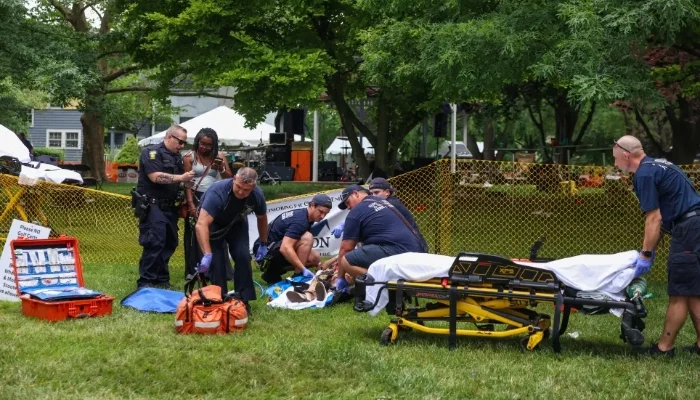
Emergency medical services (EMS) arrived within minutes to establish triage areas. First responders worked frantically to stabilize the wounded, while police officers secured the perimeter and began treating victims using tourniquets and trauma kits. The coordination between the Toledo Police Department, the Toledo Fire and Rescue Department, and local hospital networks was put to the test under highly stressful conditions. Multiple ambulances transported victims to nearby trauma facilities, including ProMedica Toledo Hospital and Mercy Health – St. Vincent Medical Center, while some victims were driven to emergency rooms in private vehicles by frantic family members and friends.
Victims, Demographics, and Medical Status
The toll of the Toledo festival shooting is immense, with at least 12 individuals sustaining gunshot wounds of varying severity. The medical status of these victims remains a primary concern for the community. During a late-night press briefing, Toledo Police Department officials confirmed that two of the victims are in critical condition, fighting for their lives in intensive care. The remaining ten victims suffered non-life-threatening injuries, ranging from graze wounds to complex orthopedic injuries requiring surgical intervention.
A Wide Range of Demographics Affected
The demographic makeup of the victims highlights the indiscriminate and devastating nature of public gun violence. According to police Lt. Dan Gerken, the age range of those wounded spans several generations, illustrating how a diverse cross-section of the public was affected. The oldest victim of the shooting is 61 years old, a reminder that senior citizens enjoying the community event were not spared from the danger. Conversely, the youngest victim is just 14 years old, a tragic statistic that underscores the vulnerability of youth in these situations. Police noted that the vast majority of the victims were in their early 20s, a demographic that heavily populated the festival’s music venues and food markets during the late afternoon hours.
In the table below, we summarize the key metrics of the incident as currently known to authorities and medical professionals:
| Metric | Details / Statistics |
|---|---|
| Date and Time of Incident | Saturday, June 6, 2026, at approximately 5:37 p.m. EST |
| Primary Location | Near the Old West End Festival, Toledo, Ohio |
| Total Wounded | At least 12 individuals confirmed |
| Critical Injuries | 2 victims in critical condition |
| Victim Age Range | 14 years old (youngest) to 61 years old (oldest) |
| Predominant Age Demographic | Individuals in their early 20s |
| Suspects Involved | At least 2 shooters (currently at large) |
| Responding Agencies | Toledo Police, Toledo Fire & Rescue, Area Trauma Centers |
Eyewitness Accounts of Heroism and Panic
In the aftermath of the shooting, numerous stories of survival, panic, and sheer heroism have emerged from the Old West End. One notable witness, Tito Aguilar, described the moments leading up to the gunfire. Aguilar was ordering food from a local food truck when he noticed a group of what appeared to be juveniles engaging in a physical altercation with another young person. Recognizing the potential for escalation, Aguilar pulled out his cellphone to record the confrontation. Seconds later, a succession of loud pops echoed through the street. His video footage, which was subsequently shared with major news outlets, captured the rapid succession of at least ten gunshots and the immediate, terrifying stampede of the crowd fleeing the area.
Another extraordinary account came from Kevin Berry, a neighborhood resident and U.S. Navy veteran with extensive medical training. Berry was sitting in the neighborhood arboretum listening to a live band when the gunshots rang out. “Everybody hit the deck,” Berry recalled. Once the immediate firing ceased, Berry stood up and noticed a handgun lying on the ground, apparently discarded by one of the individuals involved. Drawing on his military training, Berry did not flee; instead, he walked toward the sound of the chaos to search for victims who needed immediate medical attention. He ultimately located and assisted at least five wounded individuals, helping to apply pressure to wounds and calm panicking victims until paramedics could arrive on the scene. Such acts of bravery highlight the strength and resilience of the Toledo community, even in its darkest moments.
The Police Investigation and Security Measures
The Toledo Police Department is currently engaged in a highly active and complex investigation to identify, locate, and apprehend the individuals responsible for this act of violence. Because the shooting occurred in a crowded public festival, the crime scene is geographically expansive and contains a significant amount of physical and digital evidence. Detective units and forensic investigators worked through the night, cataloging shell casings, mapping ballistic trajectories, and processing the discarded firearm discovered near the scene.
Active Search for the Shooters
As of Saturday night, the shooters remain at large, and police are treating the search with the utmost urgency. Investigators are working under the hypothesis that the shooting stemmed from an escalating dispute between local groups or individuals, rather than a planned attack on the festival itself. However, the reckless disregard for human life demonstrated by firing weapons in a crowded community festival has made the apprehension of these suspects a top priority for state and local law enforcement. Police have urged residents in the Old West End and the broader Toledo metro area to remain vigilant and report any suspicious activity immediately.
While local law enforcement coordinates with regional task forces, the funding and structural support of such operations remain a topic of debate. Local law enforcement agencies often depend on federal community-policing grants to fund extra security patrols for cultural gatherings, similar to the broader conversation around grants halted by the administration and the constitutional challenges that followed. Without steady federal resource allocation, local municipalities face steep financial hurdles when trying to secure large-scale public events.
Mobile Security Infrastructure and Real-Time Crime Data
A central component of the investigation is the analysis of digital surveillance footage. Deputy Chief Heffernan revealed that the Toledo Police Department had deployed “mobile security cameras” throughout the Old West End neighborhood specifically for the festival. These cameras are linked directly to the department’s Real-Time Crime Center, allowing investigators to monitor crowd dynamics and quickly retrieve video recordings of the area where the altercation and subsequent shooting took place. This high-tech surveillance infrastructure is expected to provide critical visual evidence of the shooters’ identities and their escape routes.
In addition to city-owned cameras, authorities are heavily relying on the public for assistance. Lt. Dan Gerken emphasized that in the early stages of the investigation, statements from victims, witnesses, and privately recorded cellphone footage are invaluable. The police department has established a dedicated digital portal where citizens can upload photos and videos taken around the time of the shooting. As municipal authorities rely on complex surveillance data and digital sharing networks, we often see debates on public safety analytics parallel to how the US navigates global health information gaps on a national security level. Protecting the integrity of public data while leveraging digital tools remains a key challenge for modern investigators.
Community Impact and Political Response
The emotional impact of the shooting on the Old West End neighborhood and the city of Toledo is profound. For over half a century, the Old West End Festival has served as a symbol of community pride, cultural expression, and neighborly unity. To have this cherished event disrupted by senseless gun violence has left many residents feeling angry, vulnerable, and deeply saddened. Local community leaders have quickly organized vigils and support groups to help residents process the trauma of the incident.
Statements from Governor Mike DeWine and Local Leaders
The tragedy in Toledo quickly drew the attention of state officials. Ohio Governor Mike DeWine issued a strong statement expressing his deep concern and offering prayers for the victims and their families. “Summer festivals should be safe spaces for families to spend time together without fear of violence,” DeWine stated. The Governor promised that the state would provide any necessary resources, including assistance from the Ohio State Highway Patrol and the Ohio Bureau of Criminal Investigation, to support Toledo police in their search for the suspects.
According to official reports published by the Associated Press, Toledo Mayor Wade Kapszukiewicz also spoke passionately about the need to address youth gun violence and group disputes that spill over into public celebrations. Local activists and community organizers have echoed these sentiments, calling for comprehensive violence intervention programs, increased resources for youth outreach, and stricter measures to keep firearms out of the hands of juveniles.
The Future of Public Safety and Community Gatherings
As summer begins, Toledo officials are preparing for several additional public events, and Deputy Chief Heffernan indicated that the police department will be increasing its community safety patrols. The challenge facing city leaders is how to maintain a welcoming, open atmosphere at community celebrations while ensuring that attendees are safe from the threat of sudden violence. While violent crime represents a human-made hazard, communities across the country are dealing with a broad spectrum of critical public safety challenges, ranging from municipal violence to environmental threats such as the historic bear attack in Glacier National Park. Balancing freedom, accessibility, and robust security will remain a central debate for urban planners and law enforcement professionals alike.
The road to recovery for the Old West End neighborhood will be long. Yet, the rapid intervention of off-duty officers, the quick-thinking medical assistance provided by citizens like Kevin Berry, and the overwhelming outpouring of support from across the state of Ohio demonstrate that the community’s spirit remains unbroken. As the investigation continues, Toledo residents are united in their demand for justice and their determination to reclaim their historic streets from the shadow of violence.