Haaland Fuels Norway’s Historic 4-1 World Cup Win Over Iraq
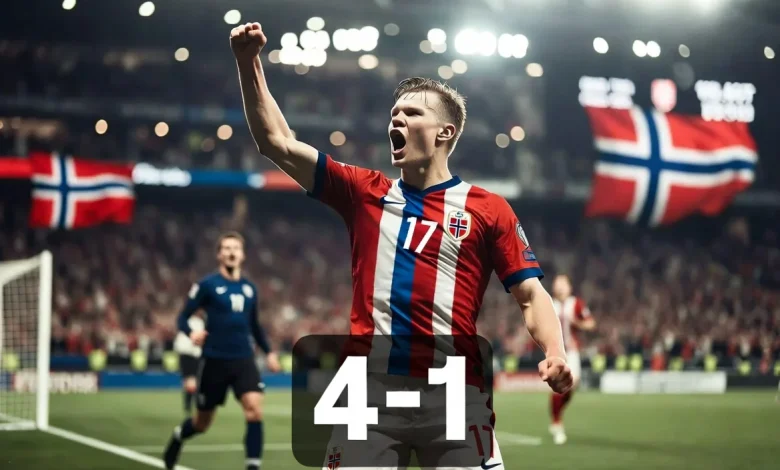
Haaland has officially announced his arrival on the world’s biggest international soccer stage. On Tuesday at the Boston Stadium in Foxborough, Massachusetts, the clinical Manchester City striker marked his highly anticipated World Cup debut with a stunning two-goal performance, propelling Norway to a commanding 4-1 victory over Iraq in their Group I opening clash. Scoring his 56th and 57th international goals, the 25-year-old superstar delivered a masterclass in predatory forward play, guiding the Scandinavian nation to its first World Cup match in 28 years—a milestone that has been nearly three decades in the making.
The historic win placed Norway at the top of Group I on goal difference, level with France, who secured a 3-1 victory over Senegal earlier in the day. For Norway, who had not graced a major international tournament since Euro 2000, the performance was an emphatic declaration of intent, signaling that they are ready to compete with the world’s elite.
Haaland Shines on the Grandest Stage: A Debut to Remember
Norway will go as far in this tournament as Erling Haaland takes it. In his tournament debut, he showed he’s more than up for that challenge. The pressure on the young forward was immense; despite winning every major club trophy with Manchester City, including multiple Premier League Golden Boots and Champions League titles, his lack of major tournament experience at the international level remained a talking point among critics. Haaland addressed those expectations in the post-match press conference with characteristic focus.
“Of course I will try,” Haaland said. “It’s about continuing and don’t think too much. It’s difficult at this stage. But I’ll focus on [the] next [game] and of course be happy. But also stay calm.” This level of psychological maturity is what separates elite athletes from their peers, allowing them to block out external noise and execute when the margins are razor-thin.
Norway coach Stale Solbakken echoed this sentiment, stating that he knew his star forward was primed for a special performance after observing him during the final training session before Tuesday’s match. “You could see that he lived up to the occasion,” Solbakken noted. “The occasion wasn’t too big for him.” His ability to maintain composure under the intense glare of the global spotlight was crucial in establishing the tempo for a Norwegian team that initially appeared nervous in the opening minutes of the match.
The Historical Context: Ending a 28-Year World Cup Exile
The significance of this victory cannot be overstated for Norwegian football. Norway’s last appearance in a World Cup tournament came in 1998 in France, where they famously defeated Brazil in the group stage before being eliminated by Italy in the round of 16. Stale Solbakken, the current head coach, was a midfielder in that legendary 1998 squad. Remarkably, Haaland was born on July 21, 2000—two years after his country’s last World Cup appearance. The long exile from major tournaments had been a source of deep frustration for a nation with a rich footballing history.
Norway’s Road Back to the Top Table of International Football
Rebuilding a national program is a long-term strategic process that requires immense planning and systemic stability. This structural focus mirrors other sectors where high-profile entities must navigate expectations and long-term targets, a dynamic that is frequently evaluated through intense analysis and strategic projections as institutions attempt to revitalize their foundations. The emergence of a “Golden Generation” featuring Haaland, Martin Odegaard, Antonio Nusa, Oscar Bobb, and Julian Ryerson is the culmination of years of grassroots development and tactical modernization designed to return Norway to the elite circle of world football.
Iraq’s Epic and Emotional Journey to North America 2026
While Norway celebrated its return, Iraq’s presence in the tournament was a testament to extraordinary resilience. Iraq was playing in the World Cup for just the second time in its history, having last qualified in 1986. No team endured a longer or more perilous road to the World Cup than Iraq, who secured their place as the 48th and final qualifiers in March after an exhausting 21-match campaign that stretched across 867 days.
The logistical hurdles did not end with qualification. Iraqi forward Aymen Hussein, the hero of their decisive play-off victory over Bolivia, was held and questioned for hours by United States immigration officials upon his arrival with the squad. Despite these challenges, Iraq brought a massive, passionate contingent of supporters to Foxborough, concentrated heavily behind one of the goals. Under the guidance of coach Graham Arnold, the Iraqi team played with immense pride and physical intensity, proving they belonged on the global stage despite the final scoreline.
Match Breakdown: How Norway Outmaneuvered Iraq in Boston
The tactical battle unfolded on the natural turf of Boston Stadium. Solbakken set his team up in a fluid 4-3-3 formation, with Martin Odegaard pulling the strings in a deep-lying playmaker role. Iraq, conversely, deployed a compact, low-block defense designed to frustrate Haaland and limit space in the final third.
The opening phase was characterized by tactical sparring, with Iraq creating the first real opportunity of the match in the 13th minute. Ali Al-Hamadi found space inside the penalty box but failed to keep his volley down, firing over Orjan Nyland’s crossbar. Norway gradually asserted control, leveraging their technical superiority to cycle the ball across the pitch and tire out the disciplined Iraqi defensive line.
| Match Statistic | Iraq | Norway |
|---|---|---|
| Goals Scored | 1 | 4 |
| Total Shots (On Target) | 7 (3) | 16 (8) |
| Possession Percentage | 41% | 59% |
| Passes Completed | 312 | 508 |
| Passing Accuracy | 74% | 86% |
| Corners Taken | 3 | 7 |
| Fouls Committed | 12 | 8 |
The Opening Salvo: Haaland’s Clinical 29th-Minute Strike
Norway’s patience was rewarded in the 29th minute with a beautifully constructed team goal. The sequence began deep in their own half with goalkeeper Orjan Nyland, initiating a 14-pass move that showcased Norway’s structural discipline. The ball was worked wide to left-back David Moller Wolfe, who delivered a perfect, low cross into the penalty area.
Haaland, demonstrating his world-class movement, peeled away from his marker, slid towards the back post, and used his right heel to deftly redirect the ball past Iraqi goalkeeper Jalal Hassan. The stunning finish ignited wild celebrations among the thousands of traveling Norwegian supporters, who dominated the stands clad in red and broke out into synchronized Viking row chants.
A Resilient Response: Aymen Hussein’s Equalizer Shakes the Stadium
Iraq did not let the setback dampen their spirits. Fueled by the energy of their supporters, they hit back just nine minutes later. In the 38th minute, midfielder Amir Al-Ammari corralled a loose ball on the left baseline, halfway between the corner flag and the goal.
Al-Ammari delivered a delicate, chipped cross to the far post. Aymen Hussein, demonstrating superb aerial ability, rose above the Norwegian central defenders and powered a clean header that bounced under the diving hand of Orjan Nyland. It was only the second World Cup goal in Iraq’s history, and the stadium erupted into a frenzy as the underdogs leveled the score.
The Turning Point: Haaland Capitalizes on a Defensive Calamity
The joy of the Iraqi equalizer was short-lived, as a critical defensive mistake just before halftime turned the tide of the match. In the 43rd minute, Iraqi defender Zaid Tahseen played a loose, under-hit backpass to goalkeeper Jalal Hassan. Hassan hesitated for a fraction of a second, which was all the time Haaland needed.
The Manchester City forward closed down the distance with explosive speed, preempting Hassan’s attempted clearance. Haaland blocked the ball, and it deflected off his shin and trickled into the back of the net to restore Norway’s lead. “It’s one of those things. It happened,” Iraq coach Graham Arnold said after the match. “It is what is and we have to learn from it.” The goal was a devastating psychological blow for Iraq, sending Norway into the locker room with a crucial 2-1 lead.
Second-Half Dominance: Ostigard and the Final Blows
The second half saw Norway consolidate their control, dictated by the midfield mastery of Martin Odegaard. Stale Solbakken made several tactical adjustments, including bringing on defender Leo Ostigard to shore up the backline and add aerial presence.
The substitution paid immediate dividends. In the 76th minute, just three-and-a-half minutes after entering the pitch, Ostigard found himself completely unmarked during a corner kick taken by Odegaard. The defender strode forward and powered a thumping header past Jalal Hassan to make it 3-1. Deep into stoppage time, another corner produced the final goal of the match, as a header pressured by Haaland was inadvertently deflected into the net by Iraq’s Aymen Hussein for an own goal, completing the 4-1 scoreline.
Tactical Analysis: Stale Solbakken’s Strategic Edge
Norway’s success was built on tactical flexibility. By utilizing Martin Odegaard in a deeper role, Solbakken ensured that Norway had a reliable metronome to dictate transition phases. This deep placement pulled the Iraqi midfield forward, creating pockets of space between the lines for young wingers like Antonio Nusa to exploit.
Furthermore, the integration of David Moller Wolfe as an attacking full-back allowed Norway to overlap effectively, bypassing Iraq’s compact central defensive block. While the defensive error in the first half showed some vulnerability, the second-half introduction of Ostigard demonstrated Solbakken’s tactical acumen, effectively neutralizing Iraq’s aerial threat.
The Global Significance of Haaland’s Performance
The global attention focused on Haaland’s World Cup debut reflects a highly competitive modern media landscape where high-profile sporting events serve as the ultimate content anchors. This intense public interest stands in contrast to the rapid shifts and attention dynamics in digital media platforms, where independent content creators are experiencing unprecedented audience volatility.
Furthermore, the massive commercial investments surrounding the 2026 World Cup showcase the financial stability of elite global sports, even during periods of broader global market fluctuations and institutional upgrades. As the tournament progresses, Haaland’s performance will remain a central narrative, driving engagement across both traditional networks and digital platforms. Fans can follow detailed coverage and live updates on the Official FIFA World Cup Platform as Norway prepares for its next crucial matchup against Senegal in New Jersey on June 22.