American Independence at 250: Incredible Journey of Unity and Polarization
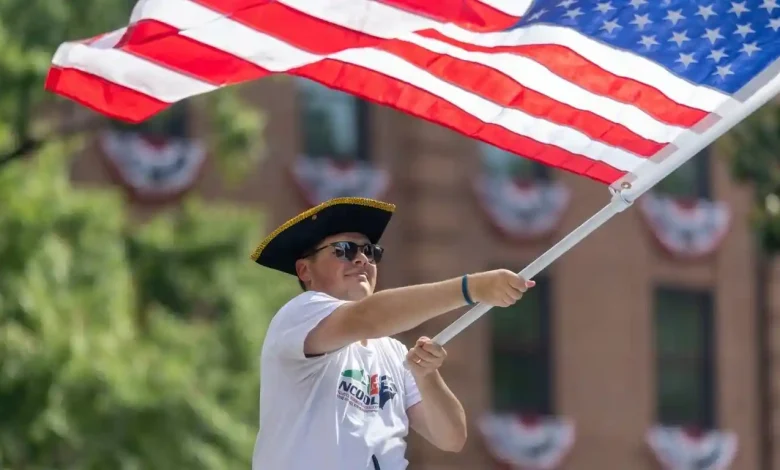
Table of Contents
American independence reached its historic 250th anniversary on Saturday, July 4, 2026, colliding with a country heavily gripped by intense political polarization, a punishing heat wave, and sudden, severe weather. For a nation marking two and a half centuries since the signing of the Declaration of Independence, the milestone served as both a grand spectacle of national pride and a complex mirror of its deepest modern struggles. The original declaration, drafted in Philadelphia in 1776, remains one of the most celebrated and ambitious articulations of democratic principles in human history. Yet, as millions of Americans gathered in cities large and small to mark this monumental semiquincentennial, the ideals of unity, equality, and self-governance were actively contested. Across the United States, celebrations took on diverse and often contradictory forms, reflecting a country suspended between its founding myths and its contemporary realities.
A Historic Semiquincentennial Under Shadow and Storm
The milestone of America at 250 has arrived at a unique inflection point. The civic ceremonies that traditionally bind the country together have increasingly become subjects of ideological division. As communities prepared parades, concerts, and historical reenactments, the mood was one of nervous anticipation rather than simple celebration. The underlying theme of the weekend was not merely historical commemoration but a search for national definition. While some viewed the day as a time to celebrate absolute exceptionalism, others used the occasion to point out the vast distance between the country’s ideals and its structural flaws.
This duality was further heightened by a series of severe meteorological challenges that swept across the continent. Instead of clear summer skies, millions of citizens were forced to contend with dangerous high temperatures and volatile storm fronts. The environmental pressures seemed to reflect the national mood: heavy, tense, and unpredictable. From the steps of the Lincoln Memorial to the granite faces of Mount Rushmore, the festivities highlighted the dualities of a superpower navigating unprecedented political tension and environmental instability.
Weathering the Storms: From Extreme Heat to Sudden Evacuations
Weather played a dramatic and disruptive role throughout the anniversary weekend, presenting immediate physical challenges to millions of revelers. Across multiple states, record-breaking temperatures tested the limits of municipal infrastructure and public endurance, while severe thunderstorms swept across the eastern seaboard on the afternoon of July 4th. These meteorological anomalies underscore the growing challenges of holding large-scale, outdoor national events during an era of increasingly volatile global weather patterns.
The National Mall Evacuation
On the National Mall in Washington, D.C., where the official ‘Salute to America 250’ event was scheduled to take place, the collision of climate and celebration was literal. Just hours before President Donald Trump was set to take the stage, a sudden and severe thunderstorm rolled over the nation’s capital. Dark, churning clouds blocked out the sun, and lightning strikes flashed dangerously in the distance. In response, park officials and law enforcement issued an emergency order to evacuate the National Mall, sending tens of thousands of damp and frustrated spectators running for shelter in nearby museums, government buildings, and metro stations.
The sudden evacuation left the massive stage empty, its patriotic red, white, and blue banners lashed by wind and rain. For nearly two hours, the future of the evening’s historic celebrations hung in the balance. Workers eventually rushed back onto the stage to sweep away standing water and dry off electrical equipment, allowing the event to proceed, albeit on a delayed and rushed schedule. When President Trump and First Lady Melania Trump finally arrived, they faced a wet, humid, but resilient crowd determined to witness the massive pyrotechnic display.
A Sweeping Nationwide Heat Wave
Beyond the flash-floods and lightning in Washington, a persistent and dangerous heat wave blanketed a vast portion of the country. From the mid-Atlantic down to the Gulf Coast and across southwestern desert states, temperatures repeatedly climbed into the high 90s and triple digits, with heat indices pushing past 110 degrees Fahrenheit. Local governments were forced to adapt quickly, setting up emergency cooling stations, distributing hundreds of thousands of free water bottles, and deploying medical personnel to treat heat-related illnesses among parade-goers.
Despite the punishing elements, many citizens refused to let the weather dampen their spirits. People dressed in star-spangled shirts and carrying miniature American flags packed public spaces, seeking shade under trees and awnings while waiting for the sun to go down. The determination to participate in the milestone reflected a deep-seated desire for connection and shared identity, even in the face of physical discomfort and extreme environmental strain.
Trump’s Vision of the Nation: Mount Rushmore and the Communism Warning
President Donald Trump took a central and highly visible role in the anniversary proceedings, starting his holiday weekend a day early with a high-profile visit to South Dakota on Friday, July 3, 2026. Set against the breathtaking, chiseled backdrop of Mount Rushmore, Trump delivered a speech that set a starkly ideological tone for the weekend. Standing beneath the towering granite faces of George Washington, Thomas Jefferson, Theodore Roosevelt, and Abraham Lincoln, the president addressed a crowd of thousands who had gathered to watch a revived fireworks display over the Black Hills.
Rather than delivering a traditional message of national unity, Trump chose to focus on what he characterized as a critical existential threat to the American republic: the rise of left-wing extremism and communism within the country’s borders. He warned that the heritage and values represented by the four presidents on the mountain were under active assault by ideological forces seeking to erase American history. This dark, combative rhetoric served as a prelude to his appearances in Washington, cementing a political narrative that cast the 250th anniversary not just as a historical milestone, but as a battleground for the survival of the nation’s core identity.
The choice of Mount Rushmore was highly symbolic. Trump has long used the monument as a visual shorthand for traditional American greatness and as a defense against modern movements to reevaluate historical figures. By centering his speech on cultural warfare and ideological threats, the president sought to energize his political base, using the weight of the national monument to validate his combative political philosophy.
Political Polarization on Display: A Nation Divided
This partisan framing of the semiquincentennial reflected the deeper, systemic polarization that has gripped the United States for over a decade. For many, the 250th anniversary was an opportunity to project strength, patriotism, and traditional values. For others, it was a moment for solemn reflection on the gap between America’s founding promises and its historic and ongoing failures. The division was not merely rhetorical; it manifested in the very structure and leadership of the weekend’s events, which often felt like parallel celebrations happening in two entirely different countries.
Contrasting Narratives of the American Experiment
While President Trump used his platform on the National Mall and Mount Rushmore to emphasize national power, law and order, and cultural defense, other leaders offered vastly different interpretations of the milestone. In New York City, where a symbolic ball drop in Times Square ushered in the holiday at midnight, Mayor Zohran Mamdani delivered an address that focused on America’s internal contradictions. Speaking from behind George Washington’s historic desk at City Hall, surrounded by a diverse group of newly naturalized citizens, Mamdani described the United States as an unfinished project.
He noted that the true genius of the American experiment lies not in its initial perfection, but in the continuous, multi-generational struggle to live up to the promise of universal equality. These competing visions of America—one centered on historical reverence and nationalistic defense, the other on progressive reform and civic struggle—defined the cultural discourse of the entire weekend, showing how deeply fragmented the concept of national identity has become.
A Breakdown of the America 250 National Celebrations
To understand how this landmark anniversary was marked across the country, it is helpful to look at the primary events, their intended themes, and the environmental factors that shaped them. The following table provides a comparative breakdown of key celebrations over the July 4th weekend.
| Location / Event | Key Celebrations & Activities | Core Political & Ideological Themes | Weather & Climate Disruptions |
|---|---|---|---|
| Washington, D.C. (National Mall) | Presidential speech, historically massive fireworks, military flyovers, and tributes to veterans and astronauts. | Executive strength, national power, and institutional pride; high alignment with the presidential administration. | Severe lightning storms causing a two-hour precautionary evacuation; high humidity and heat. |
| Mount Rushmore, South Dakota | Keynote address by President Trump on Friday, July 3, accompanied by a major fireworks display over the Black Hills. | Anti-communism, cultural preservation, and a combative defense of traditional American historical figures. | Clear skies but elevated wildfire risks, with high daytime temperatures. |
| New York City, New York | Times Square midnight ball drop to usher in July 4th, Mayor Mamdani’s address, and Brooklyn Bridge fireworks. | Pluralism, ongoing civic struggle, and casting America as an unfinished project working toward perfect equality. | Oppressive heat wave followed by lightning storms over major waterways. |
| Chicago & Midwest Region | Massive neighborhood parades, public concerts, and coordinated community-level pyrotechnics. | Localized civic pride, grassroots community unity, and historic Midwestern cultural resilience. | Dangerous multi-day heat advisory with temperatures consistently exceeding 100 degrees Fahrenheit. |
Refashioning the Holiday: Spectacle, Patriotism, and Power
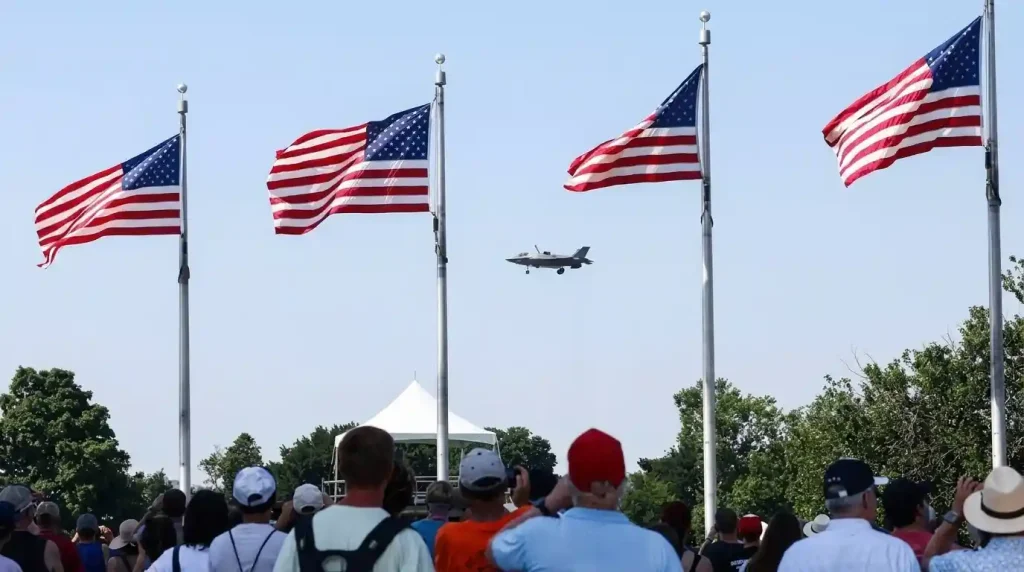
The way the 250th anniversary unfolded in Washington, D.C., highlighted the degree to which President Trump has sought to refashion national holidays into executive-driven spectacles. Throughout his political career, Trump has demonstrated an acute understanding of the power of visual media, and his ‘Salute to America 250’ was designed to be his most ambitious performance yet. By integrating high-tech military flyovers, bringing out decorated historical figures onto the stage, and executing a historically massive fireworks display, the administration created a powerful, centralized image of state authority.
Critics, however, argue that this approach politicizes events that should transcend partisan alignment, transforming a collective celebration of democratic ideals into a demonstration of personal and executive power. By bringing out figures like 107-year-old veterans and astronauts from the Artemis and Apollo space missions to stand alongside him, Trump effectively aligned the grandest achievements of American history with his own political brand. This blend of history, military might, and partisan rhetoric has redefine how the federal government marks national milestones, cementing a model where the line between state functions and political rallies is increasingly blurred.
Fulfilling the Promise: Looking Forward to the Next 250 Years
As the smoke from millions of fireworks clears and the nation recovers from a historic weekend of weather extremes, the true legacy of the 250th anniversary remains unwritten. The events of July 2026 demonstrated that the United States is still a country of immense resources, cultural power, and civic vitality. However, they also served as an urgent warning. The compounding challenges of deep political polarization and a rapidly changing climate cannot be ignored or papered over by grand fireworks shows or patriotic speeches.
If the United States is to endure and thrive for another 250 years, it will require more than just celebrating the words of the Declaration of Independence; it will require a renewed commitment to the arduous, cooperative work of democratic self-governance. Resolving the tensions between competing visions of American history is a task that lies in the hands of future generations. For more information on the history and ongoing events of the U.S. semiquincentennial, visit the official commission at America250.org.