Mount Rushmore Welcomes Trump for America’s 250th Anniversary
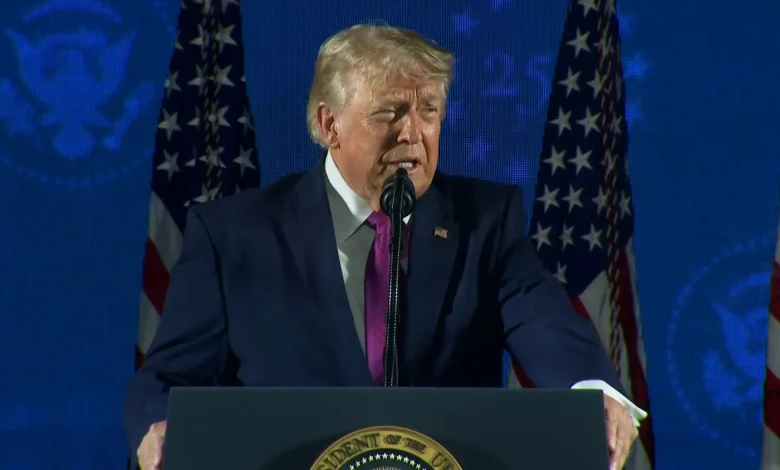
Table of Contents
Mount Rushmore was the dramatic stage where President Donald Trump kicked off the United States’ historic 250th Independence Day celebrations on the evening of Friday, July 3, 2026. Under the towering granite gazes of George Washington, Thomas Jefferson, Theodore Roosevelt, and Abraham Lincoln, the 47th President delivered a highly anticipated address to mark the nation’s Semiquincentennial. The massive event, dubbed “Freedom 250,” drew thousands of lottery-selected spectators to the Black Hills of South Dakota, though nature itself threatened to steal the spotlight when a severe hailstorm forced attendees to seek shelter in the monument’s cafeteria. Yet, as the skies cleared and the spotlight illuminated the colossal sixty-foot faces, the underlying theme of the evening was set: the immortalization of the American character, and the ongoing, deeply polarized debate over whether Donald Trump’s own face belongs among the stone giants of Mount Rushmore.
The Semiquincentennial Celebration under the Granite Faces
The atmosphere at Keystone, South Dakota, was electric yet tense as the nation poised itself to cross a historic milestone. Two and a half centuries of American independence culminated in a grand production organized by the Freedom 250 committee in partnership with the National Park Service and the state government. The ceremony began with performances by military bands, ceremonial flyovers, and tributes honoring the six branches of the United States Armed Forces. For South Dakotans, the event represented a triumphant return of the monument to the global stage, featuring a massive, $700,000 fireworks display that lit up the skies over the Black Hills for the first time in several years.
The logistics of the evening were complex, heavily dictated by extreme weather patterns sweeping across the Great Plains. Hours before Trump was scheduled to speak, severe thunderstorm and hail warnings triggered shelter-in-place orders, sending thousands of guests scrambling into the on-site dining halls and visitor centers. Despite the disruption, the program resumed under clear night skies, allowing Trump to take the stage just after 10:30 p.m. Eastern Time. Flanked by South Dakota Governor Larry Rhoden and Interior Secretary Doug Burgum, the President leveraged the towering monument as a metaphorical fortress, framing the event not just as a standard holiday tribute, but as a defense of the nation’s foundational heritage.
Inside the Dream: Trump’s Longstanding Mount Rushmore Ambitions
To understand the symbolic weight of Trump’s return to the Black Hills, one must look back to his first term in office. It was during a 2018 meeting in the Oval Office that then-U.S. Representative Kristi Noem first encountered Trump’s private ambition. As Noem recounted, she invited the President to visit South Dakota, pointing to the majesty of Mount Rushmore. Trump responded seriously, stating that it was his dream to have his face carved into the monument. What started as an offhand, private conversation quickly grew into a central fixture of Trump’s political mythology, eagerly championed by his most ardent supporters.
Over the years, the idea of adding a fifth face to Mount Rushmore became a frequent rallying cry. In early 2025, shortly after Trump was sworn in for his second term, Representative Anna Paulina Luna of Florida introduced a bill directing the Department of the Interior to study the process of carving Trump’s likeness onto the mountain. While critics dismissed the effort as performative politics, Trump’s allies have consistently kept the idea alive. In statements leading up to the 2026 visit, the White House openly supported the notion, with spokesperson Taylor Rogers declaring that there would be “no better addition to the iconic Mount Rushmore” than Donald Trump, highlighting his dual service as the 45th and 47th President.
The Role of Kristi Noem and the Iconic Bust
Governor Kristi Noem played a pivotal role in solidifying this narrative. During Trump’s previous high-profile visit to the monument on July 3, 2020, Noem presented him with a four-foot-tall, $1,100 custom replica of Mount Rushmore. This miniature bust—funded through private donations—depicted Trump’s face sculpted seamlessly alongside Washington, Jefferson, Lincoln, and Roosevelt. Financial disclosures later revealed that Trump deeply valued the gift, eventually placing it on prominent display in his private office at Mar-a-Lago. This physical token served as a tangible manifestation of an honor that, while geologically impossible, remains a powerful point of aspiration for his base.
Engineering and Geological Realities: Can a Fifth Face Be Carved?
Despite the persistent political enthusiasm, scientists, geologists, and park officials have repeatedly delivered a firm verdict: Mount Rushmore cannot be carved any further. According to the official National Park Service, the structural integrity of the Harney Peak granite that makes up the monument is too unstable to support additional sculpting. The original sculptor, Gutzon Borglum, and his son Lincoln Borglum, spent fourteen years (from 1927 to 1941) meticulously carving the four presidents, constantly adapting to natural fissures, micro-fractures, and structural faults in the stone.
Modern geological monitoring reveals that the rock faces are highly susceptible to water intrusion, freeze-thaw cycles, and shifting stress blocks. Engineers who monitor the monument’s stability warn that any attempt to use dynamite, heavy drills, or precise chiseling to carve a fifth face would risk destabilizing the existing sculptures. In particular, the rock surrounding Abraham Lincoln’s face is highly fractured; any physical disruption nearby could cause catastrophic block failure, permanently damaging the existing historic carvings. Thus, the physical reality of the mountain serves as an unyielding boundary that even the most powerful executive office cannot alter.
The Freedom 250 Keynote: Ideology, Sovereignty, and the ‘Communist Menace’
Denied a physical place in the stone, Trump used his Friday night address to carve out his legacy rhetorically. Speaking for over an hour beneath the illuminated faces of his predecessors, Trump delivered a speech that combined soaring patriotic exceptionalism with aggressive partisan warnings. He proclaimed the founding of the United States and its subsequent 250-year history as the “best and most incredible thing ever to happen on this planet by human hands, ever.”
However, the core of Trump’s address was a fierce rebuke of what he termed a “resurgence of the communist menace in our land.” Drawing historical parallels, the President argued that modern leftist ideologies pose a threat to the republic equivalent to the challenges faced during the World Wars and the aftermath of the September 11 terrorist attacks. With the pivotal 2026 midterm elections fast approaching, Trump utilized the Mount Rushmore stage to frame the upcoming political contest as an existential battle for America’s survival, warning that the nation “will never be a communist country” and urging his followers to protect their “glorious heritage, history, and accomplishments.”
Environmental Safety and the Return of Fireworks
Beyond the political rhetoric, the logistics of hosting a massive fireworks display at Mount Rushmore required intense negotiation. For over a decade, pyrotechnics were banned at the site due to severe wildfire risks exacerbated by a massive pine beetle infestation that left millions of dry, dead trees across the Black Hills. Trump’s push to bring fireworks back in 2020 was met with environmental lawsuits and warnings from federal scientists. The 2026 Semiquincentennial display, valued at $700,000, was only allowed to proceed after the National Park Service conducted exhaustive environmental and safety assessments, establishing strict protocols to abort the launch if drought-fueled fire dangers crossed a critical threshold.
Monumental Legacy: Trump’s Alternative Commemorations
While the granite of South Dakota remains closed to new additions, Trump has spent his second term aggressively seeking other ways to cement his physical and institutional legacy. Lacking a mountain carving, his administration has actively renamed and branded federal property, infrastructure, and financial programs. These efforts have allowed him to establish a level of name recognition unmatched by any modern predecessor.
Among the most prominent examples of this alternative branding strategy are:
- Federal Real Estate: The naming of a major federal building in Washington, D.C., after Donald Trump, placing his name directly in the heart of the nation’s capital.
- Naval Vessels: Early-stage designations for future naval battleships bearing the Trump name, reinforcing his role as Commander-in-Chief.
- Aviation Gateways: The renaming of a major international airport in Palm Beach, Florida, near his primary residence of Mar-a-Lago.
- Federal Programs: The introduction of a new government savings account program bearing his branding, alongside “TrumpRx,” a highly publicized federal discount platform for prescription drugs.
These actions demonstrate a deliberate shift in how presidential legacies are constructed in the 21st century—moving away from traditional post-presidency monuments and toward active, functional branding during a leader’s lifetime.
A Nation Divided: Political Polarization on the 250th Fourth of July
The Semiquincentennial arrived at a time of deep polarization across the country. Trump’s speech at Mount Rushmore was a stark contrast to other celebrations occurring nationwide. In Washington, D.C., preparations were underway for a campaign-style political rally on the National Mall, complete with military flyovers and the largest fireworks show ever staged in the capital. Meanwhile, in New York City, Mayor Zohran Mamdani delivered a very different address on America’s history, casting the country as a “nation of contradictions” that must work constantly toward perfecting its original ideals of equality and justice.
This ideological split reflects a country grappling with economic and geopolitical anxieties. High gas prices, driven by the ongoing U.S.-backed Israeli conflict with Iran, coupled with skyrocketing inflation, have left public approval ratings for the administration near historic lows. For Trump’s critics, his self-centric approach to the 250th anniversary celebrations—using iconic federal landmarks to host partisan rallies—is an overreach of executive authority. For his supporters, however, his bold presence at Mount Rushmore is a necessary defense of traditional American pride against revisionist historical narratives.
A Comparative View: How US Presidents Have Left Their Mark
The four presidents carved on Mount Rushmore were selected by Gutzon Borglum to represent the four phases of American growth: Washington (Birth), Jefferson (Expansion), Roosevelt (Development), and Lincoln (Preservation). The table below outlines how these historical giants compare to Donald Trump in terms of their physical monuments, alternative namings, and legacy strategies.
| President | Mount Rushmore Representation | Key Physical & Modern Commemorations | Legacy Strategy & Focus |
|---|---|---|---|
| George Washington | Carved (Birth of the Nation) | Washington Monument, U.S. Capital City, State of Washington | Civic virtue, national founding, military leadership |
| Thomas Jefferson | Carved (Expansion of the Territory) | Jefferson Memorial, Monticello, University of Virginia, $2 Bill | Intellectual freedom, democratic expansion, Louisiana Purchase |
| Theodore Roosevelt | Carved (Development & Conservation) | Roosevelt Island, Theodore Roosevelt Presidential Museum, National Parks | Conservationism, progressive reform, global naval power |
| Abraham Lincoln | Carved (Preservation of the Union) | Lincoln Memorial, Lincoln’s Birthplace, Gettysburg National Military Park, U.S. Penny | Union preservation, emancipation, constitutional democracy |
| Donald Trump | None (Geologically Impossible) | Trump Washington Federal Building, Palm Beach Airport, TrumpRx, Gold Coins, Passports | Populism, national sovereignty, institutional branding, executive deregulation |
The Global Stage and International Geopolitics
The geopolitical reality of 2026 also hung heavily over the Mount Rushmore event. As Trump spoke of American exceptionalism, international observers noted the strategic timing of the speech. With global alliances strained by conflicts in the Middle East and eastern Europe, the demonstration of military flyovers and heavy nationalist rhetoric at a national monument was aimed as much at foreign adversaries as it was at domestic voters. By aligning himself with the great expansionist and preservationist leaders of America’s past, Trump sought to project an image of unyielding national strength on the world stage.
Looking Ahead: The Legacy of Freedom 250 and Beyond
As the fireworks faded over the Black Hills and the 4,800 lottery winners made their way home through the cleared South Dakota night, the symbolic battle over Mount Rushmore remained unresolved. Donald Trump’s dream of joining the granite four remains a physical impossibility due to the fragile state of the Harney Peak granite, yet his rhetorical and branding footprint on the nation’s 250th anniversary is undeniable. Whether history will view his efforts to align himself with Washington, Jefferson, Lincoln, and Roosevelt as a fitting tribute or an act of unprecedented self-aggrandizement is a question that will continue to divide the nation long after the Semiquincentennial fireworks have turned to ash.