Venezuela earthquake: 1,450 dead in La Guaira rescue race
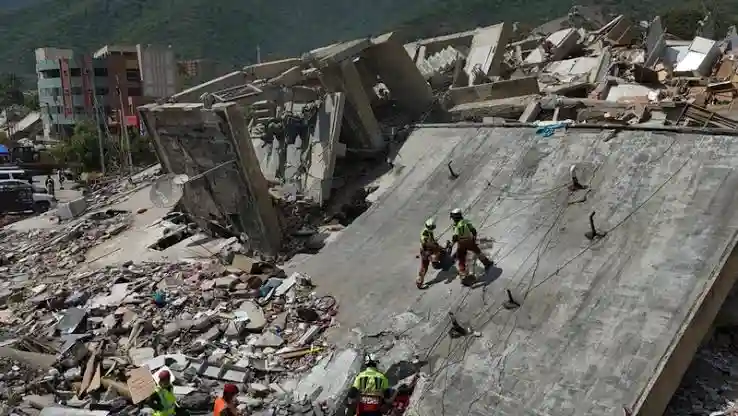
Table of Contents
Venezuela earthquake devastation has gripped the northern state of La Guaira, where local and international rescue teams are currently racing against the clock to pull survivors from the rubble. Four days after two powerful earthquakes shook the coastal region, the country is facing one of the most severe humanitarian crises in its modern history. The government reported 1,450 dead from the quakes Sunday afternoon as it faced growing criticism from Venezuelans that its response was inadequate and was overshadowed by civilian-led efforts to rescue people buried under collapsed buildings. Thousands have been reported missing, according to multiple databases being used by families searching for loved ones.
The tragedy, which began on June 24, 2026, has left a trail of destruction that stretches from the mountainous region of Yaracuy to the highly populated coastal strips of La Guaira and the capital city of Caracas. Classified by seismologists as a ‘severe seismic doublet sequence,’ the twin disasters struck just 39 seconds apart, unleashing energy equivalent to decades of tectonic tension. While the country struggles with severe blockages in communication and infrastructure, the resilience of local citizens has become the primary line of defense against absolute catastrophe.
Venezuela :The Doublet Strike: Seismology of the Dual Rupture
Seismologists around the world have pointed out that the structural mechanics of the June 24 disaster represent an exceptionally rare and violent tectonic phenomenon. The first event, registering as a magnitude 7.2 foreshock, occurred deep beneath the surface near the city of San Felipe, Yaracuy. Just 39 seconds later, as residents were scrambling to find safety, a second and more devastating magnitude 7.5 mainshock tore through the shallow crust, centered only 10 kilometers below the surface. According to data provided by the United States Geological Survey (USGS), the shallow depth of the second rupture magnified the intensity of the ground motion, rendering traditional construction methods completely useless against the violent lateral shifts.
Breaking Down the Boconó and San Sebastián Fault Systems
This rapid succession of tremors occurred at the boundary zone between the South American and Caribbean tectonic plates. The initial rupture on the Boconó Fault—a prominent northeast-southwest trending strike-slip fault system—instantly transferred stress to the east-west trending San Sebastián Fault system. The San Sebastián Fault, which runs parallel to the northern coast of Venezuela, took the brunt of this energy transfer, propagating a violent rupture line directly adjacent to the urban concentrations of La Guaira and Caracas. Seismologists note that while the northern margin of the Caribbean plate (affecting places like Haiti) has been extensively studied, the southern edge running through Venezuela has often been underestimated in international danger models, resulting in a critical lack of preparation and early-warning warning infrastructure.
Venezuela :Catastrophe in La Guaira: The Epicenter of Human Loss
La Guaira, the state immediately north of Caracas, has suffered the absolute worst of the damage. Entire hillsides have collapsed, and low-income neighborhoods built precariously along the steep slopes of the coastal cordillera have been swept away. Multistory apartment blocks in towns like Catia La Mar and Caraballeda have pancaked, trapping families inside. The government’s official death toll of 1,450 is widely expected to be a conservative estimate, with independent humanitarian organizations warning that the true toll could climb significantly higher once the rubble is cleared.
Critical Infrastructure and Hospital Collapse
The state’s healthcare network has been completely overwhelmed. Several primary clinics and regional hospitals collapsed outright during the doublet shocks, forcing medical personnel to treat patients in open-air plazas, on sidewalks, or in makeshift field hospitals. The collapse of the local electrical grid and the destruction of main aqueducts have left tens of thousands of injured survivors without access to clean water, anesthesia, or basic surgical supplies. In these dire circumstances, tracking the scale of the emergency has become nearly impossible. This highlights the complex reality of how global medical observers and the US navigates global health information gaps, particularly when operating within nations with severely degraded public health registries and disrupted communications.
Civilian-Led Heroism Amidst Government Inaction
In the wake of the disaster, a stark contrast has emerged between the official state response and the self-organized rescue networks of everyday citizens. For the first 72 hours, as governmental agencies struggled with bureaucratic inertia and a lack of heavy machinery, local community councils, motorcycle clubs, and student organizations took it upon themselves to dig through the concrete slabs with their bare hands, hammers, and car jacks. Neighbors have formed human chains to pass buckets of debris, pulling dozens of survivors from the ruins of collapsed apartment complexes while state security forces initially prioritized guarding official buildings and maintaining public order.
Grassroots Brigades Stepping Into the Void
The rise of these civilian brigades has fueled widespread public anger against the administration. Citizens complain that while state television broadcasts carefully curated footage of official operations, the actual search-and-rescue frontlines are dominated by volunteers who lack basic protective gear, thermal imaging cameras, or acoustic listening devices. In the absence of a centralized government missing-persons registry, tech-savvy youths have developed open-access online databases. Families are uploading photographs and last-known locations of their loved ones to coordinate private search efforts, bypassing official channels entirely. This bottom-up mobilization has kept hope alive for thousands of families waiting for news of the missing.
Historical Parallels: Shadows of 1812 and the 1999 Vargas Tragedy
For many residents of La Guaira, the current disaster carries haunting echoes of the past. The coastal strip of Vargas (now La Guaira state) was the epicenter of the catastrophic 1999 Vargas tragedy, where massive landslides triggered by torrential rains killed an estimated 30,000 people. Historically, Venezuela’s northern coast has been prone to devastating seismic events. In March 1812, a powerful earthquake doublet decimated Caracas and La Guaira, killing over 20,000 people and altering the course of Venezuela’s war for independence. Another severe shock occurred in 1900, followed by the landmark 1967 Caracas earthquake which exposed major structural flaws in modern high-rise architecture. Each historical milestone has demonstrated a recurring vulnerability: the combination of natural hazards with inadequate structural planning and political neglect.
Engineering Failures: High-Rises, Soft Soils, and Unheeded Warnings
Structural engineers had repeatedly warned that many of the high-rise residential buildings constructed along the northern coast over the last three decades were ticking time bombs. Much of La Guaira’s urban sprawl is built on soft, alluvial soil—sediment deposited by mountain streams over thousands of years. During a major seismic event, these soft soils undergo a process known as liquefaction, temporarily losing their strength and behaving like a liquid. Buildings not anchored deeply into solid bedrock are prone to tilting, sinking, or complete structural failure. Despite these well-known engineering principles, a lack of regulatory oversight and the bypass of construction codes allowed developers to erect highly dense residential towers without adequate seismic damping or foundation reinforcement.
Economic Fallout and the Impending Humanitarian Crisis
The economic impact of the doublet earthquake is estimated to be between US$4.7 billion and US$8.7 billion—a catastrophic blow to an economy that has spent years struggling under hyperinflation and political instability. The destruction of the Port of La Guaira, the country’s main maritime gateway for food and medicine imports, threatens to spark severe shortages across the entire central region. On a global scale, the financial fallout of such massive disasters during periods of high economic uncertainty emphasizes that systemic structural risks in 2026 remain highly interconnected with fragile supply chains, localized logistical bottlenecks, and national debt burdens.
International Response and Geopolitical Dynamics of Relief
Despite diplomatic friction, several nations have pledged immediate humanitarian assistance. The United States, Spain, France, and neighboring Latin American countries have deployed specialized search-and-rescue personnel, canine units, and field hospitals. However, getting these resources onto the ground has been complicated by geopolitical posturing and bureaucratic hurdles at ports of entry. As international emergency funds face procedural delays, observers point out how easily global aid can become politicized, recalling instances where domestic grants halted by the Trump administration sparked intense legal and constitutional battles within the United States. In the face of a massive crisis like the one in La Guaira, international observers are urging all parties to put aside political maneuvering to ensure that life-saving resources reach those trapped under the concrete without delay.
The Road to Recovery: Rebuilding a Nation in Ruins
As the initial search-and-rescue phase transitions into a long-term recovery effort, the people of Venezuela face an incredibly difficult path forward. Rebuilding La Guaira will require more than just pouring concrete; it will demand a fundamental overhaul of urban planning, geological hazard mapping, and building code enforcement. It will also require rebuilding the trust between the civilian population and the state institutions tasked with their protection. For now, the focus remains squarely on the piles of rubble where, against all physical odds, search teams and desperate families still hope to hear the faint sounds of survivors waiting to be saved.
Overview of the 2026 Venezuela Doublet Earthquakes
The following table provides a comprehensive overview of the technical parameters and current damage estimates associated with the devastating seismic events of late June 2026.
| Key Parameter | Foreshock (Earthquake 1) | Mainshock (Earthquake 2) |
|---|---|---|
| Date & Local Time (VET) | June 24, 2026, 18:04:33 | June 24, 2026, 18:05:11 |
| Moment Magnitude (Mw) | 7.2 | 7.5 (Up to 7.8 by regional sensors) |
| Focal Depth | 21.9 kilometers (14 miles) | 10.0 kilometers (6 miles) |
| Epicenter Location | Near Morón / San Felipe | San Felipe, Yaracuy (Impact focused along coast) |
| Tectonic Fault Zone | Boconó Fault System | San Sebastián Fault System (Strike-slip rupture) |
| Estimated Casualties | 1,450 confirmed dead (as of June 28); thousands missing | |
| Infrastructure Status | Critical damage to ports, collapse of regional hospitals, widespread blackouts | |
| Economic Damage Est. | US$4.7 billion to US$8.7 billion | |