Iran peace talks: Vance, Kushner & Witkoff Open Swiss Summit 2026
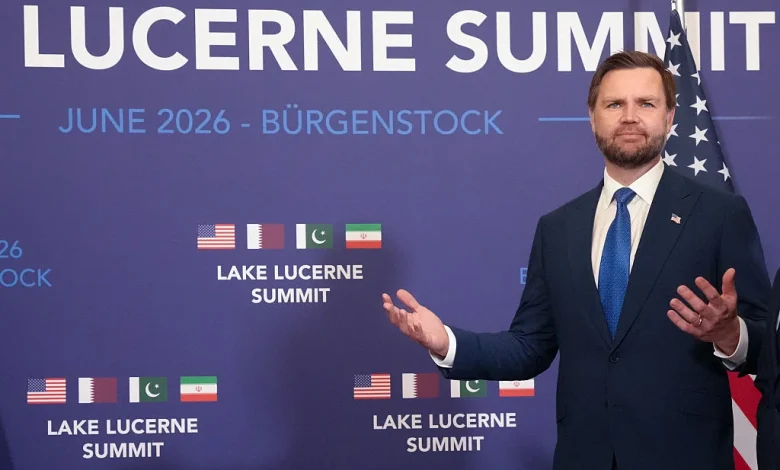
Iran peace talks commenced with extreme geopolitical tension in the Swiss resort of Bürgenstock, as a high-powered United States delegation sought to hammer out the technical details of a highly fragile 14-point memorandum of understanding (MoU). Led by Vice President JD Vance, who was joined at the negotiating table by President Donald Trump’s special envoy Steve Witkoff and son-in-law Jared Kushner, the American team met with a senior Iranian delegation in an attempt to pull the Middle East back from the brink of total war. The stakes could not be higher: even as diplomats exchanged handshakes in the serene alpine setting of Lake Lucerne, the specter of direct military confrontation loomed overhead, compounded by threats of renewed strikes from President Donald Trump on Truth Social and a sudden maritime crisis in the Persian Gulf.
The high-stakes negotiations are being actively facilitated by critical mediators, including Pakistani Prime Minister Shehbaz Sharif and Army Chief General Asim Munir, alongside key diplomats from Qatar. This dual-track mediation effort highlights the global urgency of stabilizing relations between Washington and Tehran. However, the temporary diplomatic breakthrough remains severely tested by ongoing, fierce clashes between Israel and the Iran-backed militant group Hezbollah in southern Lebanon—a conflict that Tehran has signaled must be central to any sustainable long-term agreement. Adding fuel to the geopolitical fire, Iran announced on Saturday that it had once again shuttered the Strait of Hormuz, alleging repeated Israeli violations of the regional ceasefire, a claim of maritime authority that the U.S. military has flatly rejected.
Decoding the 14-Point Memorandum of Understanding
At the center of the diplomatic flurry in Bürgenstock is a 14-point Memorandum of Understanding (MoU) initially finalized on June 17, 2026, by President Donald Trump and Iranian President Masoud Pezeshkian. While the official and complete text of the document has yet to be publicly released in its entirety, senior U.S. and international officials have shared several core pillars that form the foundation of this temporary truce. According to reports from the Council on Foreign Relations (CFR), the MoU serves as a framework to transition the region away from active hostility and toward a prolonged 60-day window of direct bilateral negotiations.
The first three points of the MoU dictate an immediate and permanent termination of military operations on all fronts, a mutual commitment to respect the sovereign boundaries of both the United States and the Islamic Republic of Iran, and a formal agreement that the execution of the document initiates a 60-day countdown to negotiate a “final deal”. The MoU also outlines an implementation mechanism designed to track and resolve ceasefire violations before they cascade into full-scale war. In exchange for compliance, the United States originally signaled a willingness to lift portions of its naval blockade on Iranian ports, while Iran agreed to keep the Strait of Hormuz open to international commercial traffic without levying unilateral transit fees. However, as the Swiss talks got underway, the viability of these 14 points was instantly thrown into question by actions on the ground.
The Strait of Hormuz Standoff and Maritime Escalation
The most immediate threat to the Bürgenstock peace summit is the sudden blockade of the Strait of Hormuz, a critical maritime choke point through which approximately 20 percent of the world’s petroleum supply transits daily. On Saturday, Tehran announced that its naval forces had once again closed the strait, pointing to what it characterized as egregious ceasefire violations by Israeli forces in southern Lebanon. The move instantly reignited fears of a major global energy shock, bringing back memories of earlier standoffs where the Hormuz oil surge hits 110 as 2000 ships strand in Gulf.
In response to Iran’s blockade declaration, the U.S. military—coordinated via its Central Command (CENTCOM)—quickly moved to deny Tehran’s claims of control over the international waterway. U.S. defense officials reiterated that the United States Navy and its allied partners would continue to assert freedom of navigation in the strait, refusing to allow commercial shipping lanes to be held hostage by unilateral Iranian actions. This maritime friction plays directly into the broader regional dynamics, as the Trump administration has previously indicated that it would not tolerate prolonged disruptions to global oil markets, demonstrating a willingness to employ a long-term blockade strategy as Trump extends Hormuz standoff indefinitely if Tehran refuses to abide by international maritime laws.
The Lebanon Equation: Hezbollah’s Role in the Swiss Talks
While the technical negotiations in Switzerland are ostensibly focused on the bilateral relationship between Washington and Tehran, the ongoing conflict in Lebanon has emerged as an unavoidable, central theme. Iranian negotiators, led by Parliament Speaker Mohammad Bagher Ghalibaf and Foreign Minister Abbas Araghchi, have made it clear that any enduring peace deal is contingent upon a complete cessation of Israeli military operations against Hezbollah. The militant group, which functions as Tehran’s primary proxy force along Israel’s northern border, has been locked in intense, devastating combat with the Israel Defense Forces (IDF).
For Iran, Hezbollah is not merely a regional ally but a vital component of its forward defense strategy. Consequently, when Israeli strikes targeted southern Lebanon late last week, Tehran interpreted the action as a direct violation of the spirit of the newly signed MoU. Iranian diplomats argued that they could not implement their side of the bargain—including keeping the Strait of Hormuz open—while their most critical proxy was under active bombardment. The U.S. delegation, however, maintains that the MoU’s primary focus is to decouple Iran from its regional proxies, demanding that Tehran halt its financial and military sponsorship of militant networks across the Levant as a prerequisite for sanctions relief.
The Trump Factor: Diplomacy Under Threat of “Hard” Strikes
The delicate atmosphere in Bürgenstock is further complicated by the volatile communication style of President Donald Trump. Shortly after Vice President JD Vance expressed optimism to reporters on Sunday, stating that “great” progress had been made toward a future “where everyone can work together to promote peace and prosperity,” the President took to Truth Social to issue a stark warning to Tehran. Trump posted: “we’ll hit Iran very hard again, just like we did last week, only harder!!!” unless the country stops “their highly paid PROXIES in Lebanon.”
This public threat serves a dual purpose. On one hand, it acts as a “maximum pressure” negotiating lever, signaling to the Iranian delegation that the United States is fully prepared to abandon the diplomatic track and resort to devastating military strikes if the technical talks stall. This is not an empty threat; the administration has consistently kept its military options highly visible, particularly after the historical precedent where CENTCOM briefs Trump on unprecedented Iran strike options. On the other hand, Trump’s online outbursts create a challenging environment for Vance, Kushner, and Witkoff, who must convince their Iranian counterparts that the U.S. is negotiating in good faith even as the commander-in-chief openly threatens renewed warfare.
Key Players and Their Diplomatic Roles
The composition of the American delegation in Switzerland reflects a unique blend of formal statecraft and unconventional, high-level backchannel diplomacy. By putting Vice President JD Vance at the head of the delegation, the Trump administration has sent a clear signal of the summit’s high priority. Vance, known for his alignment with Trump’s “America First” foreign policy, has sought to balance tough rhetoric with pragmatic economic arguments, framing the negotiations as a pathway toward regional stabilization that would benefit global markets.
Working alongside Vance are Steve Witkoff and Jared Kushner, two figures who bring extensive deal-making experience and close personal ties to the President. Witkoff, serving as the administration’s special envoy, has focused heavily on the logistical and security mechanisms of the MoU, while Kushner has leveraged his deep network of Middle Eastern contacts—developed during his work on the Abraham Accords—to facilitate communications between the primary actors and the regional mediators. On the Iranian side, Foreign Minister Abbas Araghchi and Parliament Speaker Mohammad Bagher Ghalibaf represent a complex political spectrum within Tehran, navigating intense pressure from hardliners within the Islamic Revolutionary Guard Corps (IRGC) who remain deeply skeptical of any agreement with Washington. This internal division was highly apparent during previous rounds, as highlighted when the Iran president Pezeshkian, FM Araghchi, and the IRGC see nuclear talks fracture due to domestic political infighting.
Global Economic Impact: Shipping and Oil Vulnerability
The geopolitical standoff in the Middle East has sent immediate shockwaves through global financial markets, with commodity traders closely monitoring every statement coming out of Switzerland. The closure of the Strait of Hormuz, even if temporary or contested, instantly premium-loads global oil prices due to the risk of supply disruptions. Shipping firms have already begun rerouting vessels around the Cape of Good Hope, a costly alternative that adds weeks to transit times and dramatically increases global shipping rates.
To illustrate the direct impact of the ongoing conflict and the subsequent negotiations on global energy and maritime metrics, the following table summarizes key economic indicators before and after the signing of the June 17 MoU:
| Economic Metric | Pre-MoU Period (Peak War) | Post-MoU Signing (Initial Ceasefire) | Hormuz Closure (Current Swiss Talks) |
|---|---|---|---|
| Brent Crude Oil Price (per barrel) | $110 – $115 | $85 – $90 | $102 – $106 |
| Daily Tanker Transit (Strait of Hormuz) | Blocked / Near Zero | 18 – 22 Tankers | Disrupted / Contested |
| Global Shipping Insurance Premium | Extremely High (War Risk) | Moderate / Standard | High Risk (Re-evaluated) |
| Average Days Delayed (Asia to Europe) | 12 – 15 Days (Rerouted) | Minimal / On-schedule | 8 – 10 Days (Precautionary) |
This economic volatility underscores why mediators like Pakistan and Qatar are working tirelessly to bridge the gap between Washington and Tehran. A prolonged conflict not only threatens regional security but also risks tipping major European and Asian economies into deep recessions driven by high energy costs and supply chain bottlenecks.
The Strategic Impasse: Will the 60-Day Negotiation Window Hold?
As the first round of technical talks concludes in Switzerland, the primary question facing international observers is whether the 60-day negotiation window established by the MoU can survive the immediate security crises in Lebanon and the Persian Gulf. While JD Vance’s optimistic remarks suggest that a technical framework for tracking violations and managing shipping lanes is within reach, the fundamental distrust between the two nations remains a massive hurdle. Tehran’s insistence on linking maritime freedom in the Strait of Hormuz to Israeli military actions in Lebanon directly clashes with Washington’s demand for an immediate cessation of Iranian support for regional proxy forces.
Furthermore, the pressure from domestic hardliners in both countries could easily derail the peace process. In Washington, bipartisan critics argue that the Trump administration is offering too many concessions to a regime that continues to sponsor regional instability. In Tehran, senior military commanders view the talks as a sign of weakness, urging the leadership to maintain its blockade of the Strait of Hormuz to force further diplomatic concessions. Ultimately, the success of the Bürgenstock summit will depend on whether Vance, Witkoff, and Kushner can negotiate a robust, verifiable monitoring mechanism that pacifies the immediate military flashpoints while keeping the long-term diplomatic track alive under the constant threat of renewed conflict.