Herat Protests Ignite Widespread Outrage: 3 Taliban Decrees Spark Backlash
Herat, one of Afghanistan’s largest and most culturally rich western cities, has recently erupted in a rare and powerful burst of public opposition against the Taliban’s severe and escalating restrictions on women. This public outcry reached a boiling point in early June 2026, leading to a massive security crackdown by the local authorities. The protests, which began as a spontaneous reaction to the arrest of several dozen women by the Taliban’s morality police, rapidly transformed into a broader symbol of civil resistance against what many international observers describe as a system of gender apartheid. Following days of mounting tension and violent clashes, Taliban forces deployed wide-ranging security measures on Friday to lock down the city and suppress any further public demonstrations.
Table of Contents
- Herat Becomes Center of Resistance Against Taliban Policies
- Escalation of Violence: Casualties and Gunfire in Jebrail
- Taliban Response: Official Denials and Tightened Security
- The Context of Gender Apartheid under Taliban Rule
- Summary of the Herat Protests and Response
- The Global Outcry and Implications for the Future
Herat Becomes Center of Resistance Against Taliban Policies
For centuries, the western city of Herat has been celebrated as a major center of Persian culture, intellectualism, and artistic expression. Historically, its population has demonstrated a strong commitment to education, literature, and social progress, with women playing active roles in academic and professional spheres. However, since the Taliban swept back into power in August 2021, the city’s progressive heritage has been systematically targeted by the regime’s regressive policies. Over the past five years, the Taliban have issued dozens of edicts stripping women and girls of their fundamental rights, including the right to work, travel without a male guardian (mahram), and attend high schools and universities.
Despite the pervasive atmosphere of fear and the heavy-handed tactics of the Taliban’s security forces, the people of Herat have occasionally found ways to express their discontent. The events of June 2026, however, represent a significant escalation in public defiance. Rather than a localized, quiet complaint, the demonstrations in Herat evolved into a visible, loud, and coordinated march through the city’s streets. The willingness of ordinary citizens to confront armed security forces reflects a growing desperation among a population that has endured five years of economic collapse and severe social repression.
The Trigger: Morality Police Arrests of Afghan Women
The immediate spark for this latest wave of public opposition was an aggressive campaign launched by the Taliban’s Ministry for the Propagation of Virtue and the Prevention of Vice, commonly known as the morality police. In late May and early June 2026, the morality police initiated a series of street-level sweeps in Herat, arresting and detaining approximately 30 women and girls. The authorities justified these detentions by claiming the women were violating the regime’s strict dress code, which mandates the wearing of an all-covering hijab or burqa that hides the face and hair.
According to local residents, the morality police did not merely issue warnings; they forcibly pulled women and girls into vehicles directly from public streets, often in front of their children and families. This aggressive enforcement of dress codes crossed a red line for many families in Herat. In Afghan society, the public harassment and forced detention of women by unrelated men is viewed as a deep insult to family honor and personal dignity. The detentions quickly did what years of written edicts had failed to do: they galvanized a diverse cross-section of the community, uniting people in their outrage and pushing them to take a stand in the public square.
A Community Stands United: Men and Women Defy the Regime
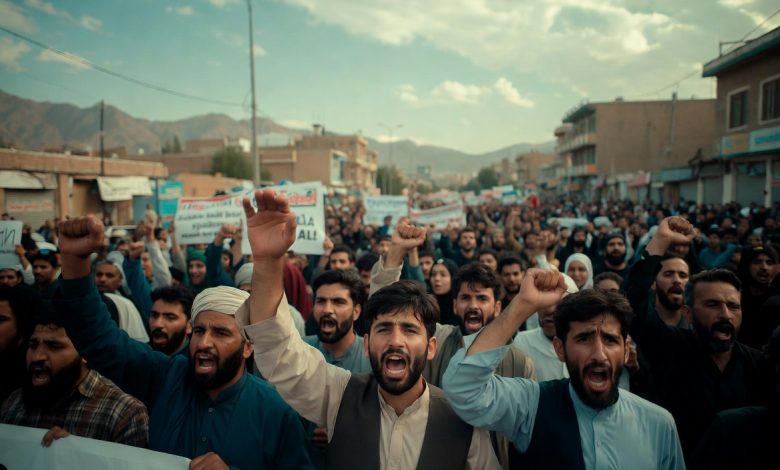
What made the protest on Tuesday particularly remarkable was the unity and composition of the crowd. Gathering in the Jebrail district of Herat—a neighborhood with a historically diverse and politically active population—approximately 150 demonstrators took to the streets. In a country where the public presence of women has been practically criminalized, women stood at the forefront of the march. Crucially, they were joined by men, including husbands, brothers, and fathers, who chose to stand shoulder-to-shoulder with their female relatives despite the immense personal risks involved.
As the demonstrators marched toward a local government administrative building, they carried handwritten signs and raised their voices in unison. They chanted the powerful and concise slogan, “Women, Work and Freedom!” alongside demands for the restoration of education for girls. The simplicity of these demands highlighted the basic human rights currently denied to millions of Afghan citizens. For a brief moment, the collective voice of the demonstrators pierced the heavy silence that the Taliban has sought to enforce through intimidation, whips, and arbitrary imprisonment since 2021.
Escalation of Violence: Casualties and Gunfire in Jebrail
The peaceful nature of the march did not prevent a violent response from the Taliban authorities. As the crowd neared government infrastructure, Taliban security forces intervened with extreme force. Eyewitnesses reported that the forces initially attempted to disperse the crowd using sticks, whips, and the butts of their rifles. However, as the demonstrators stood their ground and some began throwing stones in self-defense, the security personnel opened fire directly into the crowd of unarmed civilians.
The resulting chaos was devastating. Gunfire echoed through the streets of the Jebrail district as protesters scattered to find cover. Medical sources and independent journalists later confirmed that the crackdown resulted in severe casualties. A doctor working at a major hospital in Herat, speaking on the condition of anonymity due to a well-founded fear of Taliban retaliation, confirmed that at least three people were admitted with severe gunshot wounds. According to reports from the United Nations and partner networks like the BBC, the violence resulted in the tragic deaths of at least two people, including a woman and a young boy, while more than 20 others suffered injuries from gunfire, beatings, and stampedes.
Eyewitness Accounts and Video Evidence
Despite the Taliban’s efforts to control the narrative and restrict communications, several videos of the protest and subsequent violence managed to escape Herat’s digital blockade. These clips quickly circulated online and were broadcast by international news organizations. The unverified but highly detailed footage shows armed Taliban security personnel shooting directly at fleeing protesters. In some clips, demonstrators can be seen fighting back, throwing rocks at military vehicles, and attempting to drag wounded individuals to safety.
One particularly heartbreaking video clip shows a young boy with a severe leg injury, apparently unresponsive, being carried away by frantic bystanders. In another video sent to international journalists, a female protester delivers a chilling message that captures the gravity of the crisis: “Every woman who is arrested in Herat today represents the suffering of millions of Afghan women under the shadow of gender apartheid.” This direct testimony, recorded amid the sound of gunfire, underscores the systematic erasure of women’s agency and rights across the country.
The United Nations Responds to Excess Use of Force
The international community was quick to condemn the Taliban’s violent response to the peaceful demonstration. Richard Bennett, the United Nations Special Rapporteur on the situation of human rights in Afghanistan, expressed deep alarm over the events in Herat. In a public statement, Bennett noted that he was deeply troubled by the “excessive use of force against seemingly peaceful protesters.” He urged the Taliban authorities to immediately defuse the tension, respect the fundamental freedom of expression for all citizens—particularly women and girls—and prevent further violence, stating that those responsible for the bloodshed must be held accountable.
This incident is part of a broader, deeply concerning trend of human rights violations in Afghanistan. According to a CBS News report, the UN Assistance Mission in Afghanistan (UNAMA) has consistently warned that the Taliban’s morality police are operating with near-total impunity. During a briefing to the UN Security Council, Georgette Gagnon, the deputy head of UNAMA, accused the Taliban of systematically stripping women and girls of their most basic freedoms. Gagnon stated that the regime’s decrees have effectively criminalized the very voices and faces of women in public spaces, making genuine civil dialogue or reform impossible under the current administrative structure.
Taliban Response: Official Denials and Tightened Security
In the wake of the violent clashes on Tuesday, the Taliban’s provincial administration in Herat moved quickly to suppress information and present an alternative narrative. Sayed Masoud Hussaini, the official police spokesman for Herat province, issued a formal statement denying that any civilians had been injured or killed by police gunfire. Hussaini claimed that the security forces were merely carrying out their legal and administrative responsibilities to maintain public order and protect municipal property.
Furthermore, Hussaini criticized the demonstrators, labeling them as “agitators” who were actively opposing divine laws. In his statement, he remarked, “Today, in the area of Jebrail, a number of people have gathered and created tension under the pretext of protesting issues related to the observance of the Hijab and opposing the Islamic Hijab, which is a divine obligation.” This framing is consistent with the Taliban’s long-standing strategy of delegitimizing civil protests by characterizing them as anti-Islamic or Western-inspired provocations. To bolster this narrative, the head of Herat’s morality police, Sheikh Aziz-ur-Rahman, also released an audio statement denying that any arrests of women had taken place, claiming instead that all women in Herat voluntarily and fully comply with the regime’s strict dress codes.
The Friday Lockdowns and Security Gridlock
Despite the official denials of unrest, the Taliban’s actions on the ground painted a vastly different picture. Anticipating further public outrage and potential follow-up protests following the Friday prayers—a traditional focal point for public gatherings and political expressions in the region—the authorities implemented an extensive security lockdown across Herat on Friday. The city was placed under a state of virtual siege, with heavy military and police presence visible at every major intersection and public square.
Taliban security forces established numerous mobile checkpoints, searching vehicles, inspecting personal mobile phones for videos of Tuesday’s protests, and questioning young men and women traveling through the city. Heavily armed patrols, including members of the Taliban’s elite special forces units, patrolled the Jebrail district and surrounding neighborhoods. This display of military force successfully prevented any large-scale gatherings on Friday, but it also transformed Herat into a highly tense, militarized zone. Local residents described a pervasive atmosphere of fear, noting that even minor movements within the city were met with suspicion and intense scrutiny by the ruling authorities.
The Context of Gender Apartheid under Taliban Rule
The events in Herat cannot be viewed in isolation; they are the direct consequence of a deliberate and continuous campaign to erase women from Afghan society. Since reclaiming power in August 2021, the Taliban have issued more than 80 decrees and directives that specifically target women’s freedoms. The cumulative impact of these policies has led numerous international legal experts, human rights organizations, and UN officials to describe the situation in Afghanistan as a state of “gender apartheid.” This term reflects a system where discrimination based on gender is institutionalized, legally mandated, and enforced through state violence.
Currently, Afghanistan is the only country in the world where girls are systematically banned from attending secondary schools and universities. Women have been barred from working in non-governmental organizations (NGOs), international agencies, government ministries, and most private-sector businesses. Furthermore, they are prohibited from entering public parks, gyms, beauty salons, and amusement centers. By restricting their ability to earn an income, seek an education, or leave their homes without a male relative, the Taliban have effectively trapped millions of women and girls in a state of absolute economic and social dependency, rendering them invisible in their own communities.
Summary of the Herat Protests and Response
To provide a clear overview of the recent events in Herat, the following table summarizes the key aspects of the June 2026 protests, the casualties, the official government stance, and the international response.
| Key Aspect | Details and Reported Findings |
|---|---|
| Location of Protest | Jebrail District, Herat, Western Afghanistan. |
| Primary Trigger | Forced detention of approximately 30 women and girls by the morality police for dress code violations. |
| Demonstrator Demands | “Women, Work and Freedom!”, access to education, and an end to arbitrary arrests. |
| Estimated Crowd Size | Approximately 150 citizens, including both men and women. |
| Taliban Tactical Response | Use of whips, sticks, and live ammunition; wide-ranging Friday lockdowns and mobile checkpoints. |
| Reported Casualties | At least two dead (including a woman and a young boy); over 20 injured; multiple arrests. |
| Taliban Official Position | Spokesman Sayed Masoud Hussaini denied all injuries and deaths, labeling protesters as “agitators.” |
| International Response | UN Special Rapporteur Richard Bennett condemned the excessive use of force; UNAMA warned of systematic rights violations. |
The Global Outcry and Implications for the Future
The deadly clashes in Herat have sent shockwaves through both the Afghan diaspora and the international community. For years, Western governments and international human rights organizations have struggled to find effective leverage over the Taliban, who have consistently prioritized their strict ideological agenda over economic aid, diplomatic recognition, and international integration. The Herat protests, however, demonstrate that the greatest threat to the Taliban’s stability may not come from foreign sanctions or armed opposition groups, but from the internal defiance of its own citizens.
By pushing Afghan women to the absolute margins of survival, the Taliban have created a highly volatile social environment. The courage displayed by the protesters in Herat—where men and women stood together in the face of live gunfire—suggests that the threshold of fear is beginning to break. While the immediate security lockdown on Friday successfully prevented a repeat of the demonstrations, it has done nothing to address the underlying grievances of the population. As long as the Taliban continue to enforce their harsh restrictions and criminalize basic human rights, the potential for further civil unrest remains exceptionally high, positioning Herat as a crucial battleground for the future of human rights in Afghanistan.