Fireworks Truck Explosion on I-75 2026 Closes Tennessee Highway
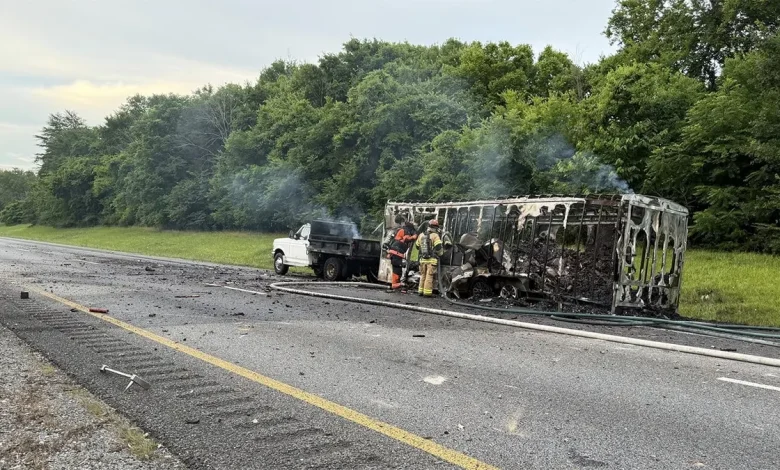
Fireworks truck explosion on I-75 near Ooltewah, Tennessee, on the evening of June 6, 2026, turned a routine weekend commute into a dazzling yet incredibly dangerous hazard. First responders racing to a reported vehicle fire on northbound Interstate 75 in the community of Ooltewah found a stopped white pickup truck hauling a box trailer that was ablaze and popping with pyrotechnics. The dramatic event, which took place near mile marker 14.2, forced emergency crews to shut down the highway in both directions as fireworks shot wildly across the lanes. This comprehensive report breaks down the incident timeline, the unique emergency tactics deployed, the safety regulations surrounding the transport of hazardous materials, and the immediate impact on local transportation networks.
Incident Overview: Fireworks Explode on Interstate 75 near Ooltewah
On Saturday, June 6, 2026, motorists traveling along the northbound lanes of Interstate 75 outside of Chattanooga, Tennessee, witnessed an unexpected and highly hazardous event. A white pickup truck pulling a closed box trailer loaded with consumer fireworks experienced an emergency, prompting the driver to pull over past the Ooltewah exit (Exit 11). Shortly after stopping on the shoulder, the trailer became engulfed in flames, initiating a rapid and uncontrollable chain reaction. The high heat quickly reached the pyrotechnic cargo inside, triggering hundreds of individual fireworks to detonate simultaneously.
The resulting scene resembled a professional pyrotechnics display, but one unfolding at ground level across a major multi-lane highway. Colorful sparks, rocket trails, and loud explosions emanated from the burning wreckage, creating thick plumes of dark smoke that billowed into the evening sky. Because the cargo consisted of various types of consumer and commercial-grade fireworks, they did not merely explode in place. Instead, dozens of rockets shot horizontally across the travel lanes, endangering passing vehicles and threatening to ignite adjacent brush. Recognizing the immediate risk to human life, dispatchers and law enforcement officials mobilized a massive response, bringing traffic to a grinding halt on one of the state’s most critical transit corridors.
The Timeline of the Fire and Subsequent Explosions
The emergency began to unfold at approximately 7:30 p.m. EST, just as dusk was settling over Hamilton County. Motorists first noticed smoke emerging from the rear of the box trailer and immediately alerted emergency services. Within minutes, the first calls flooded the Hamilton County 911 dispatch center, reporting a vehicle fire near mile marker 14.2 on Interstate 75 Northbound.
As fire crews from the Tri-Community Volunteer Fire Department and the Chattanooga Fire Department rushed to the scene, the fire breached the trailer’s structural shell. This instantly ignited the pyrotechnics. For roughly five to ten minutes, the interstate was subjected to a continuous barrage of exploding shells and high-velocity rockets. Onlookers and stranded drivers captured dramatic cellphone video showing the trailer completely engulfed in a bright orange fireball, with sparks flying in every direction. Due to the high risk of shrapnel and stray pyrotechnics, law enforcement officers from the Tennessee Highway Patrol and local sheriff deputies enacted a full closure of both northbound and southbound lanes, establishing a wide safety perimeter to protect the public.
Emergency Tactics: How Firefighters Handled an Exploding Trailer
Combating a vehicle fire involving explosives presents unique tactical hurdles for first responders. Standard operating procedures for a typical car fire involve approaching the vehicle from an upwind and uphill direction with a continuous stream of water. However, when the vehicle contains unstable explosives like fireworks, an immediate close-range attack is extremely dangerous. Firefighters face the risk of being struck by flying projectiles, experiencing hearing damage from loud detonations, and facing sudden, unpredictable explosions that can rupture firefighting equipment.
Tri-Community and Chattanooga Fire Department Coordination
The incident occurred outside the Chattanooga city limits, placing the Tri-Community Volunteer Fire Department in the lead role for the emergency response. Given the scale of the fire and the high potential for secondary blazes in the dry summer brush along the highway shoulder, Chattanooga Fire Department crews responded under a pre-established mutual aid agreement to assist. This collaborative effort ensured that enough personnel, water tankers, and specialized equipment were available on-site. Together, the agencies worked in perfect coordination with state troopers to manage both the active fire suppression and the safety of the surrounding area.
The Southbound Shuttle Water Supply Strategy
One of the most innovative and critical decisions made during the response was the implementation of a southbound water shuttle strategy. Because the northbound lanes of Interstate 75 were completely choked with bumper-to-bumper traffic, fire engines and water tankers faced immense difficulty navigating through the gridlock to reach the burning trailer. To overcome this obstacle, command officers authorized emergency vehicles to travel northbound in the southbound lanes of the interstate, which had already been closed to civilian traffic. By utilizing the empty southbound lanes, firefighters successfully established a highly efficient water shuttle system, transporting thousands of gallons of water directly to the scene. This tactical adjustment allowed crews to attack the fire aggressively from a safe distance while keeping key personnel and equipment shielded from the ongoing explosions.
Impact on Motorists and Traffic Diversions on Interstate 75
Interstate 75 is a major economic artery connecting the Midwestern United States to the southeastern coast, carrying a massive volume of commercial freight and passenger vehicles daily. A complete shutdown of this highway, even temporarily, has immediate and far-reaching economic and logistical consequences. As a result of the fire and the hazardous debris scattered across the roadway, authorities had to divert thousands of vehicles.
Northbound traffic was diverted off the interstate at Exit 11 in Ooltewah, forcing drivers onto secondary local roads that quickly became congested. While the southbound lanes of the highway were cleared of debris and reopened relatively quickly once the threat of exploding projectiles subsided, the northbound lanes remained closed for several hours. Fire crews had to carefully monitor the burned wreckage for hot spots to prevent re-ignition, while the Tennessee Department of Transportation (TDOT) assessed the asphalt for structural damage. It was not until 10:58 p.m. EST that TDOT officials reported the reopening of a single northbound lane, allowing stranded motorists to slowly crawl past the scene of the accident. The remaining lanes and the shoulder remained closed well into the night as clean-up crews worked to remove the charred chassis and the thousands of burnt firework casings.
Eyewitness Accounts and Cellular Footage of the Incident
For the hundreds of motorists trapped in the resulting traffic jam, the incident provided a surreal and unexpected spectacle. Many drivers exited their vehicles, standing at a safe distance on the highway to watch the impromptu display. Cellphone footage captured by eyewitnesses showed the sky above Ooltewah illuminated by brilliant flashes of red, green, and gold, contrasted against the thick, black smoke billowing from the burning trailer.
Several witnesses described the sound of the explosions as deafening, resembling a rapid series of mortar rounds. One motorist noted that while the visual display was spectacular, the realization that it was an active vehicle fire on a major interstate was deeply sobering. The fact that the driver of the pickup truck was able to unhitch the vehicle or that firefighters were able to save the truck cab from catching fire was widely praised by onlookers who watched the drama unfold in real time.
Rules and Safety Regulations for Transporting Pyrotechnics
The transport of pyrotechnics is a highly regulated activity governed by both federal and state laws. Fireworks contain black powder and other chemical compositions that qualify them as Class 1 explosives under federal guidelines. This incident highlights the critical importance of these regulations and raises questions about how the cargo was packaged, secured, and transported.
Hazardous Materials Transportation Standards (DOT)
The United States Department of Transportation (DOT) classifies fireworks under several categories, with the most common being Division 1.4G (consumer fireworks) and Division 1.3G (professional display fireworks). Commercial haulers transporting significant quantities of these materials must adhere to strict Federal Motor Carrier Safety Administration (FMCSA) regulations. These standards require commercial vehicles to display hazardous materials placards, carry specific shipping papers, and be equipped with fully functional fire extinguishers. Additionally, drivers must hold commercial driver’s licenses (CDLs) with hazardous materials endorsements and undergo specialized safety training to handle emergency scenarios like the one that occurred in Ooltewah.
Commercial vs. Private Transport of Consumer Fireworks
While commercial haulers are bound by rigid federal mandates, private individuals and smaller independent operators often transport consumer fireworks under different, sometimes less stringent, state-level regulations. In Tennessee, the sale and transport of consumer fireworks are legal under specific guidelines, but hauling large quantities in non-commercial, closed box trailers poses inherent risks. If a trailer lacks proper ventilation, temperature controls, or secure storage racks, the friction or electrical malfunctions within the towing vehicle can easily spark a devastating blaze. Investigators from the Tennessee Highway Patrol and local fire marshals are actively examining the circumstances of this specific incident to determine if the driver complied with all relevant safety codes or if improper loading contributed to the rapid spread of the fire.
Key Takeaways and Comparison of Notable Vehicle Fireworks Incidents
While spectacular, vehicle fires involving fireworks are fortunately rare due to stringent transport safety laws. However, when they do occur, they pose extreme challenges to local emergency services. The successful resolution of the Ooltewah incident—resulting in zero injuries—is a testament to the rapid response and strategic planning of the responding agencies. As reported by local news outlet WBIR, the highway was safely managed despite the intense hazards presented by the shooting pyrotechnics.
To put this incident into perspective, the table below provides a detailed profile of the June 6, 2026, event on Interstate 75 in Hamilton County, highlighting the key facts and figures that defined the emergency response.
| Incident Parameter | Details & Specifications |
|---|---|
| Date & Time | Saturday, June 6, 2026, at approximately 7:30 p.m. EST |
| Location | Northbound Interstate 75, Mile Marker 14.2, past Exit 11 (Ooltewah, TN) |
| Involved Vehicles | A white pickup truck and an attached closed box trailer |
| Cargo Involved | A full load of consumer/commercial pyrotechnics (fireworks) |
| Primary Responding Agencies | Tri-Community Volunteer Fire Department (Lead), Chattanooga Fire Department (Mutual Aid) |
| Key Tactical Action | Southbound water shuttle strategy utilizing empty lanes |
| Injuries or Fatalities | Zero (0) injuries reported among drivers, onlookers, and responders |
| Reopening Timeline | Southbound reopened quickly; One northbound lane reopened at 10:58 p.m. EST |
Conclusion: A Dramatic Night on the Interstate Ends Safely
The fireworks truck explosion on I-75 near Ooltewah, Tennessee, could have easily resulted in a major tragedy. The combination of high-speed interstate traffic, a highly combustible cargo, and flying pyrotechnic projectiles presented a nightmare scenario for Hamilton County emergency services. However, thanks to the disciplined and highly coordinated efforts of the Tri-Community Volunteer Fire Department, the Chattanooga Fire Department, and local law enforcement, the incident was resolved without a single injury or major secondary fire.
By implementing creative tactical maneuvers, such as routing water tankers through the closed southbound lanes, first responders demonstrated exceptional adaptability under pressure. While the economic cost of the hours-long highway closure and the total destruction of the box trailer and its cargo was significant, the preservation of human life remains the ultimate measure of success. As investigators work to pinpoint the exact cause of the initial trailer fire, this incident stands as a powerful reminder of the hidden dangers present on our nation’s highways and the vital role that highly trained emergency personnel play in keeping the traveling public safe.