Jens Dill Applauds Mills’ Primary Exit, Shifts Focus to Collins Challenge in Maine
The Shifting Sands of the Maine Democratic Primary
The Democratic primary for the U.S. Senate seat in Maine began with significant anticipation, featuring two distinct figures: the experienced, two-term Governor Janet Mills and the rising, progressive oyster farmer Graham Platner. Governor Mills, a seasoned politician and the only Democrat to have won statewide in Maine in a quarter-century, was initially seen as a formidable contender, even being recruited by Senate Majority Leader Chuck Schumer to challenge Senator Collins. Her decades of public service and name recognition were undeniable assets. However, the primary landscape proved more dynamic than initially predicted.
Mills’ Struggles and Platner’s Surging Momentum
Despite her political pedigree, Mills encountered significant hurdles, most notably in fundraising. In contemporary politics, financial resources are often the lifeblood of a campaign, determining reach, advertising, and ground game capabilities. Mills herself cited a lack of financial resources as the primary reason for suspending her campaign, stating, “While I have the drive and the passion, commitment and experience, and above all else — the fight — to continue on, I very simply do not have the one thing that political campaigns require today: the financial resources.” This issue is not uncommon, as experienced candidates who struggle to raise money are more likely to drop out of races.
Concurrently, Graham Platner, a 41-year-old oyster farmer and political newcomer, rapidly gained traction. His populist message resonated with a segment of the Democratic electorate, and he proved to be a surprisingly effective fundraiser, significantly outraising Mills in the lead-up to her withdrawal. An Emerson College poll in March, just prior to Mills’ announcement, found Platner leading Mills by a substantial 27 points, indicating the strength of his campaign and a clear shift in voter preference. His campaign’s ability to attract both grassroots support and significant financial contributions underscored a growing appetite for fresh leadership and progressive ideals within the party. This dynamic illustrates how, in high-stakes political contests, the interplay of public sentiment, candidate energy, and financial backing can redefine expectations and outcomes, much like complex strategic challenges faced in other sectors, such as those analyzed in Mythos AI: Cyberattacks, Anthropic’s Tool Redefines Warfare.
Jens Dill’s Perspective: A Veteran’s Insight into Political Strategy
Jens Dill, a retired software engineer from Winthrop, offers a grounded, pragmatic viewpoint on the evolving primary. His background, often associated with logic and problem-solving, informs his analysis of the political chess game unfolding in Maine. Dill’s initial support for Mills, despite Platner’s ascendance, suggests an appreciation for her experience. However, his commendation of her decision to step down reveals a deeper understanding of political efficacy. He recognized that Mills’ continued presence in the primary, while perhaps fueled by dedication, was ultimately siphoning resources and attention from the broader goal: defeating Senator Collins.
Dill’s statement – that Mills “gave [Platner] enough challenge to get his campaign off the ground and organized” – speaks to the often-unforeseen benefits of a competitive primary. While primaries can be bruising, they can also serve to test candidates, refine their messages, and build campaign infrastructure. Mills’ robust, albeit ultimately unsuccessful, challenge likely forced Platner to sharpen his platform and mobilize his base more effectively than if he had run unopposed. This kind of competitive pressure is vital for any campaign preparing for the rigors of a general election.
Crucially, Dill highlighted the message sent to Senator Collins: “This guy knocked me out of the race. You’re next.” This isn’t just a statement of fact but a declaration of intent. It signifies a coalescing of Democratic energy and resources behind a single candidate, presenting a clear, formidable opponent to the long-serving incumbent. This unified approach is often a desired outcome for parties seeking to unseat well-entrenched incumbents, as it avoids the divisions and resource depletion that protracted, bitter primaries can cause. The strategic withdrawal can be viewed as an act of party loyalty, prioritizing the collective goal over individual ambition.
Platner’s Ascendancy and the Consolidation of Support
With Governor Mills’ departure, Graham Platner has effectively become the presumptive Democratic nominee. This has led to a rapid consolidation of support from various factions within the Democratic Party, including key national figures like Senate Minority Leader Chuck Schumer, who had previously backed Mills. The Democratic Senatorial Campaign Committee (DSCC) and the Democratic National Committee (DNC) have also thrown their weight behind Platner, acknowledging his role as the party’s best chance to unseat Collins. This swift endorsement signals a strategic pivot, allowing the party to funnel resources and energy into the general election campaign much earlier.
Platner’s transition from an insurgent primary candidate to the party’s standard-bearer is significant. It suggests a broader shift within the Democratic electorate, possibly favoring newer, more overtly progressive voices. His campaign will now benefit from the full organizational machinery of the state and national Democratic Party, providing access to donor networks, volunteer infrastructure, and strategic guidance that were previously divided or less accessible. This unity is paramount in challenging an incumbent of Senator Collins’ stature, who has consistently demonstrated remarkable political survival skills in a state that often splits its ticket.
The Gauntlet Thrown: A Direct Challenge to Susan Collins
The declaration, “You’re next,” resonates with the determination of a party galvanized by the primary’s swift resolution. Senator Susan Collins, a five-term Republican, has long cultivated an image of independence, often crossing party lines and navigating complex political terrains. She has won multiple re-election bids, often defying national political trends and outperforming expectations, notably defeating Sara Gideon in 2020 by a nine-point margin despite national predictions of a loss.
However, the political landscape for Collins in 2026 presents unique challenges. Maine is considered a moderately blue state, having voted for every Democratic presidential nominee since 1992 and for Kamala Harris in 2024. This makes Collins the only Republican senator representing a state that Harris won, positioning her as a top target for Democrats seeking to flip Senate control.
Democrats are poised to highlight Collins’ voting record, particularly her alignment with the national Republican Party, which they argue often contradicts her image as an independent voice for Maine. Issues such as healthcare, economic policies, and her relationship with former President Trump are likely to be central to Platner’s campaign. While Collins has occasionally clashed with Trump, she has also largely supported his agenda and nominees, creating a potential vulnerability for her in a state that has consistently rejected Trump at the presidential level. The unified Democratic front aims to amplify these perceived inconsistencies and present Platner as a fresh alternative truly representing Maine’s current political leanings.
Fundraising Dynamics and Campaign Resource Reallocation
Fundraising is often a brutal and decisive aspect of political campaigns. Mills’ candid admission about the lack of financial resources underscores the immense pressure candidates face to generate consistent funding. Campaigns, especially in competitive federal races, are incredibly expensive undertakings, requiring millions for advertising, field operations, staffing, and travel. Platner’s ability to significantly outraise Mills, accumulating $4 million in the first three months of 2026 alone compared to Mills’ $2.6 million in the same period, was a clear indicator of his campaign’s viability and momentum.
With Mills out, the Democratic fundraising apparatus can now fully pivot to support Platner. This means donors who were split or hesitant can now consolidate their contributions behind a single candidate. National party committees, super PACs, and individual donors will channel their resources exclusively to Platner, dramatically boosting his financial firepower. This reallocation of resources is critical, as Senator Collins is a proven fundraising powerhouse, with her campaign having $10 million in the bank as of a recent reporting period. The unified Democratic effort will aim to match, or at least significantly offset, Collins’ financial advantage, ensuring Platner has the necessary means to run a competitive race through November. The sheer volume of money in modern elections can often dictate their trajectory, a challenge that, in a broader context, relates to discussions around economic stability and currency fluctuations, as seen in analyses like Dollar Decline: Ceasefire Sinks Currency Markets 2026.
Delegate Sentiment on the Portland Waterfront: An Energized Base
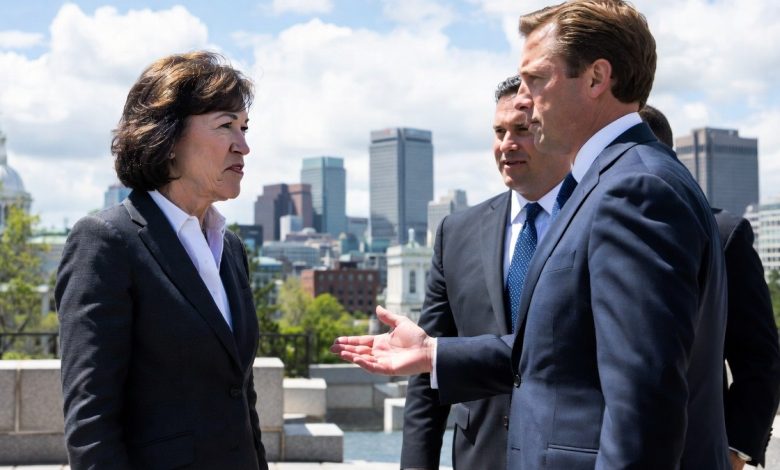
The atmosphere at the biennial Maine Democratic Party meeting on the Portland waterfront was marked by a “palpable” eagerness to look ahead to the November election. Interviews with two dozen Democratic delegates revealed a sense of relief and renewed purpose following Mills’ withdrawal. Many delegates, who had perhaps been torn between two strong candidates or concerned about a divisive primary, now expressed a clear focus on the general election. This is a common phenomenon; primaries, while essential for democratic selection, can also expose internal party divisions that must be mended before facing a general election opponent.
The mood was one of strategic alignment. Delegates recognized Mills’ decision as a pragmatic move that ultimately strengthens the party’s position. This unity is crucial for grassroots mobilization, volunteer recruitment, and sustained campaign efforts. An energized base, united behind a single candidate, can be a powerful force, particularly in a state like Maine where local engagement and community organizing play significant roles. The biennial convention, a forum for organizing, connection, and Democratic action, served as an ideal backdrop for this consolidation of purpose.
Historical Precedents of Strategic Withdrawals in Political Races
Mills’ decision to withdraw, while difficult, is not without precedent in American political history. Candidates often make strategic calculations based on fundraising realities, polling numbers, and the broader political landscape. The purpose of a primary is to select the strongest candidate to represent the party in the general election, and sometimes, a withdrawal is deemed the most effective path toward achieving that overarching goal. Research indicates that experienced candidates who struggle with early fundraising are more likely to drop out, especially in more recent election cycles.
Such withdrawals aim to prevent a drawn-out, costly primary battle that could leave the eventual nominee financially depleted and politically bruised before facing the general election. In cases where one candidate demonstrates clear and consistent momentum, a strategic exit by another contender can prevent further internal strife and allow the party to rapidly coalesce its resources and message. This ensures the party presents a unified and robust challenge to the opposition. For example, in the 2020 Democratic presidential primary, a large field of candidates was eventually winnowed down, with fundraising often being a key factor in withdrawals.
The Road to November: Key Issues and Battlegrounds
As the focus shifts to the general election, several key issues are expected to dominate the discourse in Maine. Healthcare, a perennial concern, will likely be a central battleground, with Democrats frequently criticizing Collins’ record on the Affordable Care Act and related policies. Economic issues, including the cost of living, inflation, and job creation, will also be paramount, resonating with voters across the state. Platner’s populist message and focus on working-class concerns will likely contrast with Collins’ more traditional Republican economic stances.
Environmental policy, particularly concerning Maine’s natural resources and climate change, will also be a significant area of debate, given the state’s strong environmental ethos. Furthermore, the broader national political context, including the ongoing debates in Washington, D.C., and the influence of national party figures, will undoubtedly shape the narrative. Senator Collins’ long tenure, her votes on critical legislation, and her relationship with President Trump are all expected to be scrutinized heavily by the Platner campaign. The battle will be fought not just on policy, but on leadership style, independence, and responsiveness to the needs of Maine constituents.
Analysis of the Democratic Party’s Broader Strategy
The outcome of the Maine Democratic primary offers insights into the party’s broader national strategy. By allowing a competitive primary to unfold and then consolidating quickly behind the candidate with clear momentum, the Democrats appear to be prioritizing electability and unity. This approach minimizes the risk of internal divisions festering and ensures that resources are directed efficiently towards the ultimate goal of winning the general election. This strategic approach to candidate selection and resource allocation mirrors the careful consideration given to local governance and public welfare, though the scope and scale differ. Similar strategic debates are seen in municipal policy, such as when Boston Mayor Wu’s $500 wellness vouchers sparked outrage amid deficit, highlighting the complexities of public resource management.
The party seems to be embracing a strategy that allows for new, energetic voices like Platner’s to emerge through a primary process, while also retaining the flexibility to unite quickly when a clear frontrunner materializes. This dynamic is particularly important in states like Maine, which have a history of independent voters and ticket-splitting. By presenting a strong, unified, and well-resourced candidate, Democrats hope to leverage the state’s increasingly blue leanings to finally unseat a powerful incumbent. The message is clear: the party is focused, determined, and ready to engage in a high-stakes contest for control of the Senate, a level of strategic depth also observed in complex geopolitical negotiations, for example, involving Iran President Pezeshkian, FM Araghchi, and the IRGC in nuclear talks. The ability to adapt and pivot strategically is a hallmark of successful political movements, and this primary outcome suggests the Maine Democratic Party is operating with such foresight.
Comparative Analysis: Maine Democratic Primary Campaign Metrics (Pre-Withdrawal)
To further illustrate the dynamics that led to Governor Mills’ withdrawal and Platner’s emergence, a comparison of hypothetical campaign metrics prior to Mills’ announcement is instructive. While specific delegate counts for a U.S. Senate primary are not always publicly detailed in the same way as presidential primaries, general indicators of campaign health provide a clear picture.
| Metric | Governor Janet Mills (Pre-Withdrawal) | Graham Platner (Pre-Withdrawal) |
|---|---|---|
| Fundraising (Most Recent Quarter) | $2.6 million | $4 million |
| Polling Average (March 2026, Emerson College) | 28% | 55% |
| Delegate Support (Estimated) | Significant early support, waning | Surging, broad grassroots and progressive support |
| Campaign Momentum | Struggling, declining | Strong, rapidly increasing |
| Age | 78 | 41 |
| Endorsements (National Party) | Early backing from Schumer | Post-withdrawal: Full DSCC/DNC backing |
This table vividly illustrates the challenges faced by Governor Mills and the undeniable momentum behind Graham Platner. The significant disparity in fundraising and polling numbers, particularly in the critical period leading up to Mills’ decision, provided a clear rationale for her strategic withdrawal. It was a recognition of the campaign’s trajectory and an implicit acknowledgment that the party’s best chance against Senator Collins lay with the candidate demonstrating greater viability and energy.
Conclusion: A Galvanized Opposition Eyes the General Election
Jens Dill’s observations, rooted in a practical understanding of political dynamics, perfectly capture the mood in Maine’s Democratic Party. Governor Janet Mills’ strategic withdrawal from the Senate primary, while a personal concession, has been widely interpreted as a unifying act that significantly strengthens the Democratic challenge to Senator Susan Collins. By stepping aside, Mills not only allowed Graham Platner’s ascendant campaign to fully consolidate its resources and momentum but also sent an unmistakable message to the incumbent: the opposition is now unified and fiercely determined.
The biennial party meeting in Portland became a forum for this galvanized enthusiasm, with delegates expressing palpable relief and a renewed focus on the November general election. The race against Senator Collins, already anticipated to be one of the most competitive nationwide, now features a streamlined Democratic opponent backed by a unified and energized party apparatus. With robust fundraising, strong polling numbers, and broad party support, Platner is positioned to mount a serious and sustained challenge. The coming months will test the efficacy of this strategic pivot, as Maine Democrats, with Jens Dill among them, now look forward to confronting Senator Collins with a clear, singular message: “You’re next.” The stakes are exceptionally high, not just for Maine but for the balance of power in the U.S. Senate, making this a contest that will draw national attention and rigorous scrutiny. Understanding strategic voter data will be critical for both campaigns as they refine their outreach efforts.