Iran Retaliates Across Gulf After Ten Nights of US Bombing 2026
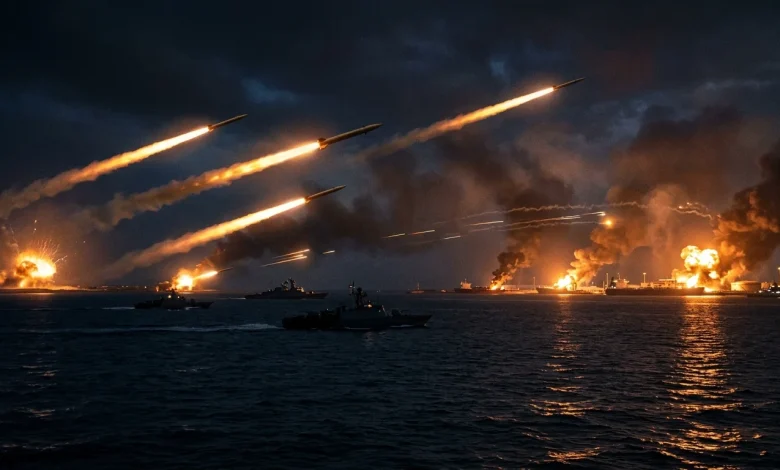
Table of Contents
Iran has initiated a sweeping retaliatory campaign across the Persian Gulf, marking an unprecedented escalation in the Middle East following a tenth consecutive night of intense US bombing. As regional tensions reach a critical boiling point, the Islamic Revolutionary Guard Corps (IRGC) announced targeted strikes against United States military assets across Jordan, Bahrain, and Kuwait. Additionally, severe disruptions have hit the maritime trade routes, with reports of massive fires breaking out on two separate commercial tankers navigating the critical choke point of the Strait of Hormuz.
Adding to the rapidly expanding theater of conflict, the Iran-backed Houthi movement in Yemen has declared an absolute maritime blockade against Saudi Arabia. This multi-layered threat directly targets key global transit routes, raising concerns over immediate shocks to the global energy supply. Military experts warn that this coordinated strategy represents a structural shift in regional warfare, moving from proxy skirmishes to direct, high-intensity confrontations.
Chronology of the Tenth Night of Aerial Escalation
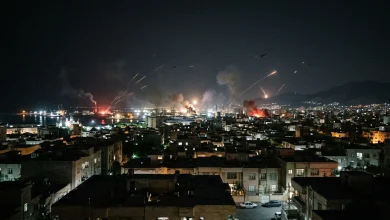
The latest phase of this conflict began in the late hours of the evening as US bombers carried out their tenth consecutive night of kinetic operations against IRGC command hubs, logistical nodes, and weapons storage depots across western Iraq and eastern Syria. This aggressive aerial campaign was designed to degrade Iran’s forward-deployed assets, yet it appears to have instead triggered a highly coordinated regional response. Geopolitical observers noted that these ongoing engagements show how U.S. airstrikes escalate Middle East security dynamics, creating feedback loops of violence rather than containment.
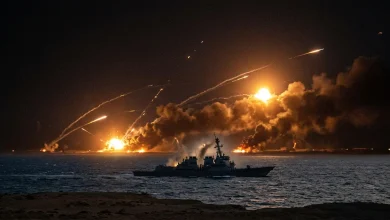
Almost immediately following the conclusion of the tenth wave of airstrikes, local radar networks detected multiple ballistic missile and one-way attack drone launches originating from southwestern Iran. The IRGC claimed direct responsibility for these launches, asserting that the operations were a legitimate exercise of self-defense aimed at neutralising the bases from which US aircraft operate. This massive show of force followed closely on the heels of the highly destructive seventh night of US military actions in the region, which had already severely weakened traditional diplomatic channels.
The Strategic Context of Tenth Consecutive Night of Bombing
The decision by the United States and its coalition partners to sustain ten consecutive nights of heavy bombardment highlights a determination to establish absolute deterrence. However, military analysts suggest that the sustained nature of the campaign has had diminishing returns, as these strikes on Iran enter ninth consecutive and tenth consecutive intervals of active combat without successfully neutralizing the IRGC’s retaliatory capacity. Rather than forcing a retreat, the prolonged air campaign has galvanized the axis of resistance, pushing local factions to align their operational timelines for maximum impact.
IRGC Targets US Assets in Jordan, Bahrain, and Kuwait
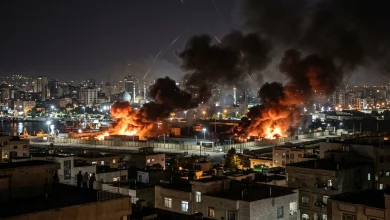
In a coordinated ballistic missile and drone offensive, the IRGC targeted key western and coalition outposts throughout the Gulf region. In Jordan, forward operating positions utilized by American forces for intelligence and drone reconnaissance faced multiple waves of loitering munitions. Air defense networks in Jordan were actively engaged, but local sources reported that several impacts occurred near military perimeters, highlighting the vulnerability of these regional outposts.
Concurrently, US installations in Bahrain and Kuwait came under direct threat. In Bahrain, home to the US Navy’s Fifth Fleet, sirens wailed as defensive missile batteries intercepted incoming projectiles over the water. In Kuwait, Camp Arifjan and Ali Al Salem Air Base implemented emergency defensive protocols as drone activity was detected nearby. The geographical spread of these attacks demonstrates Iran’s ability to hold multiple US regional facilities at risk simultaneously, especially after CENTCOM confirms fatal strike on US forces stationed near regional borders, exposing critical gaps in theater-wide air defenses.
Analyzing the Geopolitical Vulnerabilities in Bahrain and Kuwait
The targeting of facilities in Bahrain and Kuwait is a highly calculated geopolitical move. Both nations serve as central logistical backbones for the American presence in the Persian Gulf. By targeting these specific hosts, the IRGC is signaling to local governments that hosting US military infrastructure carries a direct, physical cost to their domestic security. This puts immense diplomatic pressure on regional leaders who must balance their strategic partnerships with Washington against the immediate safety of their sovereign territories and populations.
Chaos in the Strait of Hormuz: Tankers on Fire
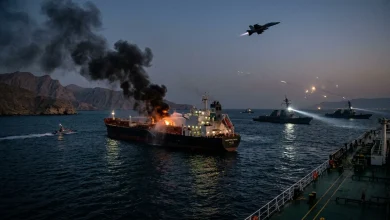
The maritime dimension of the conflict escalated dramatically when two major oil tankers, one sailing under a European flag and another under an Asian registry, were struck by precision munitions while transiting the Strait of Hormuz. The IRGC stated that “massive fires” broke out on both vessels, rendering them temporarily unnavigable and forcing their crews to send out distress signals. This development recalls past incidents where US strikes target key ports and regional logistics hubs, creating a highly volatile maritime environment.
Emergency maritime tugs and international naval task forces responded to the distress calls, but the presence of active drone swarms and naval mines in the strait has severely hindered salvage and firefighting operations. The Strait of Hormuz, through which approximately one-fifth of the world’s petroleum transits daily, is now effectively a high-risk combat zone, leading several global shipping syndicates to suspend all transits through the waterway indefinitely.
Economic Repercussions on Global Energy Supply Chain
The immediate consequence of the tankers burning in the Strait of Hormuz was a sharp spike in global crude oil prices, which jumped by over eight percent within hours of the attacks. Insurance premiums for maritime transport in the Middle East have surged to historic highs, forcing shipping companies to consider the lengthy and expensive detour around the Cape of Good Hope. If the strait remains contested or blocked for an extended period, energy analysts warn of potential global supply shortages, inflationary pressures, and severe economic disruptions in energy-importing nations across Europe and Asia.
Houthi Maritime Blockade Against Saudi Arabia
Compounding the naval crisis, the Houthi movement in Yemen formally announced a comprehensive maritime blockade targeting all shipping bound for or originating from Saudi Arabia. The Houthis warned that any vessel entering the Red Sea, the Gulf of Aden, or the Bab el-Mandeb strait that is linked to Saudi commercial interests would be treated as a hostile military target. This represents a massive escalation in the Red Sea theater, where the announced Houthi embargo targets Saudi shipping with unprecedented severity, threatening to choke off vital trade routes.
The Houthi command justified this embargo by citing Saudi Arabia’s tacit support for the US-led coalition and its ongoing cooperation in maintaining regional air corridors. By launching this blockade, the Houthis aim to split the Arab coalition and force Riyadh into a defensive, isolationist posture, thereby neutralizing Saudi Arabia’s strategic depth and economic leverage.
Saudi Arabia’s Defense Posture and Response
Saudi Arabia now finds itself in an incredibly delicate position. Having spent years negotiating a fragile truce with the Houthis to secure its southern border, Riyadh is highly reluctant to be dragged back into an active, destructive war. However, a blockade on its shipping directly threatens its Vision 2030 economic plans and its status as a reliable global energy exporter. The Saudi Royal Navy has increased patrols around key western ports, but without direct US escort operations, securing these vast maritime corridors remains a monumental challenge.
Tactical Breakdown of the Regional Military Balance
The current confrontation highlights the stark contrast between the high-tech, conventional military superiority of the United States and the asymmetric, highly distributed capabilities of Iran and its partners. While US stealth bombers and precision-guided cruise missiles can devastate fixed targets on land, Iran’s reliance on mobile missile launchers, cheap loitering drones, and fast-attack naval craft allows it to absorb these blows and strike back effectively. This asymmetric warfare makes total containment extremely difficult to achieve through aerial bombardment alone.
To illustrate the scale of this current escalation, the table below provides a comprehensive summary of the primary operational areas, targeted assets, and the strategic implications of the latest military developments:
| Sub-Region / Location | Primary Target / Asset | Nature of Operation | Strategic Impact |
|---|---|---|---|
| Jordanian Border Outposts | US Reconnaissance and Intelligence Assets | Drone Swarm & Precision Rocket Strikes | Disrupts forward surveillance and border security operations |
| Bahrain (NSA Bahrain) | US Navy Fifth Fleet Naval Infrastructure | Ballistic Missile Attacks (Intercepted) | Threatens command and control of Gulf naval patrols |
| Kuwait (Camp Arifjan) | US Logistical and Air Base Hubs | Loitering Munition Attacks | Disrupts the primary logistics backbone for US land forces |
| Strait of Hormuz | Commercial Oil Tankers | Anti-Ship Missiles / Drone Attacks | Sparks immediate energy price spikes and halts maritime transit |
| Red Sea / Bab el-Mandeb | Saudi-Linked Merchant Vessels | Houthi Maritime Blockade | Chokes off Red Sea transit routes and isolates Saudi trade |
Diplomatic Efforts and the Threat of Total War
As the military situation rapidly deteriorates, diplomatic channels are working under intense strain to prevent the outbreak of a full-scale regional war. Emergency sessions have been called at the United Nations Security Council, with several nations urging immediate restraint and a cessation of hostilities. However, the political positions of the combatants remain deeply entrenched, with both sides viewing concessions as a sign of weakness that could invite further aggression.
The Pentagon continues to reinforce its forward deployments, deploying additional fighter squadrons and carrier strike groups to the region to bolster defense systems. Meanwhile, regional actors continue to navigate the collateral risks of this campaign, even as the White House denies hitting civilian infrastructure in its official statements. Without a clear diplomatic off-ramp, the risk of a miscalculation leading to a direct, open conflict between state actors grows with each passing hour, leaving the international community on edge as the battle for control of the Gulf’s strategic waterways continues to unfold.