Monster: Lizzie Borden Story Casts Charlie Hunnam And Rebecca Hall 2026

Table of Contents
Monster: The Lizzie Borden Story is the next highly anticipated installment in Netflix’s blockbuster true crime anthology series, a franchise that has redefined how modern audiences consume historical crime narratives. The series dramatizes high-profile homicide cases in American history, with each season focusing on a different killer, examining not only the crimes themselves but the societal failures that allowed them to occur. Previous installments included the stories of Jeffrey Dahmer, Ed Gein, and Lyle and Erik Menendez, each capturing the public’s imagination while provoking widespread debate about ethics, mental health, and the justice system. Now, the anthology turns its lens back to the late 19th century to investigate one of the most famous, unsolved mysteries in the history of the United States: the brutal double homicide of Andrew and Abby Borden. Beginning streaming on Thursday, this latest season promises to deliver a masterclass in gothic suspense and domestic horror, stripping away the playground rhymes to expose the dark, claustrophobic reality of Victorian household dysfunction.
The enduring mystery of the Borden murders is a fascinating choice for a series that excels at analyzing structural issues within different eras of American history. Unlike the 1980s and 1990s settings of the Menendez and Dahmer trials, the Borden case takes us back to a time of strict social hierarchies, intense religious expectations, and rigid gender roles. By examining how these historical factors influenced both the crime and its subsequent legal fallout, the series aims to provide a comprehensive look at an era when a woman committing such an act was deemed a biological impossibility by many. This deep dive into the historical landscape ensures that the production remains intellectually stimulating while delivering the high-stakes drama that fans of the anthology have come to expect.
The Evolution of the True Crime Anthology
Ryan Murphy and Ian Brennan have systematically built an empire around the dramatization of historical tragedies, turning their true crime anthology into a cultural touchpoint. Each season is designed to act as a mirror to society, using individual criminal cases to examine broader systemic issues such as police corruption, media exploitation, and systemic homophobia. By focusing each installment on a different killer, the showrunners have been able to explore varied historical eras, showing how the prevailing cultural norms of each period shaped public perception and judicial outcomes. The artistic evolution of this series has consistently matched the prestige of critical acclaim in primetime film narratives, establishing a benchmark for how historical tragedies are reinterpreted for contemporary audiences.
This evolutionary trajectory is evident when comparing previous seasons. The initial season focused on the horrors of Jeffrey Dahmer, dealing with systemic racism and institutional neglect in the Midwest during the late 20th century. Subsequent seasons, including the exploration of Ed Gein’s mid-century transgressions and the complex psychological trauma of the Menendez brothers, have showcased the creators’ ability to adapt their storytelling style to suit different eras and narrative structures. This transition to the Victorian era with the Borden case represents their most ambitious historical leap yet, requiring meticulous research, lavish set designs, and a deep understanding of 19th-century societal pressures. By shifting the timeline back over a century, the anthology continues to push the boundaries of the true crime genre, proving its longevity and thematic flexibility.
Lizzie Borden and the 1892 Ax Murders
Lizzie Borden remains one of the most enigmatic figures in American criminal folklore. On the hot morning of August 4, 1892, the bodies of Andrew Borden and his second wife, Abby, were discovered in their home, brutally hacked to death with a sharp instrument, widely believed to be an ax or a hatchet. The sheer violence of the murders sent shockwaves through the quiet community of Fall River, Massachusetts. Suspicion immediately fell upon Andrew’s younger daughter, Lizzie, who was in the house at the time of the killings but claimed to have been in the barn. Her cold, unemotional demeanor during the subsequent inquest, coupled with inconsistent statements, led to her arrest and trial for the double homicide.
The subsequent trial was a media sensation, drawing reporters from across the country who capitalized on the public’s disbelief that a respectable, church-going Victorian woman could commit such an atrocious act. The prosecution’s case was largely circumstantial, highlighting Lizzie’s financial motives and her attempts to purchase lethal poisons shortly before the murders. However, the defense skillfully utilized Victorian-era gender biases, arguing that a woman of Lizzie’s social standing was physically incapable of executing such brutal attacks without leaving a single trace of blood on her person. Her eventual acquittal did not erase public suspicion, and she lived the remainder of her life as a social outcast. By delving into historic memoirs, diary entries, and legal transcripts, the series reconstructs this tense environment, allowing modern viewers to assess the evidence for themselves within the claustrophobic confines of the Second Street home.
Star-Studded Cast: Charlie Hunnam and Rebecca Hall
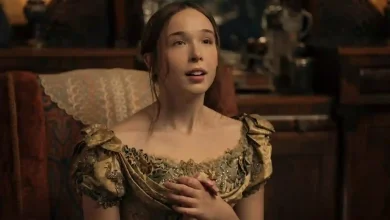
Lizzie Borden’s tragic domestic saga is brought to life by a stellar cast of internationally recognized actors. Charlie Hunnam stars as Andrew Borden, the wealthy but notoriously parsimonious patriarch whose strict financial control and austere lifestyle created immense friction within his household. Hunnam’s portrayal explores the complexities of a self-made man whose obsession with wealth accumulation came at the expense of his family’s comfort, going so far as to deny his daughters modern amenities like gas lighting and indoor plumbing. His performance offers a chilling, multi-dimensional look at a father whose domineering presence cast a long shadow over the lives of his daughters, providing a plausible psychological trigger for the tragedy that followed.
Opposite Hunnam, Rebecca Hall delivers a masterclass performance as Abby Borden, Lizzie’s stepmother. Hall, known for unveiling complex character dynamics in period dramas, portrays Abby not as a simple villain, but as a woman trapped in an incredibly tense household, navigating the open hostility of her stepdaughters while trying to secure her own financial future. The chemistry and conflict between Hunnam and Hall form the emotional backbone of the series, illustrating how simmering domestic grievances can escalate into unspeakable violence. The inclusion of such high-caliber talent ensures that this adaptation avoids the sensationalism of past retellings, elevating it to the level of award-winning performances on television.
Artistic Direction and Narrative Depth
Directorially, the season adopts a gothic, atmospheric aesthetic that mirrors the suffocating environment of Victorian Fall River. The production team has painstakingly recreated the Borden home, utilizing narrow corridors, heavy drapery, and low-light cinematography to construct a visual representation of psychological imprisonment. This deliberate slow-burn tension is reminiscent of the stylistic choices seen in captivating dark drama projects that have dominated contemporary television in recent years. By focusing on the quiet, agonizing moments of daily life—the silent breakfasts, the whispered arguments, and the oppressive heat of a Massachusetts summer—the series builds a sense of dread that is far more terrifying than the physical violence itself.
Furthermore, the narrative structure is designed to explore multiple perspectives of the same event. Rather than presenting a single, definitive version of the murders, the showrunners present various historical theories, allowing the audience to see the events through the eyes of Lizzie, her sister Emma, the family maid Bridget, and the investigators. This fragmented storytelling technique highlights the ambiguity of the historical record and the fallibility of human memory. This sophisticated approach to narrative construction shares structural similarities with provocative documentary filmmaking, challenging the viewer to question their own assumptions about guilt, innocence, and historical truth.
Comparative Analysis of True Crime Seasons
To understand the trajectory of Netflix’s true crime series, it is essential to compare how each season has approached its respective subjects. Each installment has transitioned from contemporary psychological profiles to historical period pieces, shifting the stylistic and thematic elements of the anthology. The table below outlines the evolution of the series leading up to the Lizzie Borden dramatization.
| Season | Focus Subject | Key Cast Members | Primary Thematic Focus |
|---|---|---|---|
| Season 1 | Jeffrey Dahmer | Evan Peters, Richard Jenkins | Systemic police neglect and racial inequality in Milwaukee. |
| Season 2 | Lyle and Erik Menendez | Nicholas Alexander Chavez, Cooper Koch | Abuse within wealthy families and the 1990s media sensationalism. |
| Season 3 | Ed Gein | Charlie Hunnam, Laurie Metcalf | Mid-century psychological trauma, isolation, and rural mythology. |
| Season 4 | Lizzie Borden | Charlie Hunnam, Rebecca Hall | Victorian gender constraints, class expectations, and domestic friction. |
As demonstrated in the table, the series has continuously shifted its focus to explore different dynamics of crime and punishment in American history. While early seasons examined the dark underbelly of late-20th-century urban environments, the transition to the 1890s in ‘Monster: The Lizzie Borden Story’ represents a bold stylistic pivot that challenges both the cast and crew to recreate a bygone era with historical accuracy and dramatic flair.
Cultural Impact and True Crime Obsession
True crime as a genre has seen exponential growth over the past decade, transforming from a niche interest into a dominant force in mainstream entertainment. The public’s fascination with historical homicides often stems from a desire to solve unsolved mysteries, understand the incomprehensible depths of human behavior, or explore the darker facets of society from a safe distance. Lizzie Borden’s story has been retold in books, plays, operas, and films, yet Ryan Murphy’s adaptation promises a definitive exploration of the socio-economic context of the 1890s. The series taps into a cultural obsession similar to the discussion generated by high-profile book club selections, where audiences dissect character motives, historical accuracy, and moral ambiguity.
This production does not merely seek to shock; it uses Lizzie Borden’s trial as a mirror to reflect our own ongoing obsession with justice, media sensationalism, and the public execution of character. The legal proceedings in 1892 were among the first to be heavily covered by national newspapers, creating an early prototype for the modern media circus. By examining how the press shaped public opinion and influenced the jury, the series offers a timely critique of our contemporary media landscape, where trial by social media often precedes any court verdict. This thematic depth and cultural relevance have earned similar high-prestige projects recognition across acclaimed international cinema circuits, proving that true crime, when handled with artistic seriousness, can transcend genre limitations.
Release Schedule and Stream Information
Streaming on Netflix starting this Thursday, ‘Monster: The Lizzie Borden Story’ is set to capture global audiences with its ten-episode release. True crime enthusiasts and historical drama fans alike are eagerly anticipating how the series balances the known facts of the case with dramatic license. By combining meticulous production design, a haunting score, and a powerhouse cast led by Charlie Hunnam and Rebecca Hall, the series stands as one of the most anticipated television events of the year. Whether you view Lizzie Borden as a victim of Victorian patriarchy, a cold-blooded killer who executed the perfect crime, or a tragic figure caught in a domestic nightmare, this series will undoubtedly spark intense online debates and renewed historical analysis for months to come.



One Comment