Aaron Judge Sidelined With Stress Fracture in Right Rib
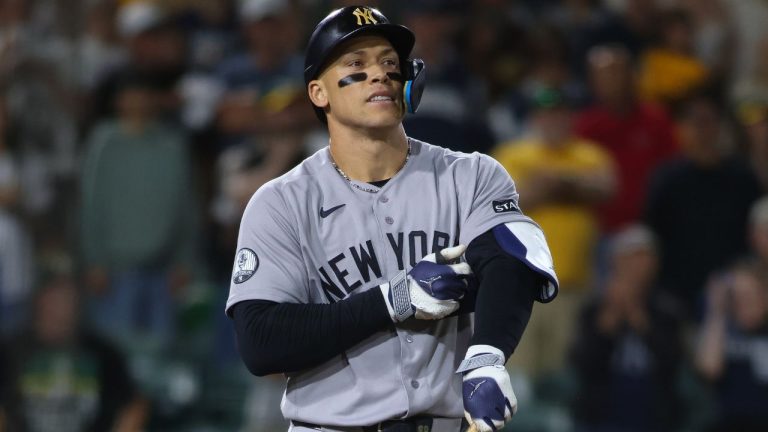
Aaron Judge has been diagnosed with a stress fracture of the first rib on his right side, delivering a massive blow to the New York Yankees’ championship aspirations. The team announced the devastating diagnostic update, confirming that the three-time American League MVP will be sidelined indefinitely. The announcement followed several days of intense medical speculation and testing, which began after Judge was scratched from the lineup earlier in the week due to what was initially described as a bone bruise and persistent right shoulder pain.
The injury represents a critical juncture for both the Yankees and their captain. After missing three consecutive games during the series against the Cleveland Guardians, Judge underwent a battery of advanced imaging, including a CT scan and an MRI. The team has stated that Judge will undergo a period of strict rest and limited activity, with plans to re-evaluate his condition using additional imaging in approximately four to six weeks. Although the recovery timeline is extensive, the Yankees expressed optimism in their official statement, noting that Judge is expected to return to the active roster ‘at some point this season.’
Introduction to the Injury
The sudden removal of Aaron Judge from the active lineup sent shockwaves through the baseball world. Entering the first week of June 2026, Judge had been the anchor of the Yankees’ offense, starting in 52 of the team’s first 59 games in right field. However, during the Yankees’ recent series against the Oakland Athletics in West Sacramento, the superstar outfielder began reporting escalating discomfort. This soreness ultimately forced him out of the lineup for three consecutive games against the Cleveland Guardians at Yankee Stadium, raising immediate red flags among the coaching staff and fanbase alike.
Initially, the Yankees’ training staff characterized the issue as a localized bone bruise in his right rib area, which was believed to be radiating pain up into his right shoulder. However, as the discomfort persisted and failed to respond to basic treatment, the organization realized that a more complex underlying condition was at play. The diagnosis of a stress fracture in the first rib on his right side explains the severe shoulder pain that had been hindering Judge’s swing over the previous several weeks, shedding light on a modest dip in his offensive output prior to the lineup scratch.
The Medical Diagnosis: Stress Fracture of the First Rib
The formal diagnosis of a stress fracture of the first rib represents a highly unusual and medically complex injury for an MLB position player. According to the official statement released by the New York Yankees, the stress fracture is located on the first rib of Judge’s right side. This specific rib is situated deep within the upper chest and neck area, structurally anchored beneath the clavicle (collarbone). Because of its anatomical position, injuries to this bone are notoriously difficult to detect via standard radiographic imaging, often requiring highly specialized scans to diagnose accurately.
To address the injury, the Yankees have prescribed a regimen of complete rest and strictly limited physical activity. There is no surgical intervention planned at this stage, as bone stress fractures of this nature primarily heal through natural immobilization and metabolic recovery. The Yankees’ medical team outlined a timeline where Judge will be re-imaged in four to six weeks. This follow-up scan will assess the level of bone remodeling and determine whether he can begin a gradual ramping up of baseball-related activities, such as light tossing and dry swings.
The Role of Specialists in Complex Diagnoses
Pinpointing the exact cause of Aaron Judge’s discomfort required a collaborative effort from some of the nation’s leading sports medicine specialists. After avoiding a three-game sweep against the Cleveland Guardians with a hard-fought 2-1 victory on Thursday, Yankees manager Aaron Boone revealed that the team had been waiting for a definitive analysis from Dr. Gregory Pearl, a highly renowned vascular surgery specialist based in Dallas, Texas. Dr. Pearl specializes in treating thoracic outlet syndrome (TOS) and vascular compromises in high-performance athletes, making him a critical consultant in cases involving complex neck, shoulder, and rib pain.
According to reports from the Associated Press, the diagnostic process was significantly complicated by localized edema (swelling) surrounding the first rib. This swelling initially obscured the fracture on earlier imaging, leading to the early classification of a bone bruise. Boone highlighted the meticulous nature of the process on Thursday morning, stating, ‘I’m obviously not a doctor, I don’t know how it all works, but there’s a lot of people involved in trying to make sure we get the right diagnosis.’ The referral to Dr. Pearl initially sparked fears that Judge might be suffering from Thoracic Outlet Syndrome, a career-altering neurological and vascular condition that often requires season-ending surgery to remove a rib. Fortunately, the stress fracture diagnosis, while severe, represents a more manageable outcome than TOS.
What is a Stress Fracture of the First Rib?
To understand the severity of Judge’s condition, it is essential to examine the clinical nature of a first rib stress fracture. Unlike traumatic rib fractures that occur from direct impact—such as a collision with an outfield wall—stress fractures are chronic injuries that develop over time due to repetitive, high-velocity muscular forces. The first rib serves as an insertion point for the scalene muscles, which are heavily recruited during the violent twisting and pulling motions of a professional baseball swing. When these muscles repeatedly contract with extreme force, they can exert significant traction on the rib bone, eventually causing microscopic cracks (stress fractures) to develop.
Because the first rib lies in close proximity to the brachial plexus—a complex network of nerves that sends signals from the spinal cord to the shoulder, arm, and hand—inflammation in this region frequently manifests as referred shoulder and neck pain. This anatomical relationship explains why Judge’s primary complaint was right shoulder pain, despite the structural pathology residing in his upper rib cage. Healing this injury requires patience, as any premature movement of the shoulder girdle can disrupt the delicate bone-healing process, potentially leading to a non-union of the fracture or long-term chronic pain.
Historical Context: Past Rib Injuries and Core Trauma
This is not the first time Aaron Judge has faced a debilitating injury to his right rib cage. In a striking piece of historical symmetry, Judge was diagnosed with a stress fracture of the exact same right rib, along with a partially collapsed lung, in March 2020. That original injury was traced back to a spectacular diving catch attempt he made in September 2019. Because the injury went undiagnosed throughout the winter, it was not discovered until he reported to Spring Training the following year. That 2020 injury was expected to cost him months of play; however, the subsequent shutdown of Major League Baseball due to the COVID-19 pandemic inadvertently allowed Judge to recover without missing a significant portion of a standard regular season.
The recurrence or emergence of a new stress fracture in the same structural area raises questions about Judge’s mechanical biomechanics and physical durability. Standing at 6-foot-7 and weighing 282 pounds, Judge generates some of the highest rotational forces of any athlete in professional sports. The sheer torque his body produces during a home run swing puts immense stress on his thoracic cage and core musculature. Managing his workload and swing mechanics will undoubtedly be a primary focus for the Yankees’ training staff as they look to preserve his health for the remaining years of his career.
Impact on the New York Yankees Lineup and Outfield Options
Losing Aaron Judge leaves a gaping, irreplaceable void in the heart of the Yankees’ batting order and their defensive alignment. As the team’s primary right fielder and number three hitter, Judge’s presence alone forces opposing pitchers to navigate the lineup with extreme caution. Prior to his injury, Judge had been slashing .248/.375/.533 with 17 home runs and 38 RBIs over 59 games, pacing the team in several key advanced metric categories. Without his elite bat, manager Aaron Boone must construct a lineup that relies more heavily on small ball, situational hitting, and defensive execution.
The defensive pivot has already begun. During the recent series against Cleveland, the Yankees relied on a platoon of José Caballero and Max Schuemann in right field. While both players bring versatility and high-energy defensive play—highlighted by Schuemann’s spectacular leaping and diving catches during Thursday’s 2-1 victory—they cannot replicate the raw power and run-producing capabilities of the reigning AL MVP. Furthermore, the Yankees’ offensive depth is already stretched thin, with veteran slugger Giancarlo Stanton currently sidelined on the injured list with a right calf strain, and top prospect Jasson Domínguez still in the midst of his rehabilitation program.
Next Man Up: Filling the Void in Right Field
To stabilize the outfield in Judge’s absence, the Yankees’ front office must explore internal promotions and potential external acquisitions. One of the most intriguing internal options is the highly touted outfield prospect Spencer Jones. Jones, who possesses a massive physical frame and raw power profile reminiscent of Judge himself, was recalled earlier this season but struggled to adjust to Major League pitching, batting .167 with 12 strikeouts in a brief 27 plate-appearance cameo. However, with Judge out for at least one to two months, an extended runway for Jones in the Majors could provide him with the development time needed to find his rhythm at the plate.
Alternatively, the Yankees could lean more heavily on veteran Cody Bellinger, who has already started two games in right field this season, or utilize a rotating cast of utility players to patch together production. If the internal options fail to produce, general manager Brian Cashman may be forced to act aggressively ahead of the mid-summer trade deadline. With the Yankees locked in a fierce, half-game battle with the Tampa Bay Rays for the American League East division lead, the front office cannot afford a prolonged offensive slump during the dog days of summer.
Comparative Analysis of Similar MLB Injuries
To contextualize Judge’s recovery path, it is helpful to examine how other MLB athletes have fared when dealing with major upper chest, rib, and thoracic outlet-related issues. The table below outlines several notable historical comparisons, highlighting the diagnostic challenges, timelines, and ultimate outcomes of these complex injuries.
| Player | Injury Diagnosis | Time Sidelined | Primary Treatment Method | Long-Term Career Impact |
|---|---|---|---|---|
| Aaron Judge (2020) | Right First Rib Fracture & Collapsed Lung | ~4 Months (No games missed due to pandemic) | Rest, physical therapy, and core stabilization | Fully recovered; went on to win multiple AL MVP awards. |
| Jared Walsh (2023) | Thoracic Outlet Syndrome (TOS) | Missed majority of the regular season | Surgical decompression and physical rehabilitation | Struggled significantly with offensive production post-surgery. |
| Mike Zunino (2022) | Thoracic Outlet Syndrome (TOS) | Remainder of the 2022 regular season | Surgical rib resection to relieve nerve compression | Experienced limited physical recovery and reduced power numbers. |
| Aaron Judge (2026) | Right First Rib Stress Fracture (New) | Indefinite (Re-evaluation in 4-6 weeks) | Strict rest, metabolic support, and limited activity | Currently rehabilitating; expected to return this season. |
As illustrated by the data, structural injuries to the rib cage and thoracic outlet area carry a wide range of outcomes. While surgical interventions for conditions like Thoracic Outlet Syndrome have historically derailed or severely hampered the careers of position players, bone-specific stress fractures that are treated conservatively with rest tend to have a much higher rate of successful recovery. By ruling out TOS and committing to a non-surgical rest program, the Yankees are taking the safest possible path to ensure Judge returns at full strength.
The Strategic Outlook for the Yankees’ 2026 Season
The loss of Aaron Judge completely reshapes the landscape of the American League postseason race. With approximately 100 games remaining in the regular season, the Yankees find themselves in a precarious position. While they possess an elite pitching staff anchored by ace Gerrit Cole, their offense will be severely tested without its primary catalyst. Manager Aaron Boone must pivot his tactical approach, emphasizing stellar defensive play, aggressive baserunning, and bullpen management to win tight, low-scoring contests.
Over the next four to six weeks, the baseball world will be watching closely as Judge undergoes his initial phase of recovery. The results of his mid-July imaging will dictate the Yankees’ strategy at the trade deadline. If the bone shows substantial healing, the team can focus on minor complementary acquisitions. However, if the imaging reveals slow recovery, the front office may have to pull off a blockbuster trade to salvage their season. Regardless of the outcome, the Yankees’ resilience, depth, and tactical adaptability will be pushed to their absolute limits as they navigate this challenging stretch without their captain.