Zach Lahn Defeats Randy Feenstra in Iowa GOP Primary Upset
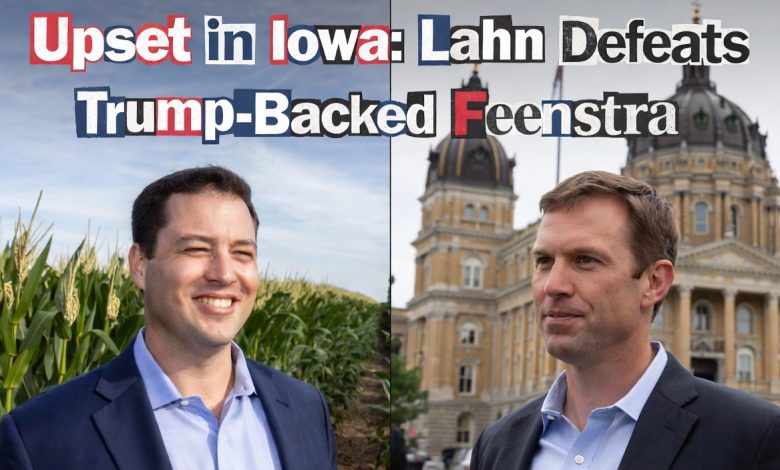
Zach Lahn has pulled off one of the most stunning political upsets of the 2026 midterm election season, capturing the Republican nomination for Governor of Iowa in a razor-thin, high-stakes battle. In a five-way race that tested the absolute limits of party loyalty and grassroots organization, the political newcomer edged out veteran U.S. Representative Randy Feenstra. This outcome sends shockwaves through both the state and national GOP establishments, signaling a massive transformation in the Republican electorate’s appetite for political outsiders.
Introduction: The Shocking Republican Primary Outcome in Iowa
For months, the race to succeed outgoing Iowa Governor Kim Reynolds, who declined to run for a third term, was widely considered Congressman Randy Feenstra’s to lose. Boasting high statewide name recognition and a formidable campaign treasury, Feenstra had the backing of the standard-bearer of the modern GOP: President Donald Trump. Yet, as the final votes were tallied on the night of June 2, 2026, the political landscape shifted beneath the establishment’s feet. Lahn, a farmer and businessman who campaigned on an unapologetic ‘Iowa First’ platform, secured an improbable victory that instantly redefines the 2026 midterm narrative.
Breaking Down the Numbers: Zach Lahn vs. Randy Feenstra
With 99% of the expected vote counted across Iowa’s 99 counties, Zach Lahn held 37.8% of the vote to Feenstra’s 37.0%. The margin, representing fewer than 2,000 votes statewide, was so narrow that major networks delayed projecting a winner for hours. However, Billy Fuerst, a spokesperson for Feenstra’s campaign, ultimately confirmed that the congressman had conceded the race to Lahn, acknowledging the mathematical impossibility of a comeback. The remaining portion of the vote was divided among the other three conservative contenders—Adam Steen, Brad Sherman, and Eddie Andrews—who collectively drew away critical support from Feenstra’s established base.
The Threat of a State Convention: Navigating the 35% Threshold
The narrow margins in this primary carried immense systemic consequences due to Iowa’s unique electoral regulations. Under state election law, if no candidate secures at least 35% of the primary vote, the contest is automatically thrown to a state party convention later in the month. At a convention, party delegates, rather than the general primary electorate, vote to select the nominee. Had Lahn or Feenstra fallen below that critical 35% mark, a wild, unpredictable floor fight would have ensued, potentially altering the entire outcome. By pushing past 37%, both candidates avoided this bureaucratic detour, ensuring that the primary electorate’s raw vote stood as the final authority.
Inside the Trump Campaign’s Post-Mortem: A ‘Randy Problem’
In the immediate aftermath of Feenstra’s concession, the mood inside the Trump campaign apparatus shifted from expectation to rapid damage control. ‘Clearly a Randy problem. Barely won his own district,’ a high-level Trump world strategist admitted in a candid text message circulated on election night. ‘But, it is what it is. So we go with Lahn. That’s fine. He did well.’ This insider acknowledgment highlights a growing sentiment that the defeat was less a rejection of Trump’s core MAGA ideology and more a reflection of Feenstra’s weakness as a candidate. To understand how a seasoned incumbent lost, strategists are looking closely at how Feenstra failed to secure his home turf.
How Feenstra’s House Base Eroded
Feenstra’s political career was built in Iowa’s 4th Congressional District, a deeply conservative swath of western and northwestern Iowa. Historically, this district has been the bedrock of his political power. However, the primary returns showed that even within his own backyard, Feenstra was unable to generate the overwhelming margins required to counteract Lahn’s surge in the state’s central and eastern counties. Critics argue that Feenstra’s transition from local champion to Washington legislator distanced him from the immediate concerns of rural Iowans, leaving a massive opening for Lahn’s aggressive, populist outreach.
Who is Zach Lahn? The MAHA and Grassroots Uprising
Zach Lahn’s ascent is rooted in a decentralized conservative coalition that has been quietly gaining steam nationwide. Aligned with the ‘Make America Healthy Again’ (MAHA) movement and carrying a key endorsement from Turning Point USA, Lahn successfully captured the passion of the party’s activist wing. Unlike Feenstra, who relied heavily on established PAC money and political relationships built over decades, Lahn operated with the freedom of a self-funded candidate. He loaned his own campaign $2 million in 2025, declaring early on that he was his own biggest donor. This financial independence resonated deeply with voters weary of traditional political funding pipelines.
Breaking Up Monopolies and Banning Dynamic Pricing
Throughout his campaign, Lahn focused heavily on deep, structural issues that bypassed standard political talking points. Rather than relying on simple ‘bumper sticker’ slogans, Lahn campaigned on a detailed platform aimed at combating corporate overreach. Among his chief proposals are:
- Filing state lawsuits to break up corporate monopolies that hurt local agricultural producers.
- Implementing a statewide ban on dynamic pricing systems used by large corporations to artificially manipulate consumer prices.
- Enacting systemic measures to investigate and address Iowa’s high cancer rates.
When the Feenstra campaign launched late-stage attack ads targeting Lahn’s past investments, Lahn successfully framed the attacks as the desperate gasps of a career politician who had broken a promise not to run a negative campaign.
Trump’s Late Endorsement and Midterm Implications
One of the most analyzed aspects of the primary is the role of President Donald Trump’s late-stage endorsement. Trump officially backed Feenstra via his Truth Social platform just days before the election, declaring him ‘MAGA all the way’. While Feenstra expressed deep honor and humility in receiving the endorsement, it ultimately failed to act as the kingmaker tool it has historically been. Political observers note that because all major candidates in the primary—including Lahn—remained highly supportive of Trump’s broader national agenda, the endorsement became less about ideology and more about choosing between the establishment and the grassroots.
The First Major Blow to the Trump Endorsement Machine in 2026
If the current vote margin holds, Lahn’s victory marks the first major defeat for a Trump-backed gubernatorial, House, or Senate candidate in the 2026 midterm primaries. This loss comes at a time when national focus is trained on Trump’s administrative maneuvers, including battles over international diplomacy and trade, which have been complicated by recent legal challenges like major unlawful tariff rulings. Despite these national headwinds and Trump’s aggressive negotiation style on the global stage, Iowa Republicans proved they are willing to decouple their support for Trump from his specific choice of local candidates. Lahn’s win proves that grassroots energy, when properly funded and organized, can successfully challenge the direct wishes of the party’s national leadership.
The General Election Battle: Zach Lahn vs. Rob Sand
The Republican primary is only the first hurdle. Zach Lahn now faces a formidable challenge in the general election, where he will square off against Democrat Rob Sand. Sand, the current State Auditor, is the only Democrat currently holding statewide office in Iowa. Having run unopposed in the Democratic primary, Sand has spent months building a massive $18 million campaign war chest, focusing his message on fiscal accountability and moderate, rural-friendly policies. Democrats view Sand as their best opportunity in a generation to reclaim the governor’s mansion, counting on the bitter divisions from the Republican primary to alienate moderate voters. This race is set to become one of the premier national battlegrounds, reflecting the future ideological battlegrounds of both major parties as they march toward the late 2020s.
Comparative Analysis of the GOP Candidates’ Campaigns
To understand how this dramatic upset took place, it is helpful to look at the differences in campaign strategies, financing, and policy priorities between the two leading candidates in the Republican field.
| Campaign Dimension | Zach Lahn (Nominee) | Randy Feenstra (Runner-Up) |
|---|---|---|
| Final Vote Share (%) | 37.8% | 37.0% |
| Primary Financial Strategy | Self-funded via $2M personal loan; heavy emphasis on individual grassroots donations. | Traditional PAC fundraising, national GOP network, transferred $1.4M from congressional fund. |
| Key Endorsements | Turning Point USA, MAHA (Make America Healthy Again) Coalition. | President Donald Trump, Republican Governors Association (RGA). |
| Core Policy Focus | Anti-monopoly litigation, ban on dynamic pricing, agricultural supply-chain security. | Established legislative track record, federal farm security, traditional MAGA platform alignment. |
| Campaign Tone | Populist, grassroots-driven, heavily defensive against establishment attacks. | Incumbent-style frontrunner, late transition to negative advertising. |
As the dust settles on this historic primary, both factions of the Iowa Republican Party must quickly find common ground. While Trump-world strategists may dismiss the loss as a localized ‘Randy problem,’ the reality is that Zach Lahn’s grassroots-fueled victory represents a potent blueprint for future insurgent campaigns across the country. To track the further development of this race and access historical data on past primary challenges in the state, readers can consult Ballotpedia’s detailed coverage of the Iowa gubernatorial transition.