South Dakota GOP primary: Runoff Triggered in Governor Race
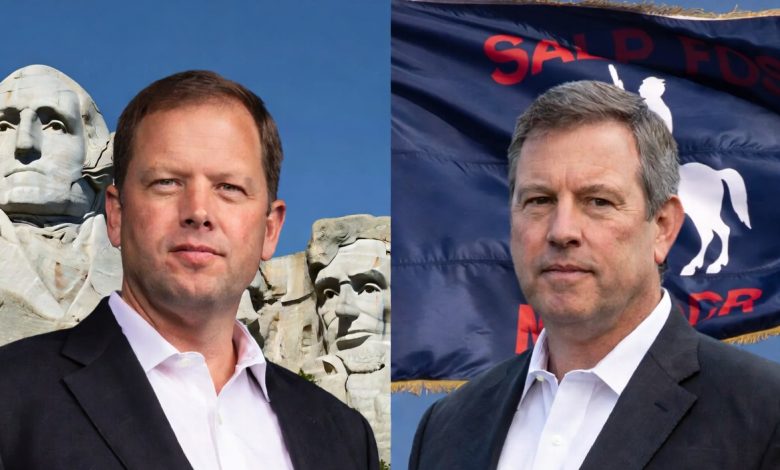
South Dakota GOP primary voters have delivered a historic and dramatic result in the state’s highly anticipated four-way gubernatorial race, shattering decades of political precedent. With returns finalized across the Mount Rushmore State’s 686 precincts, Aberdeen businessman and self-described political outsider Toby Doeden has surged to the front of the pack, securing approximately 30% of the vote. Incumbent Governor Larry Rhoden, who assumed the state’s highest office in early 2025 following Kristi Noem’s departure for Washington, finished in second place with 26% of the vote. Because South Dakota law mandates that a candidate must eclipse a strict 35% threshold to win a primary outright in a multi-candidate field, the race is officially headed to a high-stakes runoff election on July 28, 2026. This marks the first time since the passage of the state’s runoff law in 1985 that a Republican primary will be settled in a mid-summer head-to-head duel, transforming what was already a fierce ideological battle into an unprecedented campaign sprint.
The Historic South Dakota GOP Primary Results
The June 2, 2026, primary election will go down in South Dakota history as one of the most competitive and volatile gubernatorial contests ever recorded. For months, independent polling suggested a tight, multi-faction split within the state’s dominant political party, but few predicted just how evenly the electorate would divide. The closed primary, restricted exclusively to registered Republicans, drew substantial turnout as voters wrestled with the future direction of the state’s conservative movement. In a state where the Republican primary nominee is virtually guaranteed victory in the November general election, the stakes could not have been higher.
For Governor Larry Rhoden, the night was a sobering reminder of the challenges of incumbency. Despite having the institutional backing of much of the state’s political establishment and campaigning alongside Lieutenant Governor Tony Venhuizen, Rhoden was unable to consolidate the party’s base. The rise of Toby Doeden, coupled with strong campaigns from U.S. Representative Dusty Johnson and state House Speaker Jon Hansen, fragmented the electorate. This fractured result showcases a deep ideological debate within South Dakota: a choice between established, pragmatic governance and a disruptive, populist brand of conservative activism.
Breaking Down the Four-Way Vote Share
To fully understand the dynamics of this historic primary, it is essential to examine how the votes were distributed among the four major candidates. The tight cluster of results shows that each candidate commanded a distinct and loyal segment of the Republican electorate, leaving no single contender with a clear mandate. The unofficial final tallies indicate a remarkably balanced field:
| Candidate | Primary Vote Share (%) | Key Campaign Themes | Runoff Status |
|---|---|---|---|
| Toby Doeden | 30% | Political outsider, MAGA alignment, business background | Advanced to July 28 Runoff |
| Gov. Larry Rhoden | 26% | Property tax cuts, law enforcement, agricultural heritage | Advanced to July 28 Runoff |
| Rep. Dusty Johnson | 24% | Pragmatic conservatism, federal legislative record, agricultural advocacy | Eliminated |
| Speaker Jon Hansen | 21% | Staunch social conservatism, legislative experience, constitutional focus | Eliminated |
Why No Candidate Crossed the 35% Threshold
The transition from a standard primary to a mid-summer runoff is governed by a specific provision in South Dakota election law designed to ensure that major party nominees command a substantial baseline of support. Under state statute enacted in 1985, if there are three or more candidates seeking the nomination for governor, U.S. Senator, or U.S. Representative, and no candidate receives more than 35% of the total votes cast, the top two vote-getters must compete in a secondary runoff election. This law was designed to prevent a candidate from winning a nomination with a small plurality in a highly fractured field, which could lead to weaker candidates representing the party in November.
Prior to this year’s primary, South Dakota had never actually triggered a runoff under the 1985 statute. In historical instances before the law was passed, when no candidate cleared the 35% threshold, the nomination was decided by delegates at a state party convention—a process often criticized for its susceptibility to backroom deals. By forcing a direct runoff on July 28, the decision remains firmly in the hands of everyday Republican voters, according to detailed analysis on historical primary structures available on Ballotpedia. This democratic mechanism ensures that either Doeden or Rhoden will emerge with a clear majority of the primary electorate’s backing before facing Democratic nominee Dan Ahlers in the November general election.
Toby Doeden: The Political Outsider Leading the Pack
Toby Doeden’s rise to the top of the Republican primary field has sent shockwaves through South Dakota’s political establishment. An investment group president and retail executive from Aberdeen, Doeden entered the race as a self-funded political outsider determined to challenge the status quo. His campaign website boldly branded him as a “total political outsider who’s tired of the government’s failure to deliver on its promises” and positioned him as one of Donald Trump’s “fiercest supporters.” By heavily self-funding his campaign, Doeden was able to bypass traditional gatekeepers, launching a massive media blitz that focused on anti-establishment sentiment and populist economic reform.
Doeden’s campaign tapped into a rising populist economic sentiment that favors protectionist policies and deep tax relief. This populist economic fervor mirrors national debates, such as when federal judges intervened and tariffs were deemed illegal after being struck down in trade disputes. By framing himself as a successful businessman who cannot be bought by lobbyists or special interests, Doeden resonated deeply with working-class voters, particularly in East River communities and rural counties. His aggressive style, direct rhetoric, and rejection of political norms allowed him to capture the largest slice of the primary vote, establishing him as the front-runner heading into the July runoff.
Governor Larry Rhoden: Fighting to Maintain the Incumbency
Governor Larry Rhoden’s political journey is deeply rooted in South Dakota’s agricultural and legislative traditions. A lifelong rancher from Union Center, Rhoden served as a state representative, state senator, and agriculture secretary before being selected by then-Governor Kristi Noem as her running mate in 2018. When Noem resigned in January 2025 to accept President Donald Trump’s nomination to lead the Department of Homeland Security, Rhoden was elevated to the governorship. However, serving less than half a term as governor proved insufficient to clear the primary field, leaving Rhoden to defend his position against three aggressive challengers.
Rhoden’s re-election campaign was built on a foundation of proven leadership, stability, and concrete conservative achievements. He campaigned extensively on delivering substantial property tax cuts, bolstering rural law enforcement, and supporting the state’s vital agricultural sector. Standing before supporters at his election watch party in Rapid City, wearing his signature black cowboy hat, Rhoden remained optimistic about the upcoming runoff. Backed by Lt. Gov. Tony Venhuizen and a broad coalition of state lawmakers, Rhoden’s campaign will seek to paint Doeden as an unpredictable and unproven commodity, arguing that South Dakota’s economic success is best served by experienced, steady leadership.
Dusty Johnson and Jon Hansen: The Narrow Misses
The elimination of U.S. Representative Dusty Johnson and state House Speaker Jon Hansen highlights the razor-thin margins that defined this primary. Dusty Johnson, who has served as South Dakota’s lone at-large congressman since 2019, entered the race with high name recognition and a reputation as a highly effective, policy-oriented conservative. Campaigning on his federal record of agricultural advocacy and fiscal responsibility, Johnson was widely seen as a formidable contender. However, his brand of pragmatic conservatism struggled to capture the highly motivated anti-establishment base that turned out for Doeden, leaving him just short of the runoff with 24% of the vote.
State House Speaker Jon Hansen, representing the staunchly conservative wing of the state legislature, finished in fourth place with 21% of the vote. Campaigning alongside his running mate, Representative Karla Lems, Hansen focused heavily on constitutional principles, pro-life advocacy, and local control. While his message resonated strongly with social conservatives and grassroots activists, it was ultimately not enough to overcome the massive media footprint of Doeden or the institutional advantages of Rhoden. The exit of Johnson and Hansen leaves nearly half of the primary electorate’s votes up for grabs, making their endorsements and the realignment of their supporters the central focus of the runoff campaign.
The Shadow of Kristi Noem and Donald Trump
The political vacuum created by Kristi Noem’s departure for Washington has fundamentally reshaped South Dakota’s political landscape. Noem’s transition to lead the Department of Homeland Security occurred as Donald Trump restructured his Cabinet, drawing high-profile state leaders into federal service. During his administration, Trump’s federal policy actions—such as when grants halted by the Trump administration were deemed unconstitutional by federal courts—kept the national spotlight on executive authority and state-federal friction. Noem’s resignation left South Dakota Republicans without a clear, unifying leader, triggering a fierce battle to claim her populist mantle.
Adding to the complexity of the primary was Donald Trump’s decision to remain neutral. Despite Doeden’s vocal alignment with the MAGA movement and his branding as one of Trump’s “fiercest supporters,” the former president did not issue an endorsement in the South Dakota gubernatorial race. This lack of a formal presidential endorsement allowed multiple candidates to claim the pro-Trump mantle in their own ways. While Doeden channeled Trump’s anti-establishment, outsider rhetoric, Governor Rhoden pointed to his alignment with Trump’s policy goals at the state level. The absence of a unifying endorsement ensured a competitive, multi-faction primary that will now be resolved in a direct, head-to-head matchup.
Key Policy Battles: Tax Cuts, Crime, and Populism
As the campaign shifts to a two-candidate runoff, the key policy differences between Toby Doeden and Governor Larry Rhoden will take center stage. While both candidates share fundamental conservative principles, their approaches to governance, taxation, and economic development differ significantly. Rhoden has focused heavily on targeted property tax relief and boosting funding for law enforcement to combat rising crime rates in mid-sized cities. His approach is highly legislative, relying on his deep understanding of Pierre’s political machinery to deliver stable, incremental reforms.
In contrast, Doeden has championed a more disruptive economic and political agenda. He has called for sweeping tax cuts, a dramatic reduction in state spending, and a hardline stance against corporate influence in state government. A major undercurrent in the race has been the controversy surrounding carbon dioxide pipelines and eminent domain—an issue that has deeply divided South Dakota’s agricultural community. Doeden has positioned himself as a staunch defender of private property rights, criticizing what he views as the state government’s cozy relationship with pipeline corporations. This issue, along with debates over educational standards and parental rights, will define the rhetorical battleground over the next eight weeks.
What Lies Ahead for the July Runoff
The upcoming July 28 runoff represents uncharted territory for South Dakota political strategists, candidates, and voters alike. With the field narrowed to Doeden and Rhoden, the central question is how the supporters of Dusty Johnson and Jon Hansen will realign. Because Johnson’s supporters tend to favor pragmatic, experienced governance, many political analysts expect a significant portion of his 24% vote share to shift toward Governor Rhoden. However, Hansen’s 21% vote share, which consists of highly motivated social conservatives and grassroots activists, could prove more volatile, with some drifting toward Doeden’s anti-establishment message and others backing Rhoden’s proven conservative track record.
The intense polarization within South Dakota’s Republican Party mirrors broader national trends. Just as Harris’s 2028 ambitions stir debate over the election postmortem on the Democratic side, the GOP is undergoing its own post-primary soul-searching. Ultimately, the July runoff will decide whether South Dakota Republicans want to continue the stable, establishment-aligned governance represented by Larry Rhoden or embark on a new, populist path led by Toby Doeden. The winner of this historic contest will secure the Republican nomination and become the heavy favorite to win the governorship in November, ensuring that the eyes of the region will remain firmly fixed on South Dakota throughout the summer.