60 Minutes Clash: Pelley Accuses Weiss of Murdering Show
Introduction: The Battle Within CBS News
60 Minutes has erupted into an unprecedented corporate and journalistic civil war, exposing a deep rift at CBS News under its new management. A highly contentious internal staff meeting on Monday, June 1, 2026, transformed into an open rebellion when legendary correspondent Scott Pelley launched a scathing, direct attack against the network’s editor-in-chief, Bari Weiss, and the program’s newly appointed executive producer, Nick Bilton. The confrontation, captured in leaked audio recordings that quickly circulated throughout the media industry, highlights the growing anxieties surrounding corporate consolidation, editorial independence, and the perceived sanitization of legacy newsrooms.
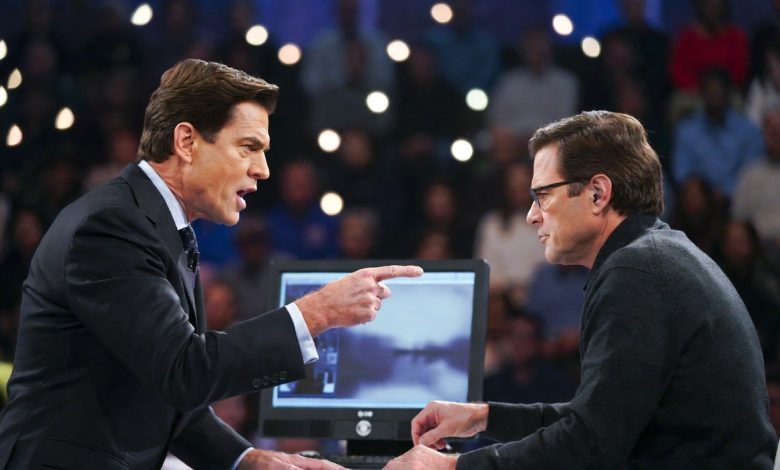
The tension within the storied Midtown Manhattan headquarters of CBS was palpable. Designed to introduce Nick Bilton—a veteran tech columnist and filmmaker who has never worked in traditional broadcast television—as the new editorial leader of the nation’s most prestigious newsmagazine, the meeting quickly spiraled into a referendum on the network’s direction. Pelley, a 30-year veteran of CBS News and a 60 Minutes correspondent for over two decades, bypassed corporate niceties to accuse Weiss of actively dismantling the program. His explosive remarks, which included accusing Weiss of “murdering” the show, have sent shockwaves through the television industry and raised urgent questions about the future of investigative journalism.
Black Thursday and the Decimation of 60 Minutes
The roots of Monday’s historic clash lie in what newsroom staffers have grimly dubbed “Black Thursday”. Just days prior to the meeting, Bari Weiss stunned the media industry by orchestrating a massive, top-down purge of 60 Minutes leadership. Among those abruptly fired was executive producer Tanya Simon, a respected 30-year veteran of the network who represented a direct, unbroken lineage to the show’s legendary founder, Don Hewitt. Alongside Simon, several longtime producers and two of the show’s seven prominent correspondents—Sharyn Alfonsi and Cecilia Vega—were also shown the door.
For the remaining staff, the sudden removal of these key figures was not merely a routine corporate restructuring; it was viewed as an act of institutional aggression. The ouster of Simon, Alfonsi, and Vega stripped the program of decades of investigative expertise, leaving the newsroom shell-shocked and deeply suspicious of management’s motives. When Bilton stood before the remaining staff to assume leadership, he was not just stepping into a new office—he was stepping into a newsroom that felt systematically violated by its own corporate parents.
The Profile of Nick Bilton: A Tech Outsider
To replace Tanya Simon, Bari Weiss made the unconventional and highly controversial decision to hire Nick Bilton. Bilton is well-known in media circles as a former technology columnist for The New York Times, a special correspondent for Vanity Fair, and an accomplished documentary filmmaker. While his journalistic credentials in print and digital spaces are widely recognized, his complete lack of experience in the complex, highly specialized world of multi-camera broadcast television was immediately flagged as a major liability by legacy staffers.
By inserting Bilton, a veteran tech reporter, Weiss is attempting to replace traditional broadcast architecture with digital-native sensibilities. This echoes broader trends where Silicon Valley tech narratives overlap with traditional cultural institutions, similar to how the Elon Musk OpenAI legal drama highlights the ongoing struggle between legacy protocols and tech-first disruptions. In the eyes of Pelley and other broadcast veterans, appointing an executive producer with no history in linear television to steer the crown jewel of CBS News was an insult to the craft—and a clear sign of corporate intent to dilute the program’s rigorous investigative formula in favor of bite-sized, digital-friendly content.
The Transcript of the Confrontation: Step-by-Step
The Monday morning staff meeting was intended to be a routine introduction, with Bilton attempting to project calm and operational continuity. “For me, the journalism is the journalism,” Bilton told the assembled staff, attempting to establish common ground. “That is why I am here. That is why we are all here.” He sought to directly address rampant anxieties that the show’s format would be heavily altered to match modern social media trends. “The rumors people are spreading, that I’m going to turn the show into 60 one-minute episodes, that it’s going to be like TikTok, that is not changing. The show is going to stay exactly like it is for now,” Bilton added.
However, the atmosphere shifted permanently when Bilton attempted to defend his boss, Bari Weiss, by claiming she held a deep reverence for the program’s legacy. “Bari loves this institution. She loves ’60 Minutes,'” Bilton asserted, according to the leaked audio.
Scott Pelley immediately interrupted him, delivering a sharp and uncompromising rebuttal: “She is murdering ’60 Minutes.’ She does not love this place. She was brought in to kill it, and she’s been doing exactly that”.
The exchange quickly escalated as Pelley turned his fire directly onto Bilton’s own qualifications. “She has no qualifications for her job; you have slender qualifications for this job,” Pelley declared, directly challenging the executive producer in front of his entire new staff. “The changes that she’s made at the ‘Evening News’ have been catastrophic, so why should we expect that any of this is going to be any better?”
‘This is Not an Interview’: How the Clash Escalated
Rather than backing down, Pelley pressed Bilton on the specific operational decisions that led to the mass firings of “Black Thursday”. He demanded to know the rationale behind terminating Sharyn Alfonsi, asking point-blank, “What was wrong with Sharyn Alfonsi?” When Bilton attempted to sidestep the inquiry, stating he would “defer” from answering the question, Pelley sharply warned him, “This is not the crowd to dodge”.
The confrontation grew so tense that Charles Forelle, the CBS News Managing Editor and a staunch ally of Weiss, intervened. Observing the prosecutorial nature of Pelley’s questioning, Forelle remarked, “This is not an interview”. Pelley, true to his investigative roots, coolly replied, “It’s working for me”.
Bilton tried to maintain composure under the intense barrage, telling Pelley, “I will show you. That’s what I have to say”. He also maintained that he had “no problem taking a job in a place that I am not welcome in”. When Pelley asked why he would accept the role knowing he would face institutional resistance, Bilton simply stood his ground, attempting to pivot back to a cooperative tone. However, the damage was done, and the meeting concluded after just 15 minutes of highly charged back-and-forth.
Weiss’s Corporate Playbook: The Skydance Media Blueprint
To fully understand the severity of this internal rebellion, one must look at the broader structural changes that have swept through CBS News since its parent company, Paramount, merged with Skydance Media in late 2025. Under the direction of billionaire David Ellison, Skydance initiated a massive cultural and political pivot within the legacy media giant. Bari Weiss was brought in as Editor-in-Chief with a clear mandate to disrupt what the new ownership viewed as an outdated, linear, and politically biased operation.
Weiss has publicly argued that legacy media must radically modernize or face financial ruin. “Our strategy until now has been to cling to the audience that remains on broadcast television,” Weiss stated during a tense CBS News town hall meeting. “I’m here to tell you that if we stick to that strategy, we’re toast. CBS News is still in a linear mentality and we need to shift to a streaming mentality immediately”.
While Weiss frames her disruption as a necessary transition to a modern digital economy, her critics view it as a thinly veiled effort to alter the network’s editorial DNA. The broader media ecosystem is currently witnessing severe disruptions, where even digital titans face rapid shifts; for instance, the recent collapse of prominent digital pundits demonstrates that both legacy and alternative platforms are navigating treacherous waters in maintaining audience trust. In the case of CBS, staff members fear that the destruction of traditional broadcast structures is designed to make the network’s reporting less adversarial and more commercially compliant.
The Political Dimensions: Trump, Mergers, and Editorial Freedom
Beyond digital modernization, there is a distinct, highly charged political layer to the overhaul of 60 Minutes. The parent company, Paramount, is currently seeking crucial regulatory approval from the Trump administration to finalize its high-stakes acquisition of CNN and the remainder of Warner Bros. Discovery. In this delicate regulatory climate, maintaining an aggressive, hard-hitting investigative news program that frequently draws the ire of political figures is seen by some corporate executives as a distinct liability.
Donald Trump has historically had a highly litigious relationship with 60 Minutes. In 2024, he filed a high-profile multi-billion-dollar lawsuit against CBS News over the editing of an interview with Kamala Harris. Under its new Skydance ownership, Paramount chose to settle the lawsuit rather than defend its editorial practices in court. Furthermore, as part of the concessions to secure administrative goodwill, Paramount agreed to eliminate diversity, equity, and inclusion (DEI) programs, hired a dedicated bias ombudsman, and abruptly canceled The Late Show with Stephen Colbert.
These corporate adjustments under David Ellison are viewed by critics as part of a wider effort to align Paramount with the current administrative mood in Washington. Just as various executive mandates and grants halted by the Trump administration have reshaped federal spending and regulatory landscapes, media conglomerates are actively repositioning themselves to survive administrative scrutiny. Within this context, Pelley’s accusation that Weiss was “brought in to kill” 60 Minutes represents a fear that the show is being declawed to prevent political blowback during critical corporate mergers.
Catastrophic Changes: The Fall of the CBS Evening News
During the confrontation, Pelley specifically pointed to the “catastrophic” changes made to the CBS Evening News under Weiss’s leadership as a warning sign of what is to come for 60 Minutes. Under Weiss’s handpicked anchor, Tony Dokoupil, the network’s flagship nightly broadcast has undergone a radical transformation, focusing on alternative formats and adopting what some staff members describe as a more politically conservative lean.
The editorial shift has coincided with a severe and highly visible ratings decline. Throughout much of April 2026, the CBS Evening News dipped below 4 million nightly viewers, a historically low threshold that has caused panic among local affiliates. For Pelley, who personally anchored the broadcast from 2011 to 2017 and maintained its reputation for serious, hard-news reporting, the decline under Dokoupil is proof of the failure of Weiss’s editorial philosophy. His concern is that the same modernizing playbook, if applied to 60 Minutes, will alienate the program’s fiercely loyal audience and destroy its status as the most-watched news program on television.
The Legacy vs. The New Regime: A Structural Comparison
The clash between the old guard and the new regime at CBS News is not just a personal feud between Scott Pelley and Bari Weiss; it is a battle between two fundamentally incompatible models of journalism. The table below highlights the stark structural and philosophical differences between the traditional 60 Minutes model and the newly imposed Skydance-Weiss framework:
| Feature/Role | The Legacy Era (Tanya Simon / Traditional) | The Skydance-Bari Weiss Regime (Nick Bilton) |
|---|---|---|
| Executive Producer Background | Decades of broadcast news experience, deep institutional knowledge (Tanya Simon: 30-year veteran). | Tech journalism, digital reporting, and documentary filmmaking (Nick Bilton: former NYT/Vanity Fair). |
| Editorial Philosophy | Focus on high-quality, long-form investigative linear television packages with rigorous editorial standards. | Accelerated shift toward streaming-first delivery, digital modernization, and shorter-form engagement. |
| Political & Corporate Context | Independent editorial silo protected from direct parent company interference and political appeasement. | Aligns with Skydance Media CEO David Ellison’s corporate strategy, seeking regulatory favor with political figures. |
| On-Air Personnel Strategy | Stability with highly recognizable, veteran network correspondents (e.g., Sharyn Alfonsi, Cecilia Vega). | Aggressive downsizing of traditional correspondents; restructuring to trim operational costs and shift talent. |
This structural divergence shows why the current transition is being met with such fierce resistance. For broadcast veterans, the shift represents a dismantling of the checks and balances that historically protected the newsroom from corporate and political pressures.
The Apprehension of the Newsroom: Applause and Resistance
Despite the tense nature of Monday’s meeting, the reaction from the wider 60 Minutes newsroom was highly revealing. According to several sources inside the room, after Bilton abruptly ended the meeting and departed, the remaining staff broke into spontaneous, enthusiastic applause for Scott Pelley. This reaction indicates that Pelley was not merely acting as a lone dissenter, but was instead giving voice to a deep, widespread anxiety shared by the entire institutional staff.
According to details first reported by The Washington Post, the sentiment within the newsroom is divided between those who view Pelley’s actions as a heroic defense of the program’s soul and those who view them as highly unprofessional. While Charles Forelle and other Weiss loyalists condemned the veteran correspondent’s tone as “rude,” other senior broadcast figures have publicly backed his stance. Rome Hartman, a legendary 25-year producer for the show who retired last year, openly characterized the recent wave of firings under Weiss as an act of “arrogance, disrespect, and cruelty”.
Conclusion: Can 60 Minutes Survive the Corporate Guillotine?
60 Minutes now stands at the most critical crossroads in its nearly 60-year history. The public and highly aggressive nature of Pelley’s rebellion has shattered any illusion of a smooth transition under Nick Bilton and Bari Weiss. As Bilton begins his tenure by attempting to schedule individual meetings with shell-shocked staff members, he does so under a dark cloud of illegitimacy and intense internal hostility.
Whether the program can survive this corporate overhaul without losing its legendary investigative teeth remains to be seen. If Weiss and Bilton succeed in diluting the program’s traditional format to appease corporate owners and political figures, they risk alienating the millions of viewers who rely on the show for uncompromising, high-stakes journalism. The civil war inside CBS News is far from over, and its outcome will likely shape the landscape of investigative broadcast television for decades to come.