Vinícius Leads Brazil to World Cup Knockouts with Spectacular Brace 2026
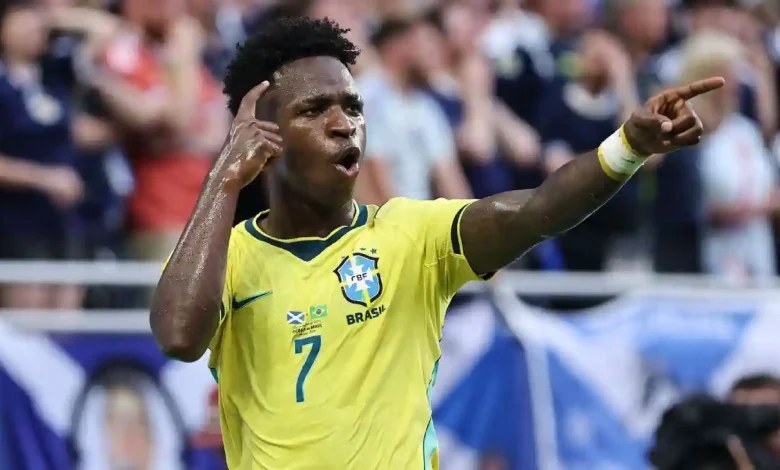
Table of Contents
Vinícius, the scintillating Real Madrid and Brazil forward, put on a masterclass at South Florida’s premier sports venue, proving once again why he is regarded as one of the most lethal attackers on the planet. Amidst the intense tropical heat of Miami Gardens, Brazil dismantled a stubborn Scotland side with a convincing 3-0 victory, booking their place in the highly anticipated knockout stages of the 2026 FIFA World Cup. The match at Hard Rock Stadium served as a testament to the Seleção’s tactical evolution under manager Carlo Ancelotti, who has successfully blended defensive resilience with the explosive, free-flowing football that fans across the globe adore. With this victory, Brazil secured their position at the summit of Group C, advancing to the Round of 32 with immense momentum and sending a clear warning to their tournament rivals.
Vinícius Ignites Brazil’s World Cup Campaign in Miami
The stellar performance from Brazil’s attacking core highlights a tournament that has already delivered endless drama. Coming into their third matchday, the pressure was firmly on the South American giants to deliver a statement win. Having previously secured a 3-0 win against Haiti and a hard-fought 1-1 draw against Morocco, the Seleção needed to refine their offensive cohesion. Under the brilliant tactical guidance of Ancelotti, they did just that. Driven by the electric movements of their frontline, Brazil played with a level of intensity and tactical discipline that Scotland simply could not replicate over the course of ninety minutes. This decisive performance ensures Brazil maintains its flawless record of reaching the tournament’s knockout phase, continuing a historic footballing lineage.
Group C Decider: Brazil vs. Scotland Match Analysis
The tactical showdown between Brazil and Scotland was one of the most anticipated matchups of the group stage. Scotland, led by manager Steve Clarke, set up in a disciplined and compact 4-4-1-1 formation, aiming to frustrate the Brazilian midfield and exploit counter-attacking opportunities through Lawrence Shankland and Scott McTominay. On the other side, Carlo Ancelotti opted for an aggressive, fluid 4-3-3 system, starting Vinícius Júnior, Matheus Cunha, and the young prodigy Rayan in attack. Brazil’s midfield, anchored by Bruno Guimarães and Lucas Paquetá, dictated the tempo from the opening whistle, suffocating Scotland’s attempt to build from the back. While public and media speculations about Brazil’s starting lineup often create high-profile drama—much like how the Lively-Baldoni settlement reached an unofficial close to their public dispute—Ancelotti kept his squad entirely focused on tactical discipline on the pitch, resulting in a cohesive performance that left Scotland with very few answers.
The Early Breakthrough: Vinícius Strikes in the Seventh Minute
It did not take long for the deadlock to be broken, as Brazil’s high press immediately forced a critical error from the Scottish defense. In the seventh minute, 19-year-old striker Rayan intercepted a misplaced pass in the final third and played a perfectly weighted through-ball into the path of Vinícius. Exhibiting his trademark electric pace and composure, the Brazilian winger rounded Scotland’s goalkeeper Angus Gunn with a single touch before calmly slotting the ball into an empty net. The early goal completely disrupted Steve Clarke’s defensive game plan, forcing Scotland to abandon their low block and seek an equalizer, which ultimately left more space for the Seleção to exploit.
Doubling the Advantage: A Clinical Close-Range Header Before Halftime
Despite Scotland’s efforts to stabilize their midfield and mount a response, Brazil’s relentless attacking pressure paid off once again just before the halftime whistle. In stoppage time of the first half, Bruno Guimarães delivered a pinpoint cross into the penalty area after a fluid team build-up. Vinícius anticipated the delivery perfectly, ghosting past his marker to send a powerful, close-range header past Gunn. The second goal of the night stunned Scotland, securing a comfortable 2-0 cushion for Brazil as they headed into the tunnel and demonstrating the winger’s ever-improving aerial ability and tactical positioning inside the penalty area.
Golden Boot Race: Vinícius Closes in on Messi, Haaland, and Mbappé
With his exceptional brace against Scotland, Vinícius has firmly established himself as a frontrunner for the prestigious Golden Boot award. The Brazilian superstar has now scored in all three of Brazil’s group matches, bringing his individual tally to four goals in the tournament. This impressive feat ties him with Norway’s Erling Haaland and France’s Kylian Mbappé, leaving him just one goal behind Argentina’s legendary Lionel Messi, who leads the charts with five goals. The race for the tournament’s top scorer is heating up, and the relentless consistency shown by the Seleção’s number seven indicates that he will remain a central figure in this elite statistical battle as the knockout rounds commence.
Group C Final Standings and Statistics
The conclusion of Group C action solidified the standings, with Brazil finishing at the top of the table on goal difference over a resilient Morocco. Meanwhile, Scotland’s dreams of advancing past the group stage for the first time in their history were dashed, although they put up a commendable fight throughout their three fixtures. Below is the detailed breakdown of the final Group C standings and the tournament’s top goalscorers according to the official tournament statistics published on FIFA’s official tournament hub.
Group C Final Table
| Team | Played | Won | Drawn | Lost | GF | GA | GD | Points |
|---|---|---|---|---|---|---|---|---|
| Brazil (Q) | 3 | 2 | 1 | 0 | 7 | 1 | +6 | 7 |
| Morocco (Q) | 3 | 2 | 1 | 0 | 6 | 4 | +2 | 7 |
| Scotland | 3 | 1 | 0 | 2 | 2 | 6 | -4 | 3 |
| Haiti | 3 | 0 | 0 | 3 | 2 | 6 | -4 | 0 |
Golden Boot Leaderboard (After Group Stage)
| Player | Nation | Goals Scored |
|---|---|---|
| Lionel Messi | Argentina | 5 |
| Vinícius Júnior | Brazil | 4 |
| Erling Haaland | Norway | 4 |
| Kylian Mbappé | France | 4 |
The Crowning Moment: Neymar’s Triumphant Return from Injury
While the goalscoring exploits of Vinícius dominated the headlines, the night was also defined by a highly anticipated return that sent shockwaves of excitement through the footballing world. Neymar, Brazil’s all-time leading goalscorer with 79 goals in 130 international appearances, made his tournament debut in the 76th minute. The 34-year-old forward had been sidelined for Brazil’s first two matches against Morocco and Haiti due to a stubborn right calf injury sustained during pre-tournament training. His absence had raised concerns among fans and pundits alike, but his late cameo on Wednesday proved that the iconic forward is ready to contribute to the nation’s quest for a historic sixth World Cup title.
Hard Rock Stadium Erupts for the Number 10
The atmosphere inside Hard Rock Stadium reached a fever pitch midway through the second half as the partisan Brazilian crowd noticed Neymar warming up on the sideline. Chants of his name echoed throughout the massive arena, escalating into a deafening roar when he finally trotted onto the pitch to replace young prodigy Rayan. The emotional outpouring from the fans highlighted the deep-seated connection between the legendary number 10 and the Brazilian public. Despite his limited minutes, Neymar’s presence instantly lifted the team’s spirits and added an extra layer of creative flair to an already dominant Brazilian attack, providing a preview of the offensive synergy Ancelotti hopes to utilize in the later stages of the tournament.
Assessing Neymar’s Fitness Ahead of the Round of 32
As the Seleção transition into the high-stakes environment of single-elimination football, Neymar’s physical fitness will be under intense scrutiny. His 14-minute appearance against Scotland was a calculated move by Carlo Ancelotti to give the playmaker valuable competitive minutes without risking a setback. Sports science experts suggest that managing calf injuries requires a delicate balance, and his integration back into the starting lineup will likely be gradual. Such elite athletic journeys draw parallels to historic sporting narratives, like the remarkable story of Devaux’s journey from stable worker to Breeder’s Cup champion, proving that resilience and careful physical management are the core engines of championship-level greatness. Whether Neymar starts in the Round of 32 or continues to be deployed as a super-sub remains one of the most critical tactical questions facing the Brazilian coaching staff.
The Global Logistics: South Florida Welcomes the World Cup
Hosting a match of this magnitude presented significant logistical challenges for the city of Miami Gardens and the broader South Florida region. Over 75,000 passionate football fans, primarily clad in the vibrant yellow and green of Brazil, flooded the stadium, creating a vibrant carnival atmosphere. However, the influx of international travelers put immense pressure on local transportation infrastructure, with travel logistics in the South Florida region experiencing immense pressure, reminiscent of when Spirit Airlines shuts down leaving thousands stranded at Fort Lauderdale-Hollywood International Airport. Despite these regional transport hurdles, the Samba spirit prevailed, and local authorities managed to guide the massive crowd safely in and out of the venue, highlighting Miami’s capability as a premier global sports destination.
Group C Finale: Morocco’s Thrilling Comeback Over Haiti
Simultaneously in Atlanta, the other Group C fixture delivered an absolute classic as Morocco rallied to defeat a spirited Haiti side 4-2. Haiti, playing in their first World Cup since 1974, defied all expectations by taking an early lead through a Yassine Bounou own goal, marking their first World Cup goal in over five decades. Although Morocco equalized through Achraf Hakimi, Haiti stunned the 2022 semifinalists once again when Wilson Isidor scored a brilliant strike to restore their lead before halftime. However, Morocco’s tournament pedigree and depth eventually shone through, with goals from Ismael Saibari, Soufiane Rahimi, and Gessime Yassine completing a thrilling second-half comeback. The victory secured second place in the group for the Atlas Lions, ensuring their progression to the Round of 32 alongside Brazil.
Looking Ahead: Path Through the Knockout Rounds
With the group stage behind them, Brazil’s focus shifts entirely to the knockout rounds, marking their 15th consecutive appearance in the World Cup elimination phase—a remarkable record of consistency unmatched in modern football history. Having progressed as Group C winners, the Seleção will now prepare to face one of the third-placed qualifiers in the Round of 32, with potential matchups including highly competitive European or South American opponents. Carlo Ancelotti’s side has shown steady improvement over their three group matches, transitioning from a slightly rusty 1-1 draw against Morocco to back-to-back 3-0 triumphs over Haiti and Scotland. As they pursue their elusive sixth World Cup trophy, the defensive solidity of Marquinhos, the creative midfield hub of Bruno Guimarães, and the unstoppable attacking tandem of Vinícius and Neymar will be the pillars upon which Brazil’s dreams rest.