Hidden Beneath the Wall: The Secret 20,000-Person Underground City Found by Accident
Introduction
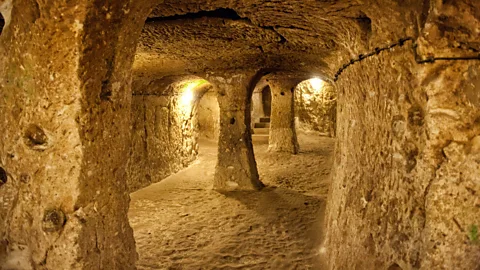
In 1963, a simple home renovation in the Nevşehir Province of Turkey led to one of the most staggering archaeological discoveries of the 20th century. While knocking down a wall in his basement, a local man discovered a hidden room that opened into a dark, hand-carved tunnel. This was the threshold to Derinkuyu, a massive subterranean metropolis that could accommodate up to 20,000 people. Hidden Beneath the Wall: The Secret 20,000-Person Underground City Found by Accident has since become a focal point for historians, geologists, and travelers alike, revealing a complex urban ecosystem buried deep within the soft volcanic rock of Cappadocia.
This article explores the architectural genius, the historical necessity, and the modern-day significance of Derinkuyu. We will delve into how an entire civilization managed to thrive hundreds of feet below the surface, surviving siege after siege throughout the millennia. From its ingenious ventilation systems to its impenetrable rolling stone doors, Derinkuyu stands as a testament to human resilience and engineering ingenuity in the face of existential threats.
Table of Contents
History / Background
The origins of Derinkuyu are as layered as the city itself. While the exact date of its inception remains a subject of academic debate, most archaeologists believe the initial excavation began with the Phrygians, an Indo-European people, between the 8th and 7th centuries BCE. These early inhabitants utilized the unique properties of the local tuff—a soft, pliable rock formed from ancient volcanic ash—to carve out basic storage and living quarters.
As the centuries progressed, the city underwent significant expansion. During the Byzantine era (approximately 395–1453 CE), the site was heavily modified and enlarged by early Christian communities. For these residents, the city served as a vital sanctuary. Cappadocia sat at the crossroads of major trade routes and was frequently caught in the crossfire of the Arab-Byzantine wars. When invading armies approached, the local population would retreat into the depths, vanishing from the surface entirely.
Derinkuyu remained in use for centuries, even providing refuge for Christians during the Ottoman period as late as the early 20th century. It was only after the population exchange between Greece and Turkey in 1923 that the tunnels were finally abandoned, eventually being forgotten by the surface world until that fateful renovation in 1963. Today, it is recognized as a UNESCO World Heritage site, representing the pinnacle of troglodyte (cave-dwelling) architecture.
Deep Dive Analysis
Derinkuyu is not merely a series of caves; it is a fully realized urban environment descending approximately 280 feet (85 meters) across 18 distinct levels. To understand how 20,000 people could survive here, we must analyze the specific systems that supported life in total darkness.
Subterranean Engineering
The most critical component of Derinkuyu’s design is its ventilation system. Engineers carved over 50 vertical shafts that reached the surface, ensuring a constant flow of fresh air even to the lowest levels. Interestingly, many of these shafts did not reach the surface directly, preventing invaders from poisoning the air supply from above. Instead, they were cleverly integrated into the city’s layout to facilitate natural convection.
- Water Management: The city featured deep wells that reached the water table. Some of these wells were deliberately not connected to the surface to prevent enemies from poisoning the water during a siege.
- Lighting: Oil lamps fueled by linseed oil were placed in small niches carved into the walls, providing a dim but functional light source for the windowless corridors.
- Stability: Despite the softness of the rock, there are no recorded instances of major collapses. The builders possessed an advanced understanding of load-bearing pillars and arches, distributing the weight of the mountain above them with precision.
Social and Daily Life
Life underground was remarkably organized. Derinkuyu was designed to function as a self-contained unit for months at a time. The upper levels were primarily used for livestock and storage to minimize the odors and waste that would filter down to the living quarters. As one moved deeper, the city revealed its complexity:
- Wineries and Oil Presses: Massive stone vats and presses indicate that the inhabitants continued their agricultural traditions, processing grapes and olives brought down from the surface.
- Educational and Religious Spaces: On the second level, there is a large room with a barrel-vaulted ceiling believed to be a religious school. Deeper down, cruciform churches were carved directly into the stone, allowing for communal worship.
- Communal Kitchens: Large hearths with blackened ceilings show where food was prepared. These kitchens were shared by multiple families to conserve fuel and minimize smoke.
Defensive Mechanisms
The defensive strategy of Derinkuyu was based on the concept of “security through depth.” The tunnels are intentionally narrow and low, forcing invaders to move in single file and crouch, making them vulnerable. However, the most iconic defensive feature is the rolling stone door. These massive, circular stones—resembling millstones—could weigh up to 1,100 pounds. They were designed with a central hole that served as a peephole or a port for spears, and they could only be opened or closed from the inside. This meant that once the city was sealed, it was virtually impossible to breach from the outside without explosives or massive machinery.
GEO: The Heart of Cappadocia
The existence of Derinkuyu is inextricably linked to the geography of the Central Anatolia Region in Turkey. The Cappadocia landscape is characterized by its “fairy chimneys” and unique rock formations, which are the result of ancient volcanic eruptions from Mount Erciyes and Mount Hasan. The resulting tuff rock is exceptionally soft when first exposed but hardens upon contact with the air, making it the perfect medium for subterranean excavation.
Regionally, Derinkuyu is part of a larger network. There are estimated to be over 200 underground cities in Cappadocia, with Derinkuyu and nearby Kaymakli being the most famous. Recent archaeological surveys using ground-penetrating radar suggest that many of these cities may actually be connected by miles-long tunnels, forming a massive, interconnected provincial defense system that spans dozens of miles. This geographical quirk turned the region into a natural fortress that protected various civilizations for over 2,500 years.
Future Trends & Predictions
As technology advances, the study of Derinkuyu is entering a new era. We are likely to see the following developments in the coming decade:
- LIDAR and 3D Mapping: High-resolution laser scanning is currently being used to create precise 3D models of the tunnels. This will allow researchers to discover previously unknown chambers and hidden passages without physical excavation.
- Subterranean Connectivity: Predictions suggest that we will soon confirm the existence of a “mega-tunnel” connecting Derinkuyu to Kaymakli (approx. 5.5 miles away), redefining our understanding of ancient logistical capabilities.
- Sustainable Tourism: As tourism grows, Turkish authorities are implementing “smart monitoring” to track humidity and CO2 levels. Future trends will focus on preserving the delicate rock balance while allowing thousands of daily visitors.
- Climatological Research: Scientists are studying these ancient cities as models for modern “Earth-sheltered” architecture, which could provide energy-efficient housing solutions in extreme climates.
What You Will Learn
By studying the history and structure of Derinkuyu, several key insights emerge:
- Resourcefulness: Ancient populations utilized local geological weaknesses to create architectural strengths.
- Defensive Ingenuity: Simple physical mechanics (like rolling stone doors) can be more effective than high-tech solutions when defending against superior numbers.
- Urban Planning: Even in 800 BCE, humans understood the necessity of zoning, separating waste and livestock from living and educational quarters.
- Historical Resilience: The ability of a community to vanish underground for months illustrates the extreme measures humans will take to preserve their culture and faith.
FAQ
Q: How deep is the Derinkuyu underground city?
A: Derinkuyu reaches a depth of approximately 85 meters (about 280 feet), consisting of at least 18 levels, although only 8 are currently open to the public.
Q: Could people actually live there permanently?
A: While the city was fully equipped for long-term living, it was primarily used as a temporary refuge during times of war or religious persecution. Inhabitants likely spent most of their lives on the surface when it was safe.
Q: How did they breathe so deep underground?
A: The city features a sophisticated network of over 50 ventilation shafts that used natural air currents to circulate oxygen throughout the various levels.
Q: Who discovered Derinkuyu?
A: It was rediscovered in 1963 by a Turkish homeowner who was renovating his basement and found a hidden tunnel behind a wall.
Q: Is Derinkuyu safe to visit today?
A: Yes, it is a major tourist attraction. However, the tunnels are narrow and low, which may be difficult for those with claustrophobia or limited mobility.
Q: Was Derinkuyu the only underground city?
A: No, there are over 200 underground cities in the Cappadocia region, though Derinkuyu is one of the deepest and most complex.