Religious liberty: Trump Panel Urges Church-State ‘Bridges’
Religious liberty in the United States stands at a historic crossroads following the release of a sweeping 224-page draft report by a Trump administration commission on Friday afternoon. The advisory body, officially designated as the Presidential Religious Liberty Commission, was established last year and populated almost exclusively by conservative Christian leaders, along with a single Orthodox rabbi. Rather than upholding the decades-long legal doctrine of separating church and state, the draft report champions a radically different framework: building interactive “bridges” between government institutions and faith communities. This philosophical and policy document represents a major shift, seeking to elevate religious expression and practice in schools, government offices, and the public square.
The commission’s report is designed to serve a dual purpose: it acts as a direct policy blueprint for executive branch actions and functions as an extensive philosophical treatise challenging the secularized legal status quo. Coming amid a wave of conservative judicial victories, the document is an ambitious attempt to codify a new understanding of the First Amendment, signaling an aggressive push to weave religious practice directly into the fabric of American governance.
Breaking Down the “Bridges Over Walls” Philosophy
The central thesis of the draft report is a direct challenge to the “wall of separation” metaphor, first coined by Thomas Jefferson in his 1802 letter to the Danbury Baptists and subsequently embedded in decades of Supreme Court jurisprudence. Instead of viewing secularism as a neutral ground, the commission argues that strict separation has frequently morphed into hostility toward religion. The report posits that a healthy democracy is not one that keeps faith hidden behind closed doors, but one that actively invites religious organizations and beliefs into the policymaking process.
Challenging the Establishment Clause
For generations, the Establishment Clause of the First Amendment has been interpreted as a safeguard preventing the government from endorsing or establishing any religion. However, the commission’s report proposes a fundamental reinterpretation. It argues that the government should actively accommodate and collaborate with religious institutions, asserting that secular neutrality is an artificial construct that frequently marginalizes traditional belief systems. By constructing “bridges,” the state would recognize faith as a core pillar of civil society rather than an entity to be kept at arm’s length. This framework asserts that the original intent of the founders was to protect religious institutions from state interference, not to purge religious beliefs from public life.
The Philosophical Shifts
This transition from a “wall” to a “bridge” is not merely semantic; it carries profound implications for how public funds are distributed, how public schools operate, and how civil rights laws are enforced. The commission’s philosophical backing relies heavily on the premise that America’s founding was deeply rooted in Judeo-Christian values. By restoring those values to a prominent place in government, the authors claim, the country can address contemporary moral and social crises. The draft report explicitly argues that a secularized state is vulnerable to moral decay, and that partnering with faith communities is the ultimate mechanism to preserve national unity and moral order.
Core Recommendations of the Commission
The draft report outlines a comprehensive suite of policy changes designed to dismantle traditional barriers. These recommendations touch upon almost every facet of public life, ranging from federal tax law to military policy and the administration of public school classrooms.
Repealing the Johnson Amendment
One of the most politically charged proposals in the document is the outright elimination of the “Johnson Amendment.” Added to the tax code in 1954 under sponsor Senator Lyndon B. Johnson, this provision prohibits all 501(c)(3) tax-exempt organizations, including churches and houses of worship, from endorsing or opposing political candidates. President Trump has long targeted this amendment, claiming it restricts the free speech of pastors. The draft report echoes this view, recommending that the federal government restore full political speech rights to religious organizations, thereby enabling them to engage directly in electoral politics without fearing the loss of their tax-exempt status. Critics argue that removing this rule would effectively turn houses of worship into tax-exempt political action committees (PACs), allowing massive, untraceable sums of political dark money to flow through religious organizations.
Vaccine Exemptions and Military Compensation
Addressing grievances originating from the pandemic era, the draft report calls for federal compensation for military service members who were discharged for refusing COVID-19 vaccines on religious grounds. This proposal goes beyond mere reinstatement, suggesting that the government owes financial reparations, retroactive pay, and formal apologies to those who stood by their conscientious objections. This move represents a highly controversial effort to codify absolute religious exemptions within the armed forces, where collective readiness and medical compliance have traditionally overridden individual choice. The report asserts that the military’s handling of vaccine mandates violated the Religious Freedom Restoration Act (RFRA), setting a precedent for future public health crises.
Boosting Religious Representation in Public Life
The commission also aims to increase the visibility of religion in historical and public contexts. It recommends setting up displays, exhibits, and markers at historic federal sites to honor the contribution of faith to America’s national identity. Additionally, the report proposes the creation of prestigious civil honors, including a “Presidential Medal of Religious Liberty” and “First Freedom Hero Awards,” to recognize individuals who have fought for religious causes. In addition to these ceremonial changes, the report suggests directing public funds toward faith-based agencies that provide social services, such as adoption, foster care, and addiction treatment, allowing these agencies to maintain faith-based hiring practices and reject clients based on religious objections.
Proposed Federal Oversight and Compliance Mechanisms
To ensure that these sweeping recommendations are actually implemented across federal departments, the draft report suggests creating new government enforcement tools. The commission recommends that federal agencies publish prominent “Know Your Rights” posters in public settings, clearly informing employees and citizens of their rights to religious expression. Furthermore, it calls for the establishment of specialized hotlines designed to receive and investigate complaints regarding religious liberty violations in schools, offices, and government agencies.
Any public official found to have improperly curtailed an employee’s religious expression would face strict accountability measures, representing a powerful new layer of bureaucratic enforcement. For example, if a public school administrator prevents a teacher from leading a voluntary prayer group or displaying religious symbols, the hotlines would act as an immediate escalation channel to initiate federal investigations. This system would effectively turn the federal government into an active guardian of religious practices within local and state institutions, reversing decades of federal efforts to maintain strict secular guidelines.
Public Reception and Growing Criticism
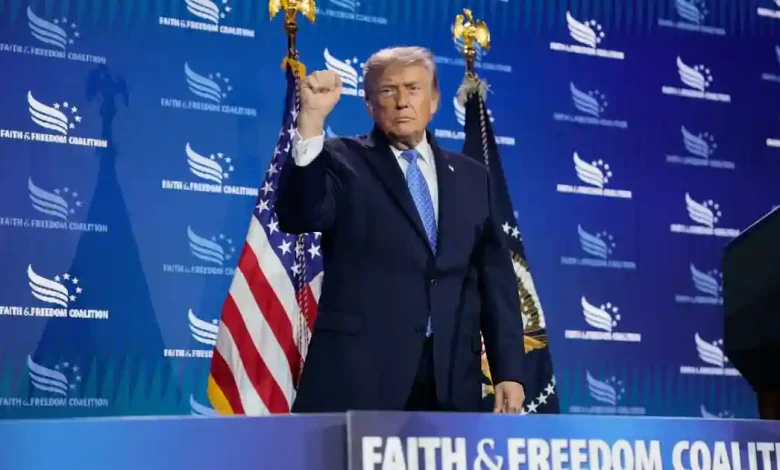
The release of the report on Friday afternoon immediately ignited a fierce debate across the political spectrum. Proponents, primarily conservative Christian groups and religious freedom advocacy organizations, hailed the document as a necessary course correction after years of what they perceive as secular overreach. They argue that the recommendations will protect people of faith from being forced to violate their deeply held beliefs in the workplace or school system. Prominent conservative organizations, celebrating at the Faith & Freedom Coalition’s policy conference where Trump spoke on the same day, expressed enthusiastic support for the draft’s vision.
Conversely, civil liberties advocates, secular organizations, and interfaith alliances have raised major alarm bells. Critics argue that the commission’s composition—filled almost exclusively by conservative Christians—lacked any meaningful ideological or religious diversity, resulting in a highly biased document. According to PBS NewsHour coverage, opponents argue that replacing the wall of separation with “bridges” will inevitably lead to government-sanctioned discrimination against religious minorities, non-believers, and LGBTQ+ individuals. There are also deep concerns that the commission has paid little attention to issues like anti-Muslim efforts, focusing almost entirely on the grievances of the Christian right, though the report does pay some tribute to combatting antisemitism through legal tools.
Comparing the Traditional and Proposed Models
To understand the profound shifts proposed by the commission, it is helpful to look at how these policies differ from established American legal norms. The table below outlines the contrast between the traditional separation model and the commission’s proposed vision of building bridges between church and state.
| Policy Area | Traditional Model (Separation of Church & State) | Proposed Model (“Building Bridges” Commission Draft) |
|---|---|---|
| Political Activities | Johnson Amendment restricts tax-exempt houses of worship from political endorsements. | Elimination of the Johnson Amendment to allow political campaigning and endorsements. |
| Public School Options | Secular curriculum with limited opportunities for religious exemptions. | Broader opt-outs for parents objecting to lessons (pronouns, secular themes, sex ed). |
| Government Funding | Restrictions on public funding directly supporting religious organizations. | Greater access to public money and grants for faith-based social agencies. |
| Public Displays & Historic Sites | Neutrality in government spaces to avoid establishing or preferring religion. | Inclusion of religious markers, historic monuments, and heritage honors on public land. |
| Conscientious Objections | Narrow exemptions, typically requiring secular justification or limited scope. | Expanded protections against vaccine mandates, identity policies, and local regulations. |
Legal and Constitutional Ramifications
Should these recommendations transition from a draft report into executive orders or statutory law, the United States would see a wave of legal challenges. For decades, the Supreme Court utilized the “Lemon test”—originating from the 1971 case Lemon v. Kurtzman—to determine whether a government action violated the Establishment Clause. Under the Lemon test, laws had to have a secular legislative purpose, must not advance or inhibit religion, and must not result in “excessive government entanglement” with religion. While the current conservative-majority Supreme Court has systematically rolled back these precedents in favor of “historical practices and understandings,” the commission’s proposals push the envelope even further.
Eliminating the Johnson Amendment, for example, would transform houses of worship into potent political action committees, completely altering the tax-exempt landscape and the role of money in politics. Furthermore, granting broad, blanket exemptions for pronoun usage, classroom curriculums, and workplace mandates would set up a direct conflict between religious liberty claims and federal civil rights protections. Constitutional scholars suggest that the Supreme Court’s current trajectory suggests some receptivity to these arguments, as seen in cases like Kennedy v. Bremerton School District and 303 Creative LLC v. Elenis. However, the sheer scale of the commission’s recommendations would test the boundaries of constitutional law like never before, potentially leading to a fundamental rewriting of constitutional rights.
Conclusion and Path Forward
The Presidential Religious Liberty Commission has opened a 15-day window for public comment on the 224-page draft report, ensuring that the debate will remain at the forefront of the national conversation. Whether this document serves as a blueprint for executive actions in a second Trump administration or remains a highly controversial manifesto, it clearly defines the conservative movement’s ultimate vision: a nation where the traditional divide between church and state is dismantled in favor of an active, government-supported religious presence. As both sides prepare for the upcoming legal and legislative battles, the very definition of American secularism hangs in the balance.





One Comment