7 Shocking Facts About Upriver Fire Spokane: Suspected Human Remains Found
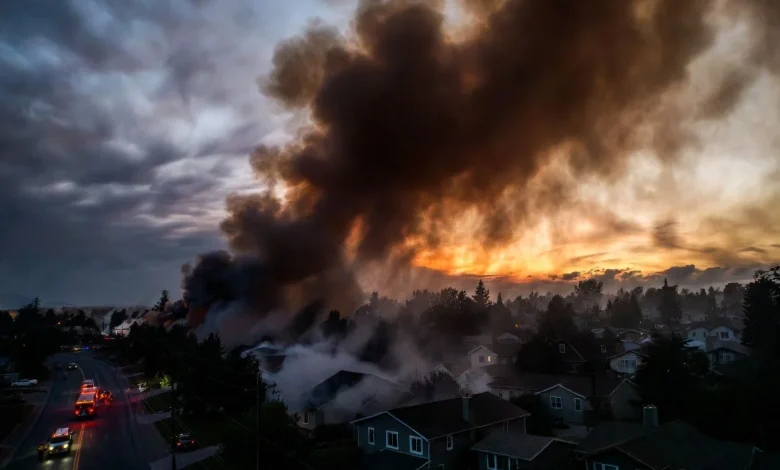
Table of Contents
Upriver Fire response efforts in Spokane County, Washington, took a tragic turn on Wednesday, June 17, 2026, when forensic investigators discovered what appeared to be human remains inside a home destroyed by the fast-moving blaze. The devastating wildfire, which broke out on Tuesday, June 16, 2026, quickly grew to consume 222 acres near the Beacon Hill area and subdivisions close to Camp Sekani. As firefighters battled the wind-driven flames, emergency personnel faced the difficult challenge of evacuating thousands of residents in densely populated wildland-urban interface zones. The discovery of potential remains has cast a somber shadow over the ongoing containment operations, highlighting the severe dangers associated with disregarding emergency evacuation orders. The Upriver Fire Spokane County Sheriff’s Office, in tandem with regional emergency teams, continues to navigate the grim task of identifying the victim, while wildland crews work around the clock to prevent further flare-ups.
Chronology of the Upriver Fire Development
The origin of the Upriver Fire dates back to the late afternoon of Tuesday, June 16, 2026. Ignited under highly volatile weather conditions characterized by high ambient temperatures, low relative humidity, and unpredictable, gusty winds, the fire quickly transitioned from a localized brush fire into a fast-moving crown fire. It started east of the city of Upriver Fire Spokane, near the heavily forested Beacon Hill area, which features steep terrain and dense stands of timber and understory fuels. Within hours, pushed by relentless winds, the fire breached firebreaks and moved directly into several densely populated subdivisions near Camp Sekani Park.
As the fire advanced, local agencies including Upriver Fire Spokane County Fire District 9, the Spokane Valley Fire Department, and the Washington State Department of Natural Resources (DNR) mobilized a massive Level 3 “Go Now” evacuation order. The sudden onset of the fire left many residents with only minutes to gather their belongings and escape. Aerial tankers and helicopters were immediately deployed to drop thousands of gallons of water and red fire retardant to establish a protective barrier for the subdivisions on the hillside. Despite these heroic efforts, the intense heat and rapid rate of spread compromised several properties. At least 15 homes were confirmed lost or heavily damaged within the first twelve hours of the fire’s active run, demonstrating the sheer power of the blaze.
Discovery of Suspected Human Remains and Forensic Investigations
The incident shifted from a major property-loss disaster to a potential loss of life on Wednesday, June 17, 2026, when the Upriver Fire Spokane County Sheriff’s Office announced that its forensic unit had located what appeared to be human remains. The search was initiated after a family member contacted law enforcement requesting a wellness check on an elderly relative. According to the caller, the resident had flatly refused to evacuate despite the immediate proximity of the encroaching flames and could no longer be reached by phone.
Upon returning to the property—which had been completely destroyed in the fire’s path—the Sheriff’s forensic team began a meticulous excavation of the ash and structural debris. Forensic work in the immediate aftermath of a wildfire is exceptionally challenging. Extreme temperatures can severely compromise biological evidence, requiring anthropologists and forensic investigators to sift through materials with immense care. Authorities are working closely with the Upriver Fire Spokane County Medical Examiner’s Office to positively identify the remains, verify if they are indeed human, and determine the exact cause and manner of death. Because of the level of destruction, this process is expected to take several days, if not weeks, relying on dental records, DNA analysis, or medical implants to secure a definitive identification. To date, no other injuries or casualties have been reported by officials, making this the only suspected fatality of the incident.
The Critical Nature of Evacuation Orders and Public Compliance
This tragedy underscores a growing, nationwide challenge for emergency management officials: civilian compliance during catastrophic wildfire events. During a press conference held shortly before the forensic discovery, Upriver Fire Spokane County Sheriff John Nowels addressed the media with a stark and emotional message. He emphasized that far too many people underestimate the rapid, erratic nature of modern wildfires, choosing to stay behind either to protect their properties or due to a false sense of security.
Sheriff Nowels noted that while some citizens cooperated fully and evacuated safely, others ignored direct orders from law enforcement. “As we go through the aftermath of recovering from this fire, the lessons learned will be that people could have been more compliant with fire orders, law enforcement orders, and it could have made a difference,” Nowels stated. He expressed frustration at the dangerous trend of residents staying behind to record video, use garden hoses, or simply wait out the fire, which places both their lives and the lives of rescue personnel at extreme risk. Local coverage by The Spokesman-Review highlighted that the rapid acceleration of wildland-urban interface fires often leaves no margin for error, as shifting winds can trap residents in their homes within seconds.
Challenges Faced by First Responders and Forced Retreats
The timeline of events on Tuesday reveals the intense pressure and danger that first responders faced as they tried to enforce evacuations. According to the Upriver Fire Spokane County Sheriff’s Office, deputies and officers had actively visited the neighborhood surrounding the victim’s home when nearby structures were already fully engulfed in flames. Seeing the immediate danger, deputies knocked heavily on the door, announced their presence, and urged everyone inside to evacuate. Receiving no answer, and finding the door unlocked, they entered the residence to conduct a sweep. Despite repeating their warnings loudly inside, they found no one readily visible and received no response.
Moments later, as the wall of fire quickly closed in on the property, commanders issued an urgent evacuation order for all emergency personnel. The deputies were forced to retreat to save their own lives. This sequence of events highlights the terrifying speed of wind-driven fires and the legal and physical limitations under which law enforcement operates; officers cannot physically force a competent adult to leave their property, even when facing certain peril. The decision of a resident to stay behind can lead to heartbreaking outcomes, as seen in this grim discovery.
Tactical Firefighting Operations and Containment Efforts
By late Wednesday, containment efforts for the Upriver Fire had reached 10%. Containment refers to the percentage of the fire’s perimeter that has been secured by a physical barrier—such as a cleared dirt line, a road, or a natural barrier—that prevents the fire from spreading further. Achieving 10% containment on a 222-acre fire in steep, wind-swept terrain is a hard-fought victory for the nearly 350 emergency personnel on site. Led by the Washington Department of Natural Resources, firefighters focused on building hand lines, deploying hose lays, and extinguishing hot spots near threatened structures.
The tactical approach utilized a combination of ground crews and aerial support. Heavy air tankers dropped fire retardant on key ridges to slow the fire’s advance, while helicopters targeted flare-ups in deep ravines that ground crews could not safely reach. Fire District 9 Chief Matthew Vinci reported that nearly 12,000 residents and over 2,300 structures were initially threatened when the fire broke out. The coordinated attack prevented the fire from expanding significantly past its initial footprint, but officials warn that dry fuels and potential wind shifts mean the area remains highly vulnerable.
Wildfire Incident Summary and Key Facts
To provide a clear overview of the Upriver Fire and its operational status as of late Wednesday, the following table compiles verified data from InciWeb, the Upriver Fire Spokane County Sheriff’s Office, and the Washington Department of Natural Resources.
| Metric / Parameter | Incident Details |
|---|---|
| Incident Name | Upriver Fire |
| Location | Approximately 1 mile east of Upriver Fire Spokane, WA (Beacon Hill / Camp Sekani) |
| Size (Acres) | 222 Acres |
| Containment | 10% (as of late Wednesday) |
| Lead Agency | Washington Department of Natural Resources (DNR) |
| Personnel Deployed | Over 340 responders (including local fire districts) |
| Structures Destroyed | At least 15 homes confirmed lost |
| Threatened Structures | 2,340 structures (nearly 12,000 residents) |
| Fatalities / Injuries | 1 suspected fatality (unconfirmed remains discovered); no injuries reported |
Broader Implications and Regional 911 Dispatch Debate
The timing of the Upriver Fire has also reignited a fierce political and operational debate within Upriver Fire Spokane County regarding the region’s emergency communications infrastructure. Historically, emergency dispatch has been managed under a unified system known as Upriver Fire Spokane Regional Emergency Communications (SREC). However, the city of Spokane is currently in the process of transitioning away from SREC to launch its own independent fire dispatch agency, a move scheduled to take effect over the coming year. This split has sparked concern among local business leaders, tax advocates, and safety officials who fear a fractured dispatch network could slow response times during multi-jurisdictional disasters.
The Spokane Business Association (SBA) issued a statement on Tuesday, urging city and county leaders to reconsider the separation. Gavin Cooley, the president of the SBA and former chief financial officer of the city of Upriver Fire Spokane, emphasized that disasters do not respect municipal borders. He questioned why local leaders have spent years fighting over governance and fees instead of maintaining the seamless, regional system that voters expected. Although SREC officials clarified that the pending split did not impact the initial tactical response to the Upriver Fire—as the “status quo” is being maintained during the transition phase—the incident serves as a stark reminder of the critical need for absolute interoperability and clear communication channels during widespread emergencies.
The Impact of Extreme Weather and Red Flag Conditions
The rapid escalation of the Upriver Fire was not an isolated event but rather a symptom of severe weather conditions that gripped Eastern Washington. On the day the fire erupted, the National Weather Service had issued Red Flag warnings for Spokane and surrounding counties, predicting high winds, low relative humidity, and highly combustible dry fuels. These conditions were mirrored across the region, sparking multiple wildfires simultaneously. Other blazes, such as the Kartar Fire on the Colville Reservation and the massive Tule Road Fire to the south, demonstrated similarly extreme fire behavior, stretching regional firefighting resources to their limits.
Climate experts point out that the Pacific Northwest is experiencing increasingly dry springs and earlier-onset summer conditions, which prime forest fuels for explosive fire growth much sooner in the season than in previous decades. This shifting seasonal pattern increases the likelihood of highly destructive wildland-urban interface fires, where wildlands meet residential areas. When fires break out under these Red Flag conditions, conventional firefighting tactics are often insufficient to stop the initial run, making early evacuations and defensible space planning the most effective defenses for communities located in fire-prone landscapes.
Community Recovery and Ongoing Safety Guidelines
As the community of Spokane grapples with the destruction of homes and the tragic loss of a resident, recovery efforts are beginning to take shape. For residents returning to areas where evacuation levels have been downgraded from Level 2 (“Get Set”) or Level 1 (“Be Ready”), fire officials urge extreme caution. Hazards such as damaged utility poles, unstable trees (hazard trees), pockets of active smoldering ash, and compromised electrical wiring present ongoing dangers in fire-affected zones. Local utilities are working diligently to restore power and inspect infrastructure before allowing full re-entry into the hardest-hit neighborhoods.
To mitigate the risk of future disasters, Spokane County emergency managers are emphasizing the importance of creating defensible space around residential properties. This includes clearing dry brush and dead vegetation within 30 feet of any structure, pruning low-hanging tree branches, and using fire-resistant landscaping materials. Furthermore, the incident serves as a powerful reminder of the necessity of having an established family evacuation plan, maintaining an emergency “go-bag” with essential documents and medications, and, most importantly, immediately complying with evacuation warnings. When local authorities issue a Level 3 notice, it is because conditions are directly threatening lives, and delay can lead to catastrophic consequences that are entirely preventable.