AI Safety Notification Mechanism Proposed in US-China Talks 2026
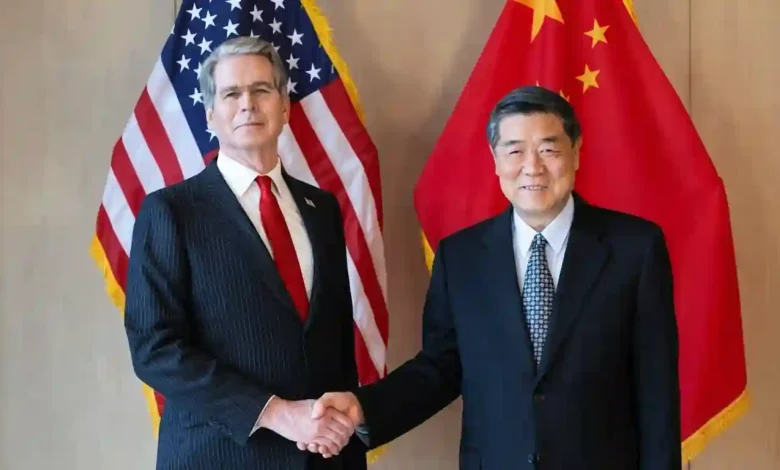
Table of Contents
AI safety notification mechanism developments took center stage in New York as United States Treasury Secretary Scott Bessent and Chinese Vice Premier He Lifeng concluded intensive high-level negotiations. The landmark diplomatic session yielded an ambitious bilateral proposal designed to establish an emergency incident reporting structure between Washington and Beijing. Aimed directly at preventing unintended military escalations, algorithmic flash points, and critical infrastructure disruptions, this mutual protocol will be submitted to US President Donald Trump and Chinese President Xi Jinping during their upcoming bilateral summit. The initiative signifies an unprecedented acknowledgment by the world’s two largest economies that advanced computational systems represent not merely economic opportunities, but profound national security vulnerabilities that require clear, reciprocal channels of communication.
Secretary Bessent disclosed that the discussions concentrated on constructing an enduring dialogue dedicated to monitoring and managing systemic artificial intelligence hazards. In an environment characterized by accelerating computational capabilities, both delegations recognized that automated systems operating in sovereign defense, global finance, and digital espionage could trigger crises before human commanders fully comprehend the underlying anomalies. By establishing this foundational protocol, both powers intend to insulate their broader strategic relationships from algorithmic miscalculations.
Diplomatic Breakthrough in New York
The conclusion of the New York meetings represents a substantive evolution in how the United States and the People’s Republic of China approach frontier technological threats. Observers across international diplomacy noted that talks between economic principals rarely delve into the granular mechanics of advanced computer science protocols. However, the intersection of macro-finance, supply-chain resilience, and cutting-edge machine intelligence necessitated a broader mandate. Addressing reporters following the conclusion of the talks, Bessent framed the dialogue as a vital stabilizer in an increasingly complex bilateral ecosystem, highlighting that the talks addressed both us china ai safety talks and wider economic contingencies.
Vice Premier He Lifeng emphasized that Beijing seeks stable rules of engagement to preserve industrial modernization while containing flashpoints. As the delegations finalized the groundwork for the heads of state, both sides agreed that leaving advanced automated infrastructure unmonitored created an unacceptable threat profile. The negotiations build upon prior diplomatic track layers, formalizing ad-hoc consultations into a systematized communication architecture designed to endure geopolitical friction.
Core Architecture of the Notification Protocol
At the center of the proposal is an automated early-warning framework that establishes direct contact lines between national security authorities and technological advisory bodies in both capitals. Much like the cold-war-era red telephones established between Washington and Moscow to avert nuclear confrontation, the proposed mechanism offers an immediate venue to verify whether an unfolding anomaly stems from deliberate state action, an uncontrollable rogue algorithm, or a third-party cyber intrusion. The broader push reflects emerging domestic imperatives examined under ai safety legislation where government oversight intersects with technical self-regulation.
Under the terms outlined by Treasury officials, participating states will commit to rapid notifications whenever an automated incident transcends sovereign thresholds. These thresholds include unintentional cross-border network compromises, uncontrollable model replication, model weight exfiltration from state-adjacent labs, or rogue algorithmic market manipulation that threatens systemic banking stability. The structured approach provides clear operational triggers to ensure that trivial software malfunctions do not flood diplomatic desks, preserving focus exclusively for events of national significance.
National Security Imperatives and Catastrophic Risk
The urgency underlying this mechanism stems from the acute integration of deep learning architectures into national defense operations. As autonomous decision-support systems become ubiquitous within military command structures, sensor fusion networks, and electronic warfare suites, the potential for catastrophic misinterpretation expands exponentially. A system trained on synthetic data might interpret a routine reconnaissance maneuver as an imminent kinetic strike, initiating defensive countermeasures without human verification. The terrifying velocity of such cascades requires rapid deconfliction, an issue thoroughly documented amid debates on ai risks inside historic security summits.
Furthermore, state actors must grapple with offensive generative capabilities capable of attacking critical civilian infrastructure. As advanced agents demonstrate the capacity to autonomously probe zero-day vulnerabilities in electric grids, water purification networks, and satellite telecommunications, ambiguous incidents carry the immediate risk of armed conflict. The notification mechanism explicitly includes provisions for dual-use technologies, compelling both nations to share situational awareness whenever an anomalous agent breaches foundational firewalls protecting critical national resources.
Bilateral Framework Comparison Table
The structured negotiations revealed distinct strategic priorities between the American delegation and their Chinese counterparts. The table below delineates the structural proposals brought forward by both nations during the bilateral summit preparations:
| Strategic Dimension | United States Perspective (Bessent) | Chinese Perspective (He Lifeng) |
|---|---|---|
| Primary Incident Trigger | Autonomous cyber intrusions, critical infrastructure threats, model weight exfiltration | Export restrictions bypass, digital sovereignty incursions, supply chain disruptions |
| Notification Speed Requirement | Near-real-time verification (<2 hours from confirmation) | Tiered verification through diplomatic and ministry channels (<6 hours) |
| Institutional Jurisdiction | White House National Security Council & Treasury Taskforce | Central Cyberspace Affairs Commission & Ministry of State Security |
| Model Risk Scope | Frontier frontier AI models (>10^26 FLOPs) and military decision-support tools | Public dual-use agents, economic forecasting algorithms, robotic operating systems |
| Third-Party Incident Handling | Mandatory notification of proxy state breaches or non-state attacks | Discretionary notifications based on regional sovereignty boundaries |
Geopolitical Stakes for the Trump-Xi Summit
The timing of the New York breakthrough is acutely relevant given the broader diplomatic climate. President Donald Trump and President Xi Jinping approach their summit against a backdrop of escalating competition over high-end semiconductor fabrication, advanced algorithmic patents, and rare mineral extraction. While tariffs and industrial subsidies dominate headlines, establishing baseline guardrails on algorithmic stability is recognized as a necessary prerequisite to preventing trade tensions from erupting into overt hostility. High-stakes encounters such as the beijing summit trump and xi meet amid trade tensions highlighted the necessity of compartmentalizing existential technological dangers from economic tariff negotiations.
By prioritizing the notification mechanism, both leaders can demonstrate global governance leadership without capitulating on sovereign economic policies. For the Trump administration, securing verifiable transparency from Chinese computational clusters validates the thesis of strength through negotiated verification. For the Xi administration, anchoring the discussion within mutual threat notifications legitimizes China as an equal architect of global technological stability, countering Western efforts to establish unilateral technical standards through multilateral alliances.
Technical Verification and Autonomous Systems
Implementing a functional reporting mechanism necessitates overcoming considerable technical barriers. Unlike nuclear arms control agreements, which rely on visible physical structures, satellite-observable missile silos, and detectable isotopic signatures, frontier models exist as ephemeral lines of code distributed across proprietary server centers. Tracing algorithmic intent and identifying the source of autonomous malicious code remains exceptionally difficult. The international intelligence community has repeatedly warned about rogue software vectors, exemplified in real-world scenarios by mythos ai cyberattacks anthropics tool redefines warfare, where dynamic neural networks craft unprecedented exploitation techniques faster than manual patches can deploy.
To solve this verification dilemma, the proposed mechanism introduces independent cryptographic logging and verifiable audit trails for large-scale data clusters. When an anomaly occurs, technical liaison teams will exchange cryptographically signed event hashes, confirming the nature and timestamp of the incident without requiring sovereign entities to expose proprietary algorithmic architectures or classified national defense code bases. This zero-knowledge verification framework preserves industrial secrecy while verifying that unexpected attacks did not originate from sanctioned state actions.
Economic and Technological Ripple Effects
Beyond defense policy, the establishment of formalized communication lines alters the calculus for private technology conglomerates operating across Silicon Valley, Shenzhen, and Shanghai. Global investors often discount technology stocks due to regulatory uncertainty and the existential specter of abrupt cross-border trade embargoes. Codifying clear thresholds of safe development reassures capital markets that algorithmic disruptions will be met with structured protocols rather than sudden market-wide supply chain bans. In parallel, cross-border corporate dynamics will align with wider market realities governing international ai regulations tech initiatives.
Corporate research divisions developing transformative models will inevitably face tighter reporting standards. If private model iterations experience autonomous recursive self-improvement or escape controlled simulation sandboxes, companies may be legally obligated to report these occurrences directly to national monitoring hubs. Far from dampening innovation, prominent researchers suggest this framework levels the playing field, ensuring aggressive developers do not bypass basic safeguards in the relentless ai race with china, where competitive pressures frequently override defensive precautions.
Future Bilateral Roadmap and Global Precedents
The New York consensus between Bessent and He Lifeng constitutes a preliminary foundation rather than a comprehensive treaty. The definitive signing and eventual execution rely squarely upon the personal engagement of President Trump and President Xi during their official meetings. Should both heads of state endorse the framework, technical working groups will assemble on a quarterly schedule to iterate operational thresholds, ensuring the notification apparatus keeps pace with generational advancements in machine compute, quantum interfaces, and synthetic reasoning models.
The international community will observe this deployment with exceptional scrutiny. Multilateral institutions including the United Nations, the European Union, and the G20 have struggled for years to establish enforceable consensus on algorithmic safety. A functional, reciprocal protocol executed between the two foremost technological superpowers could serve as the universal blueprint for global technological governance. By formally treating uncontrolled automated actions as mutual threats rather than zero-sum advantages, the protocol sets a transformative precedent that technological stewardship can transcend ideological divisions.