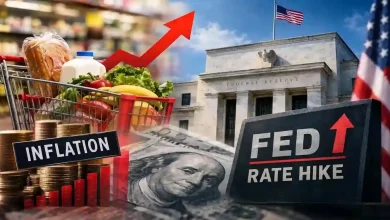
Financial markets brace for Fed rate hike as inflation rises 2026
Table of Contents
Financial markets across the globe are adapting to a rapidly evolving macroeconomic landscape as monetary policymakers prepare to meet. The heightened sensitivity of a major U.S. stock index to central bank messaging highlights the massive stakes involved in the upcoming Federal Open Market Committee (FOMC) session. With market participants actively trying to decipher how aggressively the Federal Reserve will act, the latest pricing metrics indicate a substantial consensus is forming around a continuation of the hawkish regime. This development occurs as persistent inflation threatens to undermine long-term price stability, forcing the central bank to maintain its aggressive posturing despite growing concerns over global economic growth. In this deeply detailed analysis, we explore the intricate dynamics driving these market shifts, analyzing CME FedWatch data, underlying inflation reports, labor market indicators, and the broader global implications of the Fed’s imminent policy decision. The modern financial landscape is highly interconnected, meaning that shifts in the pricing of federal funds futures ripple instantly across global equities, sovereign bond markets, and currency valuations.
Markets :Financial Markets and the Shift in Federal Reserve Expectations
The adjustment period currently observed in the broader financial markets is characterized by a significant transition in investor sentiment. For several months, there was a pervasive hope among market participants that the Federal Reserve would soon reach its terminal rate and begin a series of programmatic rate cuts. However, those expectations have clashed with the reality of economic indicators that refuse to conform to a cooling narrative. Modern monetary policy transmission is a complex mechanism, and the current delay in economic cooling has forced institutional players to reassess their risk models. Traders are now pricing in a higher-for-longer interest rate paradigm, which has forced a revaluation of financial assets globally. This shift has been particularly pronounced in interest-rate-sensitive sectors, where capital is being reallocated away from speculative growth assets and toward defensive instruments with reliable cash flows.
Markets :Analyzing the CME FedWatch Tool Shift: From 72% to 87%
The primary barometer of near-term interest rate expectations, the CME FedWatch tool, has registered a remarkable shift in sentiment over a remarkably short timeline. Financial markets initially priced in a 91% chance of a quarter-point rate hike at the Fed’s meeting on Tuesday and Wednesday, before settling back to a still-overwhelming 87%. This represents a stark escalation from the 72% probability recorded just days prior on Thursday. This rapid reassessment of probability reflects a market that is no longer expecting an early pause or pivot. Instead, fixed-income traders and equity analysts alike are acknowledging that the central bank is fully committed to stamping out price pressures, even if it requires keeping the benchmark rate elevated for a longer duration. Such drastic shifts within a single trading week highlight the extreme data-dependency of current market valuations and show how quickly capital can reallocate when economic indicators deviate from consensus forecasts.
Firmer Inflation Readings and the Producer Price Index
A major driver behind this hawkish repricing is the recent release of firmer-than-expected inflation metrics. Chief among these indicators is the latest Producer Price Index (PPI) report, which demonstrated that wholesale price pressures remain firmly entrenched within the supply chain. When producer prices rise, these input costs are inevitably passed down to the consumer, signaling that future consumer price index (CPI) prints could continue to surprise to the upside. This structural inflation sticky behavior is particularly problematic for the Federal Reserve, which has targeted a return to its long-term 2% inflation objective. Because core services inflation remains elevated, policymakers are left with little choice but to maintain restrictive monetary conditions. The persistent strength of commodity prices, coupled with logistics bottlenecks and localized supply chain re-shoring, has created a floor under inflation that simple demand-side policies have struggled to dismantle.
Markets :Labor Market Resilience: Job Growth and Unemployment Trends
The second critical leg of the Fed’s dual mandate, employment, continues to exhibit remarkable resilience, providing the central bank with the necessary economic cover to pursue further tightening. Recent data on U.S. job growth confirms that businesses are still expanding payrolls at a healthy clip despite higher borrowing costs. Furthermore, as unemployment falls to historically low levels, the labor market remains tightly coiled, maintaining upward pressure on wages. While strong wage growth is positive for workers, it presents a significant hurdle for inflation mitigation, as higher labor costs can lead to a wage-price spiral. For Fed officials, a robust labor market indicates that the economy is strong enough to absorb additional interest rate hikes without entering a severe downturn. Consequently, any hopes of an imminent policy easing have been effectively dashed by the reality of a job market that refuses to cool down.
Markets :Historical Context: Navigating the 3.50%-3.75% Benchmark Range
To understand the current monetary policy trajectory, it is essential to place the Fed’s benchmark overnight interest rate, which currently sits in a restrictive 3.50% to 3.75% range, in historical perspective. This range represents the highest cost of capital seen in over a decade, representing a dramatic departure from the near-zero interest rate policy (ZIRP) era that defined the post-financial crisis years. For commercial banks, a benchmark rate of this magnitude elevates the prime rate, which in turn raises the cost of credit cards, mortgages, auto loans, and corporate debt. The rapid transition from an accommodative stance to a highly restrictive one has forced corporations to deleverage and consumers to reconsider big-ticket purchases. However, because inflation has consistently run above target, the current nominal rate of 3.50%-3.75% translates to a real interest rate that is only marginally positive, meaning further tightening may still be required to achieve a truly restrictive economic stance.
| Meeting Date | Current Target Range | Projected Target Range | Probability of Hike | Key Economic Driver |
|---|---|---|---|---|
| September Meeting | 3.50% – 3.75% | 3.75% – 4.00% | 87% | Firmer PPI & Resilient Jobs |
| October Meeting | 3.75% – 4.00% | 4.00% – 4.25% | 45% | Core Services Inflation |
| December Meeting | 4.00% – 4.25% | 4.25% – 4.50% | 60% | Wage-Price Dynamics |
Impact on Treasury Yields and the Global Fixed Income Landscape
The fixed income markets have responded to this hawkish outlook with remarkable volatility. As investors price in a higher-for-longer rate environment, benchmark 10-year yields have climbed to multi-year highs, reflecting expectations that short-term rates will remain elevated for several quarters. This rise in yields has triggered a massive global bond selloff, as falling bond prices correspond to rising yields. For international investors, the rising yield on U.S. government debt acts as a powerful magnet, drawing capital out of emerging markets and into dollar-denominated assets. This capital flight has strengthened the U.S. dollar, putting additional pressure on foreign central banks to raise their own interest rates to defend their currencies and curb imported inflation. The interconnectedness of global debt markets means that a decision made in Washington reverberates instantly across financial capitals from London to Tokyo.
Equities and the Broader U.S. Economic Shockwaves
For equity investors, the prospect of an even more aggressive Federal Reserve represents a formidable headwind. Higher interest rates reduce the present value of future corporate cash flows, a dynamic that disproportionately penalizes high-growth sectors such as technology and biotechnology. As the cost of corporate borrowing escalates, profit margins are squeezed, and capital expenditure budgets are trimmed. These tightening financial conditions are sending profound U.S. economic shockwaves through the corporate sector, as small and medium-sized enterprises find it increasingly difficult to refinance existing debt. Economists warn that while the economy has shown resilience thus far, the cumulative impact of monetary tightening operates with a variable lag. The full restrictive force of these cumulative rate hikes may not be felt entirely for another several quarters, raising the risk of an eventual hard landing if the Fed overtightens.
Beyond September: Future Projections for October and December
Looking beyond the immediate horizon of the upcoming meeting, Wall Street is increasingly focused on the path of monetary policy through the end of the year. Most major economists agree that the combination of sticky inflation and labor market resilience will compel Fed officials to raise borrowing costs not only next Wednesday, but potentially again in October or December. The idea of a ‘one-and-done’ hike has been thoroughly dismissed as the central bank struggles to gain a definitive upper hand over price pressures. If economic indicators do not show a clear, sustained deceleration, the terminal rate could easily exceed 4.50% by the end of the year. For market participants, this means that volatility is likely to remain a permanent fixture of the financial landscape, requiring a highly defensive asset allocation strategy that priorities liquid assets, high-quality corporate bonds, and value equities with strong pricing power.