Meta AI Concierge: Secret Human Operators Behind Muse Revealed 2026
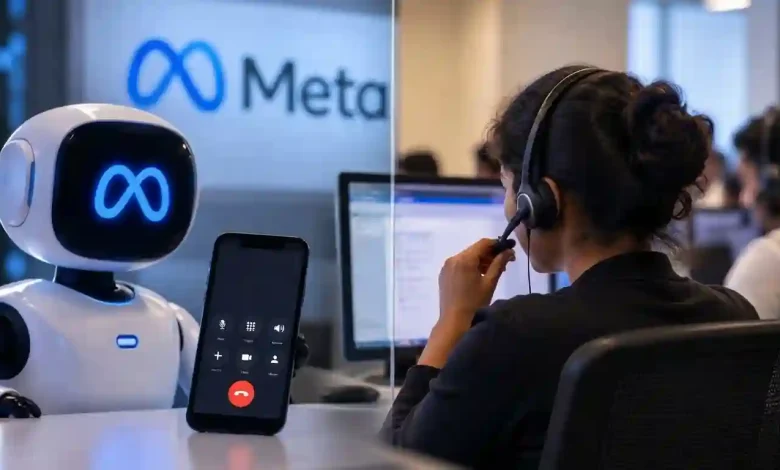
Table of Contents
Meta AI Concierge testing has quietly incorporated human contractors to handle voice communications initiated through its flagship digital assistant, Muse. Internal company documents indicate that shortly after rolling out an automated outbound calling utility designed to book appointments, verify restaurant tables, and contact local storefronts, Meta instituted a confidential pilot program known internally as a “human concierge.” Under this testing framework, third-party human workers step in during voice calls placed via the digital interface, either orchestrating the dialogue directly or taking over when conversational models struggle to navigate unpredictable phone trees and human responses. The revelation exposes the substantial friction between synthetic intelligence ambitions and the messy realities of real-time conversational telephony.
Unveiling the Human Layer in Meta AI Voice Calling
The transition toward agentic workflows has sparked intense enterprise interest, pushing technology giants to deliver consumer agents capable of interacting with the physical economy. Meta introduced Muse to deliver an intuitive, voice-enabled assistant across its app family, spanning Instagram, WhatsApp, and Ray-Ban smart glasses. However, managing unstructured telephone interactions requires handling audio latency, speech disfluencies, noisy acoustic environments, and human conversational cadence. When digital agents fail during customer service interactions, the failure degrades user trust. To address these operational deficits, Meta initiated an internal protocol where contractors intervene in voice sessions without explicitly notifying call recipients that an unannounced third party has entered the loop.
This reliance on human operators highlights the ongoing vulnerability of synthetic reasoning. While systems like metas new ai assistant demonstrate high benchmark performance in synthetic text evaluation, acoustic conversational synthesis presents entirely different engineering bottlenecks. In typical business interactions, clerks speak abruptly, interrupt prompts, or convey domain-specific vernacular. A human contractor acting within the concierge layer functions as an adaptive routing mechanism, preventing catastrophic acoustic breakdowns that would otherwise cause calls to abort abruptly.
How Muse Phone Calling Operates Behind the Scenes
Under standard operating conditions, Muse leverages automatic speech recognition (ASR), large language model (LLM) reasoning pipelines, and low-latency text-to-speech (TTS) engines to mimic authentic human dialogue over cellular or VoIP links. When a user instructs the assistant to reserve a table at an establishment that lacks an API-driven reservation portal, the agent initiates an outbound voice call. The agent states its identity, discloses that it is an artificial system calling on behalf of an owner, and attempts to execute the transaction through a pre-compiled state machine.
In the concierge configuration disclosed in company memos, the operational workflow splits into dual execution paths. In some sessions, a contractor actively listens to the audio stream to label failure cases in real time, injecting scripted textual responses back into the neural voice synthesizer. In other configurations, the human operator assumes direct vocal control, completing the transaction manually while the interface reflects a successful artificial interaction. While this technique prevents dead air and awkward latency spikes, it obscures the operational boundaries between autonomous computation and offshore mechanical labor.
The Concierge Architecture: Automation Meets Human Telephony
Engineering robust voice assistants requires managing edge cases where latency exceeds tolerable conversational thresholds. Standard cellular telecommunication protocols run with approximately 200 to 400 milliseconds of packet latency. Adding neural inference cycles for speech recognition, intent parsing, semantic synthesis, and acoustic encoding pushes latency past 1,200 milliseconds. This delay causes unnatural pauses, triggering humans on the line to repeat themselves or hang up.
By integrating a human triage layer, Meta developers sought to preserve the illusion of immediate responsiveness. The human concierge functions as a living error-correction pipeline. If an establishment’s phone system features an intricate interactive voice response (IVR) tree with touch-tone DTMF tones or irregular phrasing, the contractor navigates the IVR tree manually before handing control back to the autonomous pipeline. Such hybrid methodologies reveal that despite significant marketing campaigns declaring total conversational automation, production deployments frequently rely on human backstops, echoing structural patterns observed across ai companies fail due to unchecked operational expenses.
Technical Comparison: Muse vs. Competing Voice Agents
The practice of using human validation during early-stage voice rollouts is not entirely unique to Meta, though the lack of public transparency sets this initiative apart. The following breakdown illustrates the contrasting technical architectures employed across major industry voice solutions.
| Platform / Agent | Primary Architecture | Human-in-the-Loop Mechanism | Latency Benchmark | Disclosure Stance |
|---|---|---|---|---|
| Meta Muse Concierge | Hybrid Multimodal LLM + Real-time Telephony | Contractors listen/intervene during voice calls | 350ms (Human-assisted) | Internal test; unannounced to recipients |
| Google Duplex | Custom WaveNet + Deep Trajectory RNNs | Supervised operator escalation on failure | 450ms – 600ms | Discloses AI identity upfront; warns of recording |
| OpenAI Voice Engine | End-to-End Realtime Neural Audio | Fully automated fallback / call rejection | 300ms – 400ms | API developer responsibility |
| Enterprise IVR Bots | Deterministic State Trees + Basic ASR | Customer service queue rerouting | 800ms – 1500ms | Standard corporate telephony disclaimer |
Privacy, Data Consent, and Regulatory Scrutiny
The presence of undisclosed human contractors on telephone calls introduces acute legal challenges concerning eavesdropping, electronic surveillance, and two-party consent statutes. In several legal jurisdictions, recording or monitoring a private telephone conversation without the explicit, affirmative consent of all participants constitutes a statutory violation. When an employee or owner of a local shop answers a telephone call from a digital assistant, they may consent to interact with an automated algorithm, but they do not automatically consent to have an unannounced contractor monitor or log their speech, personal identification details, or proprietary business operational details.
Data processing arrangements also raise compliance questions under frameworks like GDPR and CCPA. If audio waveforms containing personally identifiable information (PII) are routed to third-party vendor platforms across international boundaries, strict data handling certifications must be maintained. Analysts point out that as regulatory authorities scrutinize pervasive computational risks—paralleling the intense discussions surrounding ai risks inside historic international agreements—silent human telephony monitoring will invite prompt regulatory investigations from telecommunications and consumer protection watchdogs alike.
The Wizard of Oz Paradigm in Modern AI Development
In human-computer interaction literature, the “Wizard of Oz” technique refers to an experimental methodology where a system appears autonomous to the user, but its core logic is executed or aided by an unseen human behind the scenes. This method allows software teams to evaluate user acceptance, measure optimal interface parameters, and capture rich behavioral data before completing complex underlying engineering. While standard within academic laboratories, deploying the Wizard of Oz technique in live commercial deployments creates notable friction.
Silicon Valley startups have repeatedly leaned on this tactic to accelerate funding rounds and generate product enthusiasm, only to face severe consumer backlash when the illusion collapses. Meta’s use of human concierges suggests that despite spending billions on specialized compute clusters and recruiting elite machine learning researchers, the long tail of real-world telephony remains largely intractable for pure end-to-end models. As broader enterprise budgets navigate tighter margins and compute shortages, detailed in debt issuance for ai capital structures, deploying human labor often proves cheaper in the short term than solving complex non-linear audio intelligence in silicon.
Infrastructure Burdens and Compute Tradeoffs
Executing zero-latency synthetic conversations at internet scale represents an extreme infrastructure burden. Running full duplex multimodal audio models demands dedicated accelerator hardware operating at maximum power draws, requiring dedicated server hubs like the meta data center alberta facilities constructed to support intense enterprise inference. Processing continuous token generation alongside acoustic neural streaming drives unit costs to unsustainable levels for free consumer software.
When a call requires two minutes of live compute on high-end clustered accelerators, the operational inference cost can easily exceed several dollars per transaction. By contrast, routing edge cases to distributed human contractor networks in developing markets can occasionally be executed at lower variable cost while capturing high-fidelity training data. However, this strategy introduces a scalability bottleneck: while software scales with infinite marginal efficiency, human-in-the-loop operations scale linearly with labor costs, limiting widespread deployment across billions of Meta users.
Market Implications for the Conversational AI Industry
The disclosure of Meta’s human concierge experiments disrupts the mainstream narrative of imminent autonomous capability. Investors and corporate enterprises evaluating conversational automation have frequently budgeted under the assumption that voice agents would operate without material human overhead. Instead, the persistent need for human monitoring emphasizes that autonomous conversational agents remain fragile when faced with unconstrained open-world complexity.
This dynamic mirrors broader industrial trends where companies face fierce investor scrutiny over return on investment, as tracked across ai rally faces investor skepticism regarding monetization timelines. Organizations that deployed conversational automation prematurely have faced customer frustration, lost orders, and administrative bottlenecks. Meta’s hybrid testing highlights that production-grade voice agents may require a permanent, structured handoff layer where software triages simple tasks while specialized humans resolve complex interpersonal logistics.
The Future of Hybrid Voice Agents and Next Steps
Looking forward, the conversational AI landscape will likely evolve away from naive claims of total autonomy toward formalized hybrid architectures. Rather than disguising human participation behind automated branding, progressive developers are designing interfaces that transparently state whether an interaction is autonomous, co-piloted, or entirely manual. Clarifying these operational tiers protects consumer privacy, preserves brand reputation, and complies with evolving international mandates like ai safety legislation passed to regulate deceptive synthetic behaviors.
For Meta, Muse represents an essential pillar in its long-term vision to control computing hardware and personal agentic interfaces, moving past reliance on competing mobile operating systems. Yet, as developers confront physical network limits, geopolitical hardware crunches outlined in ai supply chain us china dialogues, and foundational model limitations, the human concierge experiment serves as a sobering reminder. The bridge between laboratory models and resilient real-world software is still being built, and for now, it continues to rely on the dexterity, nuance, and silent interventions of human labor.