Moscow Test-Fires Sarmat ICBM Amid Ukraine Conflict Claims
Introduction
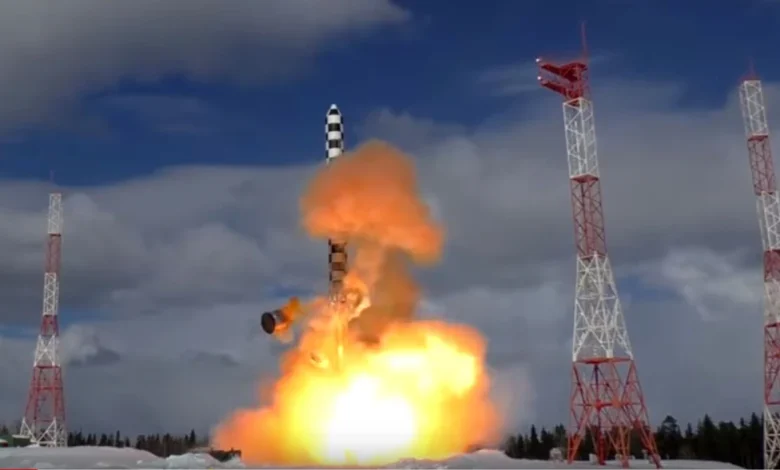
Moscow’s recent test-firing of the Sarmat intercontinental ballistic missile (ICBM) has reverberated across the globe, stirring discussions about the future of nuclear deterrence and the ongoing conflict in Ukraine. The launch, personally lauded by President Vladimir Putin, underscores Russia’s commitment to modernizing its nuclear arsenal. This development arrives at a crucial juncture, coinciding with Putin’s assertions that the military operations in Ukraine are nearing their conclusion. The Sarmat ICBM, designed to supplant the aging Soviet-era Voyevoda, is poised to enter combat service by the end of the year, potentially reshaping the strategic balance. This article delves into the implications of this missile launch, its technical capabilities, and its broader context within the geopolitical landscape.
Sarmat ICBM Unveiled: A New Era in Nuclear Deterrence
The Sarmat ICBM represents a significant leap in Russia’s nuclear capabilities. This advanced weapon system is engineered to deliver multiple independently targetable reentry vehicles (MIRVs), allowing it to strike several targets with a single missile. Its design emphasizes enhanced accuracy, maneuverability, and penetration capabilities, making it exceedingly difficult to intercept by existing missile defense systems. The Sarmat’s unveiling is not merely a technological demonstration but a strategic message, intended to reinforce Russia’s position as a leading nuclear power. The missile’s extended range enables it to reach targets across the globe, providing Russia with a versatile and potent deterrent. The deployment of such a sophisticated system could potentially alter the dynamics of nuclear deterrence, prompting other nations to re-evaluate their strategic postures and defense capabilities.
Putin’s Declaration: The End of the Ukraine Conflict?
Amidst the ongoing tensions surrounding the Sarmat ICBM launch, President Putin’s declaration that the conflict in Ukraine is nearing its end adds another layer of complexity. This statement, made shortly after overseeing a military parade on Red Square, suggests a potential shift in Russia’s strategic focus. However, the timing of this announcement, coupled with the demonstration of the Sarmat’s capabilities, raises questions about Russia’s underlying objectives. Is this a genuine move towards de-escalation, or a calculated attempt to leverage military strength to achieve political goals? The international community remains cautiously optimistic, closely monitoring developments to ascertain the true intentions behind Putin’s words. The situation remains fluid, requiring careful diplomacy and strategic foresight to navigate the challenges ahead. The rejection of peace plans and continued military advancements suggest a complex interplay of factors influencing the conflict’s trajectory.
Modernization of Russia’s Nuclear Forces
President Putin has been a staunch advocate for the modernization of Russia’s nuclear forces since assuming power in 2000. This initiative encompasses a comprehensive upgrade of the country’s nuclear triad, including land-based ICBMs, nuclear submarines, and nuclear-capable bombers. The Sarmat ICBM is a cornerstone of this modernization effort, representing a significant advancement in Russia’s strategic arsenal. The rationale behind this modernization is multifaceted, ranging from maintaining strategic parity with other nuclear powers to ensuring Russia’s national security in an increasingly complex global environment. The Council on Foreign Relations details the ongoing efforts to modernize Russia’s military might. This modernization program reflects Russia’s determination to remain a key player in the international arena, capable of projecting power and safeguarding its interests.
Technical Superiority: Sarmat vs. Western Counterparts
Putin’s assertion that the Sarmat missile surpasses Western counterparts in combined warhead power has sparked considerable debate among military analysts. While it is difficult to definitively confirm such claims, the Sarmat’s technical specifications suggest a formidable weapon system. Its ability to carry multiple MIRVs, coupled with its enhanced maneuverability and penetration capabilities, poses a significant challenge to existing missile defense systems. Moreover, the Sarmat’s extended range allows it to strike targets across vast distances, further enhancing its strategic value. Whether it truly possesses four times the power of Western missiles remains a point of contention, but there’s no doubt about its capability to inflict catastrophic damage. The challenge to existing military advantages underscores the shifting dynamics of global power.
Impact on Geopolitical Landscape
The introduction of the Sarmat ICBM into Russia’s arsenal is poised to have far-reaching implications for the global geopolitical landscape. This advanced weapon system enhances Russia’s strategic deterrence, potentially altering the calculations of other nations. The missile’s capabilities could prompt a new arms race, with countries seeking to develop countermeasures or enhance their own offensive capabilities. Additionally, the Sarmat’s deployment could impact ongoing arms control negotiations, making it more difficult to reach agreements on limiting nuclear weapons. The situation is further complicated by the internal divides that stall international talks. The international community must carefully navigate these challenges to prevent escalation and maintain stability.
Expert Opinions and Analysis
Military and strategic analysts around the world have offered varied perspectives on the Sarmat ICBM launch. Some experts view it as a calculated move by Russia to assert its military might and deter Western intervention in the Ukraine conflict. Others see it as a continuation of Russia’s long-standing efforts to modernize its nuclear forces and maintain strategic parity with the United States. Some analysts also suggest that the Sarmat’s deployment could be aimed at bolstering Russia’s negotiating position in future arms control talks. Regardless of the underlying motives, the Sarmat ICBM represents a significant development that demands careful consideration by policymakers and defense experts alike. The deployment of the Dark Eagle hypersonic missile highlights the ongoing advancements in military technology.
Sarmat ICBM: Key Specifications
| Feature | Specification |
|---|---|
| Type | Intercontinental Ballistic Missile (ICBM) |
| Status | Under Development/Deployment |
| Warhead | Multiple Independently Targetable Reentry Vehicles (MIRV) |
| Range | >11,000 km |
| Guidance | Inertial, possibly with terminal guidance |
| Developer | Makeyev Rocket Design Bureau |
| Replacement For | R-36M Voyevoda |
Historical Context: Voyevoda Replacement
The Sarmat ICBM is designed to replace the R-36M Voyevoda, a Soviet-era ICBM that has been in service for several decades. The Voyevoda, also known as the SS-18 Satan in the West, is a formidable weapon system, but it is nearing the end of its operational life. The Sarmat represents a significant upgrade in terms of range, accuracy, and payload capacity. By replacing the Voyevoda with the Sarmat, Russia aims to maintain a credible nuclear deterrent and ensure its strategic security for the foreseeable future. The transition from older systems to newer ones reflects a continuous effort to adapt to evolving security challenges and technological advancements. The enhancement of border artillery highlights the importance of maintaining a strong defensive posture.
Nuclear Rhetoric and Deterrence
President Putin has frequently employed nuclear rhetoric since the commencement of military operations in Ukraine, which is interpreted as a strategy to deter Western powers from escalating their support for Ukraine. By explicitly mentioning the possibility of nuclear conflict, Putin seeks to raise the stakes and discourage actions that could be perceived as a direct threat to Russia’s national security. While this rhetoric is unsettling, it is essential to recognize that nuclear deterrence has been a cornerstone of international security for decades. The threat of nuclear retaliation is intended to prevent any nation from launching a first strike, thereby maintaining a fragile peace. However, the use of nuclear rhetoric can also be dangerous, as it increases the risk of miscalculation and escalation. The scenarios surrounding nuclear strikes demonstrate the high stakes involved in these discussions.
Military Parade: Absence of Heavy Weapons
The military parade held on Red Square, commemorating the defeat of Nazi Germany in World War II, was notable for the absence of heavy weapons for the first time in nearly two decades. This decision has been interpreted in various ways, with some analysts suggesting that it reflects the strain on Russia’s military resources due to the ongoing conflict in Ukraine. Others argue that it was a deliberate attempt to de-escalate tensions and project an image of restraint. Regardless of the underlying reasons, the absence of heavy weapons at the parade was a symbolic departure from tradition. The IDF strikes in other regions highlight the ongoing military activities around the world.
Future Implications and Global Security
The Sarmat ICBM launch and its subsequent deployment will undoubtedly shape the future of global security. The implications extend beyond the immediate context of the Ukraine conflict, impacting arms control negotiations, strategic alliances, and the overall balance of power. The international community must engage in open dialogue and pursue diplomatic solutions to mitigate the risks associated with this new weapon system. Efforts to reduce nuclear arsenals, enhance transparency, and promote mutual understanding are essential to maintaining peace and stability in an increasingly uncertain world. The ongoing conflicts and tensions around the globe underscore the urgency of addressing these challenges. As technology continues to advance, and new weapons systems emerge, it is imperative that nations work together to prevent a catastrophic nuclear conflict. One example is the navigation of the Hormuz Strait amidst international tensions. The future of global security depends on the collective wisdom and responsible actions of all nations. The United Nations plays a crucial role in fostering dialogue and promoting peaceful resolutions to international disputes cite.