American energy exports hit record highs amid Iran war fallout
American energy is the ultimate, unspoken victor of the devastating Iran war that has brought global shipping to a near standstill. While high-level diplomats and political operatives like JD Vance and Steve Witkoff scramble between world capitals attempting to broker peace or mitigate economic fallout, the United States oil and gas industry is quietly consolidating unprecedented power. Far removed from the volatile negotiating tables in the Middle East, U.S. energy producers are experiencing a boom of historic proportions, reshaping the geopolitical landscape and redefining global supply chains for decades to come.
The Unseen Victor of the Middle East Crisis
In the fog of war, the dominant narrative has largely focused on military maneuvers, diplomatic stalemates, and the immediate humanitarian toll. Yet, beneath the surface of the geopolitical posturing lies a massive economic realignment. The current conflict in the Middle East, particularly the severe disruptions to maritime trade routes, has created a vacuum in global energy supplies. Nature, much like the global economy, abhors a vacuum. Into this void has stepped the United States, utilizing its vast shale reserves and advanced export infrastructure to capture market share that previously seemed impregnable.
As traditional lifelines of fossil fuels face daily threats, international buyers are prioritizing security and reliability over legacy relationships. This shift has not been subtle. It is a seismic realignment that forces nations, which previously balanced their energy portfolios among various Middle Eastern producers, to flock entirely to North American suppliers. The sheer volume of capital flowing into Texas, Louisiana, and North Dakota represents one of the largest wealth transfers in the modern energy era.
Breaking Down the Numbers: Record Crude and LNG Shipments
The statistics emerging from the U.S. Gulf Coast are nothing short of staggering. Last week alone, U.S. crude shipments climbed to an astonishing 12.9 million barrels per day. This shatters previous records and places the United States in a league of its own as the world’s premier energy supplier during this global crisis. Concurrently, Liquefied Natural Gas (LNG) exports have set a new monthly high, with processing facilities operating well beyond their traditionally stated maximum capacities.
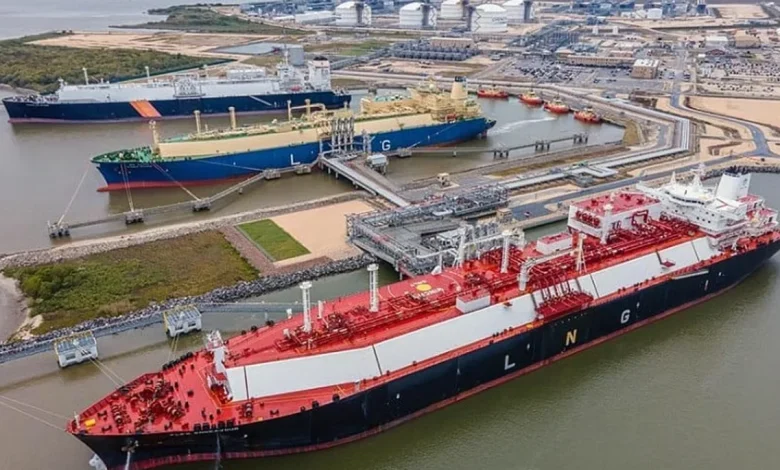
To understand the scale of this logistical marvel, one must look at the oceans. Currently, more than 60 empty supertankers—massive vessels capable of carrying millions of barrels of oil—are actively steaming toward the U.S. Gulf Coast. This figure represents triple the pre-war levels. These maritime behemoths are bypassing traditional loading ports in the Persian Gulf, opting instead for the safety and certainty of the Gulf of Mexico. According to data from the U.S. Energy Information Administration (EIA), this unprecedented vessel migration highlights a fundamental rewiring of the global energy map.
Gulf Coast Terminals Stretched to the Limit
However, this bonanza is not without its operational friction. The massive influx of maritime traffic has stretched the operational bandwidth of Gulf Coast terminals to its absolute limit. Ports from Corpus Christi to Lake Charles are operating around the clock, with harbor pilots, tugboat operators, and terminal engineers working gruelling schedules to manage the backlog of Very Large Crude Carriers (VLCCs). The logistical choreography required to load 12.9 million barrels per day safely and efficiently is immensely complex, pushing American maritime infrastructure into uncharted territory.
| Metric | Pre-War Baseline | Current Conflict Level | Percentage Shift |
|---|---|---|---|
| U.S. Crude Shipments | Approx. 4.1M bpd | 12.9M bpd | +214% |
| Empty Supertankers Heading to Gulf Coast | Approx. 20 vessels | 60+ vessels | +200% |
| Japan’s Oil Sourced from Middle East | 95% | Rapidly Declining | Transforming structurally |
| Europe’s Dependency on U.S. LNG | Approx. 25-30% | 60% | +100% or more |
How Global Dependencies Are Shifting Radically
The fallout from the conflict has laid bare the extreme vulnerabilities of nations heavily dependent on Middle Eastern energy. As a result, global powers are executing rapid, multi-billion-dollar pivots to secure their economic futures. This transition is not merely a temporary adjustment; it is quickly hardening into a structural dependency on American exports.
Japan’s Massive 56 Billion Pivot to U.S. Markets
Perhaps no nation exemplifies this rapid pivot more dramatically than Japan. Historically, Japan sourced a staggering 95% of its crude oil from the Middle East. The geographic proximity and established trade routes made the Persian Gulf the logical, though risky, lifeline for the Japanese industrial machine. However, the realities of the current war have forced Tokyo’s hand. In a monumental shift, Japanese energy conglomerates recently signed $56 billion in long-term energy deals with U.S. firms. This massive infusion of capital ensures that Japan will receive steady streams of American crude and LNG, fundamentally altering its national security and energy procurement strategies for the next quarter-century.
Europe’s Growing LNG Reliance
Across the Atlantic, Europe is experiencing a similar awakening. Following the geopolitical shocks of the past several years, Europe had already begun diversifying away from Eastern European pipelines. Now, the Middle East crisis has accelerated this trend exponentially. Europe currently sources an unprecedented 60% of its LNG from the United States. Entire industrial sectors in Germany, France, and Italy are now intrinsically linked to the output of American shale basins. This level of transatlantic energy integration is historic, creating a symbiotic economic relationship that tightly binds European industrial output to American energy policies.
Political Leverage: The Trump Administration’s Strategy
But there is a massive catch to this newfound dominance, one that leaves international allies deeply uncomfortable. Energy dependency is not merely an economic reality; it is a profound geopolitical weapon. The Trump administration has already demonstrated a clear willingness to use energy exports as direct political leverage. Last month, the U.S. ambassador to the EU delivered a stark, unprecedented warning: Europe could lose its favorable access to American natural gas unless it capitulated and approved a long-stalled, highly contentious bilateral trade deal.
This aggressive utilization of energy as a diplomatic cudgel marks a sharp departure from traditional free-market principles. It signals to the world that access to American energy comes with significant political strings attached. For nations like Japan and the European bloc, the realization that they have traded one unpredictable regional dependency for an increasingly transactional American one is a source of profound anxiety. It transforms every barrel of oil and cubic meter of gas into a bargaining chip on the global diplomatic table.
Structural Limits: Why This Boom Faces Long-Term Hurdles
Despite the current euphoria in the American oil patch, the longer-term picture is fraught with severe physical and economic limitations. The transition away from Middle Eastern oil is not as simple as rerouting ships; it involves the fundamental chemistry of the oil itself and the physical limitations of steel and concrete.
The Asian Refinery Dilemma: Heavy vs. Light Crude
The most pressing technical hurdle lies in the infrastructure of Asian refineries. For decades, the massive refining complexes in countries like China, South Korea, and Japan were specifically engineered and optimized to process heavy, sour crude oil typical of the Middle East. The United States, conversely, produces predominantly light, sweet crude from its shale formations. Running light crude through a refinery built for heavy crude is incredibly inefficient and economically damaging. Overhauling these massive industrial complexes to handle American grades takes years of downtime and billions of dollars in serious capital investment. While some blending can occur, the physical reality of refining chemistry places a hard ceiling on how much American crude Asia can realistically absorb in the short term.
Infrastructure Bottlenecks Until 2027
Domestically, the U.S. is hitting a massive wall of its own making. Export terminals in Texas and Louisiana are rapidly approaching their absolute physical capacity. The infrastructure required to process, store, and load LNG and crude oil onto supertankers cannot be built overnight. Despite the rush to expand, major new export facilities and terminal expansions will not fully come online until 2027 at the earliest. This creates a multi-year bottleneck where American producers may have the reserves, and the world may have the demand, but the physical pipes and loading arms simply cannot bridge the gap.
The Future of Global Oil Post-Hormuz Blockade
Furthermore, one must consider the eventual stabilization of the Middle East. The ongoing Strait of Hormuz blockade has artificially inflated the premium on safe, reliable American crude. The current environment, characterized by oil prices reaching extreme highs, heavily favors domestic exporters.
Market Reversals and Long-Term Implications
However, once the conflict subsides and the Strait of Hormuz reopens at scale, the fundamental economics of global energy will reassert themselves. The cost advantage of producing and shipping Gulf crude is historically undeniable. When the perceived risk of supertanker movements in conflict zones diminishes, Middle Eastern oil will flood back into the market at a significant discount. At that point, U.S. shipments will inevitably lose some of their immediate, desperate appeal, and the shifting global energy order will face another massive recalibration.
Still, history demonstrates that crises of this magnitude leave indelible marks on the global economy. Even if the immediate rush for American energy is born of temporary geopolitical desperation, the resulting infrastructure investments, long-term contracts, and shifted supply chains will create real, permanent structural changes. The United States has firmly entrenched itself as the indispensable energy superpower, a reality that will define international relations and global commerce long after the last shots of the Iran war have been fired.