Jacob Misiorowski Dominates Phillies With 15-K Maddux
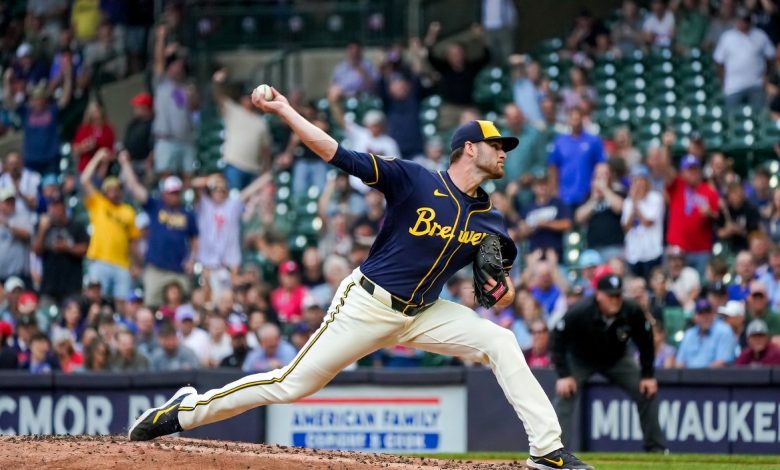
Jacob Misiorowski delivered a masterclass on the mound that baseball fans will talk about for decades to come, turning American Family Field into a theater of pitching history on Friday night, June 12, 2026. Facing the high-octane lineup of the Philadelphia Phillies, the 24-year-old, 6-foot-7 right-handed ace of the Milwaukee Brewers put together an outing that defied modern baseball limits. He didn’t just win; he orchestrated a masterpiece of sheer power, unmatched efficiency, and history-making velocity.
Prior to Friday’s opener, the Brewers had hit a minor skid, dropping two consecutive games to the Oakland Athletics. They needed their young superstar to stabilize the rotation and restore momentum. What they received was not merely a stabilization, but a historic performance: a 95-pitch complete game shutout that doubled as a “Maddux” and a showcase of raw velocity never before recorded by a starting pitcher. The Brewers rolled to a 6-0 victory, but the final score was almost an afterthought compared to the sheer historical weight of what occurred on the hill.
The Birth of a Modern Masterpiece: Inside the Numbers of Misiorowski’s Gem
To fully grasp the magnitude of Misiorowski’s outing, one must look closely at the statistical breakdown. Complete game shutouts have become increasingly rare in the modern era of tightly managed pitch counts and bullpen specialization. To throw a shutout is impressive; to do so against the National League’s elite offenses is elite; but to do it while throwing under 100 pitches and striking out 15 batters borders on the miraculous.
Over nine innings of work, the towering right-hander faced the absolute minimum of 27 batters. He allowed only a single hit, issued zero walks, and hit no batters. Of his 95 pitches, an astonishing 74 were thrown for strikes (a 77.9% strike rate). This relentless zone-pounding, combined with pitches that exceeded the speed limits of human capabilities, left the Philadelphia lineup completely bewildered. It was a pitching performance stripped of all wasted effort, designed for maximum destruction with minimal energy expenditure.
Rewriting the Record Books: A 104.5 MPH Fastball for the Ages
The tone for this legendary night was established with the very first batter of the game. Kyle Schwarber, the Phillies’ formidable leadoff hitter, stepped into the box representing one of the most dangerous power threats in the Major Leagues. Misiorowski immediately attacked, falling behind 2-0 before throwing two blistering fastballs in the strike zone to even the count.
On the fifth pitch of the plate appearance, Misiorowski unleashed a four-seam fastball that defied belief. The ball blazed across the lower outside corner of the strike zone, resulting in a helpless foul tip into the glove of catcher William Contreras. When the radar gun flashed the official velocity, the stadium erupted: 104.5 mph. This set a brand-new Major League record for the fastest pitch ever thrown by a starting pitcher since the introduction of Statcast pitch-tracking in 2008.
Analyzing the Pitch-Tracking Era Records
While relief pitchers have occasionally touched higher numbers—most notably Aroldis Chapman’s legendary 105.8 mph pitch in 2010—the physical demands on a starting pitcher are vastly different. Starters must distribute their energy across multiple innings and dozens of batters. For a starting pitcher to consistently hit and maintain triple-digit velocity is unprecedented.
Prior to this game, Misiorowski already held the starting pitcher record with a 103.4 mph fastball thrown against the St. Louis Cardinals in May 2026. On Friday, he didn’t just break his own record; he shattered the entire historical ceiling. According to reports on MLB.com, Misiorowski now holds each of the top 16 fastest pitches recorded by an MLB starting pitcher in the pitch-tracking era.
| Rank | Pitcher | Team | Velocity (MPH) | Opponent | Date |
|---|---|---|---|---|---|
| 1 | Jacob Misiorowski | Milwaukee Brewers | 104.5 | Philadelphia Phillies | June 12, 2026 |
| 2 | Jacob Misiorowski | Milwaukee Brewers | 104.2 | Philadelphia Phillies | June 12, 2026 |
| 3 | Jacob Misiorowski | Milwaukee Brewers | 104.1 | Philadelphia Phillies | June 12, 2026 |
| 4 | Jacob Misiorowski | Milwaukee Brewers | 104.0 | Philadelphia Phillies | June 12, 2026 |
| 5 | Jacob Misiorowski | Milwaukee Brewers | 103.4 | St. Louis Cardinals | May 15, 2026 |
What is a “Maddux”? Comparing “The Miz” to the Hall of Famer
In the lexicon of baseball, a “Maddux” is one of the most respected achievements for a starting pitcher. Coined in honor of Hall of Fame pitcher Greg Maddux, the term describes a complete game shutout thrown in fewer than 100 pitches. During his legendary career with the Atlanta Braves and Chicago Cubs, Maddux accumulated 13 of these games, relying on pinpoint command, devastating movement, and a philosophy of inducing weak contact early in counts.
However, Greg Maddux achieved this efficiency with a fastball that rarely crossed 90 mph. The concept of a modern “power-Maddux” is almost an oxymoron. Jacob Misiorowski, affectionately nicknamed “The Miz,” turned this classic pitching archetype on its head. He proved that you can achieve the ultimate efficiency of a control specialist while simultaneously flashing the overwhelming velocity of an elite closer.
The Anatomy of a Sub-100 Pitch Complete Game
To throw a complete game in 95 pitches, a pitcher must average roughly 10.5 pitches per inning. This requires an incredibly aggressive approach in which the pitcher trusts his stuff, challenges hitters directly, and minimizes deep counts. Misiorowski did exactly that. He threw first-pitch strikes to nearly every batter he faced and continuously got ahead in counts. The Phillies, fully aware of his historic fastball, were forced to swing early to avoid falling behind, leading to quick outs.
Breaking the Strikeout Record in a Maddux Outing
Typically, high strikeout totals push a pitcher’s pitch count upward, because strikeouts inherently require at least three pitches and often lead to longer, full-count battles. Prior to Friday, the record for the most strikeouts in a sub-100 pitch shutout during the pitch-tracking era was held by Tarik Skubal, who struck out 13 batters. Misiorowski shattered that benchmark. By striking out 15 batters on 95 pitches, he achieved a level of efficiency that defies mathematical norms, solidifying his performance as the greatest Maddux ever recorded in the tracking era.
Facing the Minimum: The Kyle Schwarber Single and Bryce Harper Double Play
The only detail that prevented Misiorowski from pitching a flawless perfect game was a single hit off the bat of Kyle Schwarber. Leading off the top of the fourth inning, Schwarber managed to make contact with a well-located slider on the outer edge of the plate, dropping a single into the outfield.
In most games, a leadoff single in the fourth would signal the start of a potential rally. Instead, it only served to highlight Misiorowski’s complete poise and control. He immediately responded by striking out Trea Turner on four pitches. The next batter, two-time NL MVP Bryce Harper, swung at a high fastball and grounded into a textbook 4-6-3 double play to end the inning.
Because Schwarber was erased on the double play and Misiorowski did not allow a single walk or hit batsman, he faced exactly 27 batters over nine complete innings. In baseball history, facing the minimum of 27 batters in a one-hit shutout is considered a “virtual” perfect game, a feat that showcases absolute control and dominance.
From Flame-Throwing Prospect to Cy Young Contender
Drafted as a high-ceiling prospect, scouts always knew that Misiorowski possessed elite physical tools. Standing 6-foot-7 with long limbs and an exceptionally low release point, his mechanics generate incredible extension toward home plate. This extension makes his 104 mph fastball appear even faster to opposing hitters, as the ball is released closer to the plate than it would be from an average-sized pitcher.
Friday’s historic game marked exactly one year to the day since Misiorowski made his Major League debut. In just twelve months, he has evolved from a raw prospect with control questions into the most dominant starting pitcher in professional baseball. With this victory, he improved his season record to 8-2, lowering his ERA to an astonishing 1.34 across 14 starts. He is now the frontrunner for the National League Cy Young Award, setting up a thrilling summer race against the Phillies’ own Cristopher Sánchez.
Domination Over the Last Eight Starts
While his season-long numbers are elite, Misiorowski’s performance over his last eight outings is historic. During this eight-start stretch, he has compiled a microscopic 0.17 ERA, giving up only a handful of hits and single runs. This is the lowest ERA over an eight-start span in Milwaukee Brewers history and ranks among the most dominant stretches in the history of the sport.
Tactical Breakdown: How Misiorowski Dismantled the Phillies’ Elite Lineup
Dismantling a lineup as potent as the Philadelphia Phillies requires more than raw power; it requires tactical execution. The Phillies entered the game with one of the highest run-scoring offenses in the league, boasting elite left-handed power and veteran plate discipline. Misiorowski neutralized their strengths by aggressively pitching to both sides of the plate and varying his speeds.
His game plan focused on throwing high-velocity four-seam fastballs on the hands of right-handed hitters like Trea Turner and Alec Bohm, while using his devastating slider to sweep away from left-handed bats. By establishing the fastball early, the Phillies’ hitters had to commit early in their swing decisions, making them highly vulnerable to his off-speed offerings.
The Pitch Mix and Velocity Consistency
What makes Misiorowski’s night truly terrifying for the rest of the league is how well he maintained his velocity into the deep innings. In the top of the ninth, he did not show a single sign of fatigue. He threw eight of his final nine pitches over 100 mph, mixing in a brilliant 92.2 mph changeup that left the hitters completely off-balance. His final pitch of the night, a 103.1 mph fastball to strike out Justin Crawford, looked just as explosive as his record-breaking pitch in the first inning.
The Milwaukee Brewers’ Postseason Aspirations
The Brewers’ 6-0 victory over the Phillies pushed their season record to 42-25, widening their lead in the highly competitive National League Central division. Under the management of Pat Murphy, the Brewers have built a team culture centered on aggressive play, elite defense, and exceptional pitching development.
“Amazing. Amazing young man. He really is,” Murphy said of Misiorowski after the game. “Forrest Gump-like. Amazingly real. Naive to a lot of things. It’s beautiful. He just goes out and lets it eat.” Having an ace of Misiorowski’s caliber gives the Brewers a massive advantage heading toward the postseason. In a short playoff series, a starting pitcher capable of dominating an entire game on under 100 pitches allows the bullpen to remain fully rested, making the Brewers a terrifying opponent in October.
Legacy of the 104.5 MPH Maddux
Jacob Misiorowski’s performance on Friday, June 12, 2026, will be remembered as one of the peak individual achievements in baseball history. It combined the historical nostalgia of Greg Maddux’s unmatched efficiency with the modern, high-tech evolution of triple-digit velocity. By facing the minimum 27 batters, throwing 104.5 mph, and striking out 15, “The Miz” proved that the boundaries of physical performance on the mound are still waiting to be rewritten.