Iran War Day 147: Trump Considers Massive Airstrikes
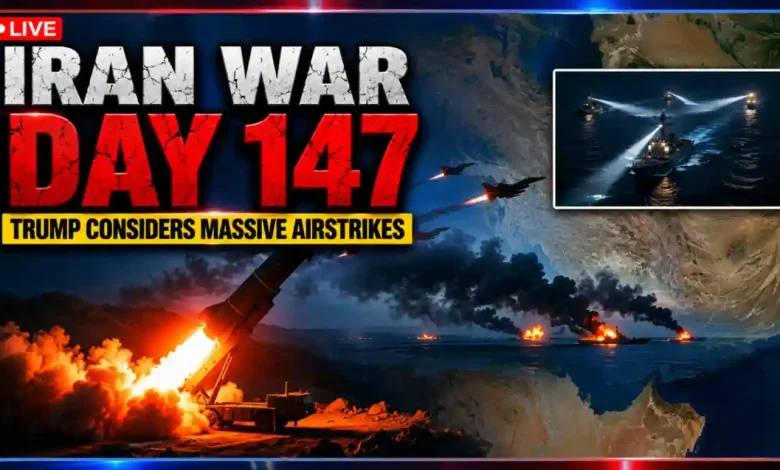
Table of Contents
Iran war hostilities have entered their 147th day, marking one of the most volatile and dangerous phases in modern Middle Eastern history. Since the initial outbreak of conflict on February 28, 2026, when coordinated U.S. and Israeli airstrikes targeted Iranian facilities, the region has been engulfed in a complex cycle of violence, diplomatic standoffs, and severe economic disruptions. What began as an operation to neutralize perceived regional threats has expanded into a multi-theater war involving various state and non-state actors, including Yemen’s Houthi rebels, Lebanese Hezbollah, and various paramilitary forces. Over the past five months, the international community has watched with mounting anxiety as the conflict shifted from direct aerial engagements to a grueling struggle over the world’s most critical maritime corridors. At Day 147, the geopolitical stakes have never been higher. With both sides reinforcing their military postures, the conflict shows no signs of a peaceful resolution, leaving global energy markets and international trade networks in a state of high vulnerability. The historical context detailed on the 2026 Iran war Wikipedia page provides crucial insights into how these escalations triggered such broad international involvement.
Introduction: The Anatomy of a Hundred and Forty-Seven Days of War
The progression of the conflict over 147 days has redefined modern asymmetric warfare. Initial stages were characterized by rapid, high-intensity precision strikes aimed at Iranian command nodes, air defense systems, and ballistic missile research facilities. Iran responded with asymmetrical retaliatory strikes, utilizing its massive arsenal of suicide drones and medium-range ballistic missiles to target coalition positions and commercial shipping lanes. As the war entered its second and third months, the fighting transitioned from a localized border skirmish into a regional maritime siege. Diplomatic attempts to de-escalate have repeatedly floundered against a backdrop of mutual distrust and conflicting strategic objectives. Today, military activity remains highly dynamic, with reports of continuous tactical adjustments on both sides. While the coalition seeks to degrade Iran’s capability to project power, Tehran continues to leverage its regional proxy network to inflict maximum economic pain on Western allies, ensuring that the conflict remains a primary global concern with no clear end in sight.
Collapse of the Mid-June Peace Memorandum
The rapid deterioration of the security situation on Day 147 is direct evidence of how the US-Iran ceasefire collapsed in spectacular fashion. Just weeks prior, there was a glimmer of diplomatic hope when the United States and Iran signed the Islamabad Memorandum of Understanding (MOU) on June 17, 2026. This landmark interim agreement, brokered with the assistance of regional mediators like Pakistan, was designed to freeze active hostilities for a 60-day window. The terms of the MOU were highly ambitious, requiring a cessation of hostilities in Lebanon, an end to Iranian-backed harassment in the Strait of Hormuz, and a gradual reduction of U.S. military assets in the Persian Gulf in exchange for targeted sanctions relief and economic reconstruction commitments. However, the fragile peace was short-lived. Disagreements over whether the ceasefire extended to Israeli military operations in southern Lebanon created immediate friction. Hours after the announcement, Israel conducted a massive air blitz in Lebanon, which Hezbollah and Tehran viewed as a material violation of the agreement. As mutual trust evaporated, the conflict truce collapsed as Trump warned that any further maritime aggression would be met with overwhelming force, officially ending the short-lived diplomatic off-ramp.
The Ever Lovely Incident and the Shipping Corridor Breakdown
The final nail in the coffin for the mid-June truce occurred when an international commercial container vessel, the Ever Lovely, was struck by one-way suicide drones in the Strait of Hormuz. The Iranian Revolutionary Guard Corps (IRGC) claimed the vessel had deviated from the preapproved shipping corridor established under the unilateral Iranian scheme, thereby violating sovereign maritime protocols. The U.S. and its allies vehemently rejected this explanation, characterizing the drone attack as a direct, unprovoked assault on free navigation. The strike on the Ever Lovely caused significant physical damage to the ship’s upper deck, forcing the crew to take emergency measures. President Donald Trump publicly condemned the incident as a foolish violation of the Islamabad MOU. In immediate retaliation, U.S. Central Command authorized targeted airstrikes on coastal radar networks and drone launch sites on Qeshm Island, signaling that the preapproved shipping corridor framework had completely disintegrated and marking a return to active, unrestrained warfare.
Thirteen Nights of Fire: U.S. and Israeli Military Operations
Following the collapse of the truce, the U.S. military embarked on a relentless air campaign designed to systematically dismantle Iran’s defensive and offensive capabilities. By Day 147, U.S. forces had completed a 12th consecutive night of strikes, which quickly rolled into a 13th night of heavy bombardments across key Iranian provinces. Operating under the command of Defense Secretary Pete Hegseth and U.S. Central Command, these airstrikes have utilized advanced aerial assets, including B-1 Lancer strategic bombers, F-15E Strike Eagles, and sea-launched Tomahawk cruise missiles. The primary focus of these nightly runs has been the degradation of Iran’s ballistic missile storage facilities, air defense radars, and drone manufacturing infrastructure. According to Pentagon briefings, the sustained intensity of the air campaign is intended to establish deterrence and protect commercial mariners. However, the strikes have also resulted in retaliatory projectile launches from Iran toward U.S. regional allies, with sirens frequently sounding in Bahrain, Kuwait, and Jordan, demonstrating that the aerial campaign has struggled to completely suppress Iran’s retaliatory capacity.
Major Sites Targeted in Recent Air Campaigns
The geography of the recent airstrikes reveals a highly strategic targeting methodology. Explosions have rocked the vital port city of Bandar Abbas, a crucial hub for both military logistics and commercial trade. In these strikes, several Iranian military targets struck by US forces sustained catastrophic damage, including naval maintenance depots and fast-attack craft harbors. Simultaneously, military installations on Qeshm Island, which serve as launchpads for IRGC drone boats and anti-ship missile batteries, were subjected to intense bombardment. Further inland, strikes targeted missile silos and air defense command nodes near Andimeshk, Omidiyeh, and Firuzabad. On the outskirts of Ahvaz along the Karun River, missile strikes reportedly destroyed a major logistics depot, resulting in multiple casualties. While the Pentagon maintains that these operations are surgically precise and strictly aimed at reducing offensive threats, Iranian state media has used the resulting damage to rally domestic support, accusing the coalition of targeting civilian infrastructure and violating national sovereignty.
Financial and Economic Toll of the Middle Eastern War
The sheer scale of the conflict has resulted in astronomical financial burdens for all parties involved. In Washington, the ballooning costs of maintaining an active war footing in the Middle East have sparked intense political debate. Defense Secretary Pete Hegseth recently disclosed that cumulative US-Iran war costs soared to $37.5 billion, a figure that continues to climb daily as heavy bombers and naval strike groups consume vast amounts of fuel and precision-guided munitions. This rapid expenditure has drawn sharp criticism from congressional budget watchdogs and political opponents, who question the lack of a clear exit strategy. On the Iranian side, the economic devastation is severe. Years of crippling economic sanctions, combined with the physical destruction of infrastructure and the complete halt of oil exports through primary ports, have pushed the domestic economy to the brink of collapse. Hyperinflation is ravaging the middle class, and the government has been forced to deplete its strategic reserves to maintain basic public services and fund its military operations.
| Milestone / Indicator | Status at Day 147 | Regional & Global Impact |
|---|---|---|
| Strait of Hormuz Traffic | Down 60% (6 confirmed crossings) | Scramble for alternative routes, severe energy supply risks |
| Cumulative U.S. War Cost | $37.5 Billion (disclosed by Sec. Pete Hegseth) | Heightened domestic budget scrutiny and political debate |
| Brent Crude Price | Breached $100 per barrel | Triggered global inflation fears and central bank rate hike expectations |
| Recent Air Campaigns | 13 consecutive nights of U.S. strikes | Degradation of IRGC drone/missile assets, strikes in Ahvaz & Qeshm Island |
| Red Sea Transit Status | Houthi blockade against Saudi-linked ships | Insurance premiums soaring, Red Sea trade route highly volatile |
Soaring Energy Prices and Monetary Tightening Fears
The economic shocks of the war are not confined to the belligerent nations; they have reverberated violently through global financial markets. As the Strait of Hormuz conflict escalated, international energy markets reacted with panic. Brent crude futures, the global oil benchmark, briefly breached the critical threshold of $100 per barrel on Day 147. This surge in energy prices has fueled widespread fears of an energy-driven inflation spike, reminiscent of the supply shocks of the 1970s. Global central banks, particularly the Federal Reserve, are monitoring the situation with growing concern. With the Federal Open Market Committee’s July policy meeting approaching, money markets have rapidly priced in a near-certain interest rate hike for the September meeting to combat potential inflationary pressures. Meanwhile, in the commodities market, gold futures have experienced extreme volatility, testing highs near $4,171 per ounce before settling around $4,050, reflecting the intense bearish and inflationary forces competing in a highly uncertain global economic climate.
Regional Escalation: Houthi Maritime Blockade and the Red Sea Crisis
Adding to the complexity of the war, Yemen’s Houthi rebels have expanded their involvement by launching coordinated attacks on commercial shipping in the Red Sea. Acting as a key regional proxy for Tehran, the Houthis declared a strict maritime blockade against Saudi-linked vessels, accusing Riyadh of assisting the U.S.-led coalition. This declaration has led to a major Red Sea shipping crisis and Houthi strikes on two Saudi oil tankers, the Amjad and the Al-Biruni. These maritime attacks have created a severe crisis for global shipping insurers. Financial institutions and insurance brokers have refused to write cargo policies for Saudi-linked vessels transiting the Bab el-Mandeb strait, forcing ships to pay exorbitant risk premiums or bypass the region entirely. The Houthi blockade has successfully weaponized maritime trade, threatening to cut off another vital global shipping route and further squeezing international supply chains.
The Strait of Hormuz Standoff and Blockade Risks
The primary focal point of global economic anxiety remains the Strait of Hormuz, where the flow of oil has slowed to a trickle. Shipping data from trackers like Kpler indicates that daily transits through the strait have plummeted by 60%, falling to just six confirmed crossings on Day 147. In response to this stranglehold, President Donald Trump has adopted an increasingly aggressive stance. Trump announced that the U.S. government intends to seize confiscated Iranian financial assets to pay for physical damages sustained by commercial vessels attacked in the strait. Furthermore, Trump threatened that the U.S. Navy could reinstate a full naval blockade on Iranian ports, warning that for every ship attacked by Iran, the coalition would destroy a critical piece of Iranian civilian infrastructure, such as a bridge or a power plant. Tehran has condemned these moves as blatant acts of piracy, warning that a total blockade would trigger a catastrophic military response that would set the entire Persian Gulf ablaze.
Diplomatic Efforts and the Uncertain Road Ahead
Despite the intense military activity, backdoor diplomatic channels remain active, though their prospects for success appear increasingly slim. Regional countries, particularly Pakistan, have attempted to act as mediators to de-escalate the situation. Iranian Interior Minister Eskandar Momeni recently visited Islamabad in an effort to find a potential path toward a new ceasefire agreement. However, these diplomatic overtures are overshadowed by the uncompromising rhetoric from both Washington and Tehran. U.S. Secretary of State Marco Rubio expressed skepticism about any new negotiations, stating that while Iran appears to be pleading for a diplomatic deal due to the immense military and economic pressure, they are ultimately unprepared to uphold any international commitments. Inside the White House, President Trump is reportedly in “revenge mode” as the war enters its fifth month without a decisive victory, and is considering a massive, unprecedented air assault on Iran’s nuclear and leadership facilities. As Day 147 draws to a close, the absence of a viable diplomatic path means the Middle East remains on the precipice of an even wider, more devastating conflagration.