Temporary Protected Status 2026: Court Backs Trump on Haiti TPS
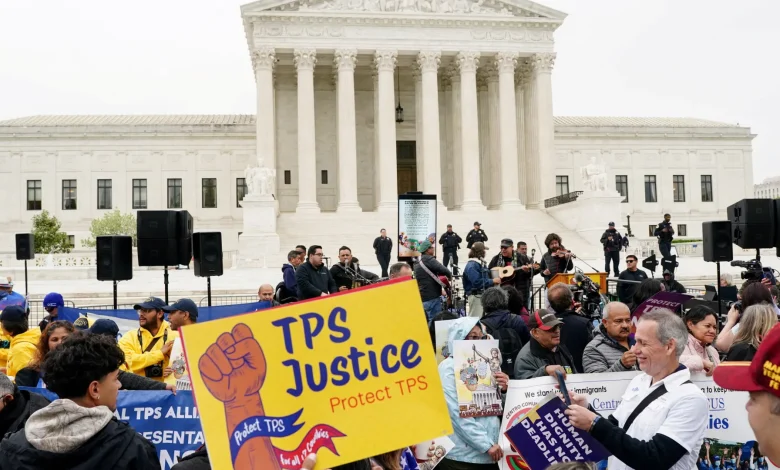
Table of Contents
Temporary Protected Status (TPS) was dealt a monumental blow on Thursday morning when the Supreme Court cleared the way for the Trump administration to terminate critical humanitarian protections for hundreds of thousands of Haitian and Syrian immigrants. In a sweeping 6-3 decision that split along ideological lines, the conservative majority ruled that federal courts lack the jurisdiction to review decisions made by the Department of Homeland Security (DHS) regarding the termination of the TPS program. For individuals like Harlaine, an emergency room and travel nurse who has lived and worked legally in the United States for years, the news was physically and emotionally devastating. Learning of the decision on Thursday morning, Harlaine described the feeling as a physical blow: ‘I just couldn’t breathe. I think I stopped breathing for a few minutes, and it was just like a heaviness on my chest.’ For more information on official court records, see the official Supreme Court of the United States website.;
Temporary: The Devastating Personal Impact: Harlaine’s Story
Harlaine’s reaction represents the collective anguish of more than 350,000 Haitian nationals who have built lives, families, and careers in the United States. Having held Temporary Protected Status since her mid-30s, she represents a vital segment of the American healthcare workforce. As an ER and travel nurse, she has spent years on the frontlines of public health crises, filling critical staffing shortages in hospitals across the nation.
Temporary:Who is Harlaine and Why Does TPS Matter?
Her legal presence was once guaranteed under humanitarian provisions designed to protect individuals from being forced back to nations devastated by war, disease, or natural disaster. Yet, the sudden stripping of this status leaves her vulnerable to deportation and unable to legally continue her career. ‘The weight of the decision sliced through me,’ Harlaine recalled, reflecting on the grim reality of being cast into legal limbo after decades of contribution. The crisis underscores broader systemic problems, including global health and administrative systemic gaps that are exacerbated when essential health professionals are suddenly removed from their roles.
Temporary:The Supreme Court Decision in Mullin v. Doe Explained
The legal catalyst for this crisis is the Supreme Court’s ruling in Mullin v. Doe (No. 25-1083), decided on June 25, 2026. This case centered on whether the executive branch’s decision to terminate TPS designations for Syria and Haiti could be subjected to judicial oversight. Attorneys representing TPS recipients argued that the Department of Homeland Security failed to follow the mandated legal procedures outlined by Congress. Specifically, they asserted that the administration had ignored reports from its own interagency review boards showing that conditions in Haiti and Syria remained incredibly dangerous.
The 6-3 Ideological Split and Judicial Review Exclusion
However, the Supreme Court’s majority opinion, written by Justice Samuel Alito, concluded that the judiciary has no authority to review these executive actions. The Court interpreted the original 1990 TPS statute as containing explicit limits on judicial review, effectively shielding DHS ‘determinations’ from being contested in federal courts. This ruling successfully neutralizes legal challenges that had previously stalled the administration’s efforts, including lower-court rulings that had temporarily blocked the wind-down of these humanitarian protections. The conservative justices emphasized that the discretion over temporary designations rests entirely within the executive’s purview, effectively placing these determinations beyond the reach of federal judges.
Temporary:Overruling Lower Courts and the Separation of Powers
The decision in Mullin v. Doe directly overturns rulings from federal courts in New York and Washington, D.C., which had previously issued injunctions to preserve TPS. Lower court judges had previously found that the administration’s termination of the program bypassed mandatory procedural steps and was influenced by political motives rather than objective assessments of country conditions. By declaring these actions non-reviewable, the Supreme Court has dramatically expanded executive authority over immigration programs. This expansion of executive power mirrors other controversial policies, such as when unconstitutional grants halted by the administration sparked intense legal debates, or when separate legal battles surrounding administrative actions challenged the limits of unilateral presidential authority. In this instance, the conservative majority reinforced that the administration holds near-plenary power over temporary migration programs.
The Scope of the Ruling: Impact on Haitians and Syrians
The immediate focus of Mullin v. Doe is on the 350,000 Haitians and 6,000 Syrians currently protected by TPS, but the long-term ramifications extend far wider. Across the United States, an estimated 1.3 million immigrants from 17 different nations are protected under various TPS designations. The ruling sets a dangerous precedent, signaling that any country’s designation can be revoked at the whim of the executive branch without the safety net of judicial appeal.
Dangerous Conditions Awaiting Deportees
For Haiti, which received its initial designation in 2010 following a catastrophic 7.0-magnitude earthquake, conditions have only deteriorated. The country has been gripped by severe political instability following the assassination of President Jovenel Moïse, systemic gang violence, and a breakdown of public infrastructure. Syria, designated in 2012 due to a brutal civil war, remains a highly active conflict zone. Under current State Department guidelines, both nations are classified under Level 4: ‘Do Not Travel’ advisories due to extreme risks of violence, terrorism, and kidnapping.
| Country Designation | Initial Designation Year | Estimated Affected Population | Original Grounds for Humanitarian Relief | Current US State Department Travel Advisory |
|---|---|---|---|---|
| Haiti | 2010 | 350,000 | Catastrophic 2010 Earthquake & subsequent civil unrest | Level 4: Do Not Travel (Gang violence, kidnapping) |
| Syria | 2012 | 6,000 | Ongoing civil war & humanitarian crisis | Level 4: Do Not Travel (Terrorism, active conflict) |
Political Discourse and Allegations of Bias
A central argument presented by the plaintiffs in the lawsuit was that the decision to terminate Haitian TPS was driven by racial animus. Attorneys highlighted various controversial public statements made by Donald Trump, including false claims regarding Haitian immigrants in Springfield, Ohio, and rhetoric describing certain nations as ‘poisoning the blood’ of the United States.
Justice Alito’s Majority Opinion on Racial Animus
Justice Alito, writing for the majority, dismissed these arguments. The majority opinion asserted that political rhetoric, even when highly controversial, does not automatically prove that the formal administrative justifications provided by DHS were legally deficient or racially motivated. The Court maintained that the administration’s stated reasons for ending the designations were facially neutral and fell within the broad discretion granted to the executive branch by Congress. The majority opinion pointed out that political discourse is often distinct from formal executive action, which they found to be grounded in administrative and geopolitical justifications.
The Dissenting Justices’ Warnings
In a sharp and passionate dissent, the Court’s three liberal justices criticized the majority for giving the executive branch unchecked authority over the lives of hundreds of thousands of legal residents. They argued that Congress never intended to shield DHS from judicial review when the agency fails to follow its own established processes and ignores the real-world dangers awaiting individuals returned to unstable nations. The dissenters emphasized that stripping legal status from people who have lived in the United States for decades—some having arrived as children or young adults—will disrupt local economies, tear families apart, and decimate essential labor forces, particularly in healthcare and agriculture. They warned that by closing the courthouse doors to these vulnerable populations, the majority has compromised the judiciary’s role as a vital check on executive overreach.
Legal Consequences and the Broad Horizon of TPS Designations
The ruling in Mullin v. Doe will have immediate administrative consequences. The Department of Homeland Security, under Secretary Kristi Noem, is now cleared to proceed with the wind-down of these protections. Legal advocates are scrambling to find alternative pathways for affected individuals, though options are limited for those who do not qualify for other visas or adjustment of status.
A Historical Overview of the Policy
Historically, TPS was designed as a temporary tool to provide safe harbor. However, because crises in home countries often persist for decades, many recipients have established deep roots in the United States. They have purchased homes, started businesses, paid taxes, and raised American-citizen children. Forcing these communities into the shadows or deporting them represents a dramatic shift in how the nation handles long-term humanitarian populations. It marks a transition toward a much more aggressive and rigid interpretation of immigration statutes, leaving little room for humanitarian considerations or local community stability.
What Lies Ahead for Immigrants and Healthcare Workers
As Harlaine and thousands of others face an uncertain future, the human toll of the Supreme Court’s decision remains the most pressing concern. Without work authorization, highly skilled professionals will be forced out of their jobs, worsening labor shortages in critical fields. Immigration advocacy organizations are calling on Congress to pass legislative fixes, such as a permanent pathway to residency for long-term TPS holders. However, in a deeply divided political landscape, the prospects of such legislation remain slim. For now, recipients must navigate a stressful reality, knowing that the legal protections they relied upon for decades have evaporated under a newly empowered executive branch. The medical field, already struggling under systemic pressures, faces yet another crisis as qualified, compassionate, and experienced workers are sidelined due to their legal status.