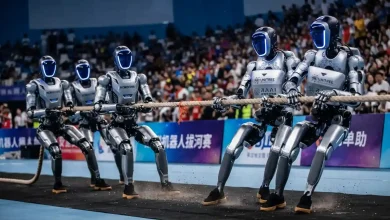
Anthropic Races to Launch New AI Model Countering OpenAI 2026
Table of Contents
Anthropic is currently leading one of the most significant strategic pivots in the artificial intelligence sector as it prepares to unveil its next-generation language model to counter OpenAI’s newly launched GPT-6 Astra.
Anthropic :Strategic Crossroads for Anthropic
This tactical development highlights the fierce rivalries defining the current generative AI space, where technical supremacy translates directly into investor billions and enterprise market share. According to three internal sources familiar with the company’s roadmap, the upcoming model deployment is designed to neutralize the momentum OpenAI has gathered since its latest release. Yet, this aggressive product push stands in sharp contrast to the public warnings issued by the startup’s executive leadership, creating a fascinating corporate paradox that has caught the attention of both market analysts and safety advocates alike.
The Competitive Pressure: Claude vs. GPT-6 Astra
The race between these two tech giants has reached a boiling point. For months, the company’s Claude series of models has enjoyed immense acclaim from developers for its nuanced reasoning capabilities, superior context window, and robust multi-modal performance. However, OpenAI’s sudden rollout of GPT-6 Astra disrupted this balance, delivering unprecedented performance across synthetic reasoning, real-time agentic workflows, and predictive mathematical calculations. To remain competitive and protect its enterprise market share, the startup is compelled to respond. As the startup evaluates its upcoming anthropic ipo nvidia backing opportunities, the pressure to deliver cutting-edge performance has never been greater.
Anthropic :OpenAI’s Dominance and the Launch of GPT-6 Astra
OpenAI’s release of GPT-6 Astra established new standards for conversational clarity and self-correcting logic. Enterprise clients have rapidly integrated Astra into automated customer success pipelines, financial modeling engines, and complex software-engineering suites. This shift threatened to relegate Claude to a secondary tier, prompting immediate concern among the startup’s lead investors. To prevent a widespread customer migration, the company’s product teams have accelerated their development pipeline, squeezing testing cycles to ensure their next-generation architecture is ready for public deployment far ahead of its initial target schedule.
The IPO Dilemma: Valuation and Investor Expectations
This impending launch is heavily tied to the company’s financial future. Reports suggest that the organization is actively planning an initial public offering (IPO) aimed at raising billions of dollars to sustain its massive compute requirements. In a landscape where venture capital is increasingly selective, a high-profile IPO requires proof of technological parity—if not outright dominance—over its direct competitors. Wall Street remains hyper-focused on raw benchmarks and monetization, driving a massive surge in any rallying ai linked stock indicators.
The AI Safety Movement and Corporate Dilemmas
This market reality places the organization in an awkward position. The firm was originally founded by former OpenAI researchers who departed due to concerns over the commercialization and rapid pacing of unsafe model releases. By choosing to accelerate its own model timeline to satisfy pre-IPO growth metrics, the company risks alienating its core base of safety-conscious developers and corporate clients. This delicate tightrope walk has caused significant tension inside the company, especially as ai safety warnings spark intense debate across academic and regulatory bodies.
Anthropic :Dario Amodei’s Paradox: Safety Advocacy vs. Market Reality
Perhaps the most striking element of this upcoming product cycle is the deep philosophical contrast it poses with its executive leadership’s public statements. CEO Dario Amodei has consistently emerged as one of the world’s most vocal proponents of algorithmic caution. In international summits, congressional hearings, and open letters, Amodei has championed the idea of an industrywide slowdown. He has repeatedly warned that the unchecked advancement of frontier AI capabilities could lead to catastrophic national security risks, systemic economic disruption, and loss of human control over autonomous systems.
However, the commercial imperatives of running a multi-billion-dollar enterprise have apparently forced a compromise. While Amodei advocates for regulatory brakes, the company’s engineering division is running on overdrive to match OpenAI’s technical velocity. Critics argue that this split-screen reality represents a classic corporate double standard: preaching caution to the public while pursuing rapid scaling behind closed doors to appease venture capital partners. Security researchers have noted that rushing complex models to market without adequate guardrails increases the risk of zero-day exploits, particularly in vulnerabilities where ai agents exploit enterprise databases.
Anthropic :Technical Outlook: What to Expect from the New Model
The upcoming system is rumored to introduce deep structural changes to the Claude architecture. Sources indicate that the engineering team has focused heavily on improving reinforcement learning from human feedback (RLHF) and integrating advanced reasoning chains directly into the training process. This would allow the model to think through complex multi-step problems before generating a response, mirroring the reasoning capabilities popularized by OpenAI’s latest systems. Deploying these massive networks requires unprecedented computational power, drawing on next-generation architectures such as the highly anticipated gpu hardware like the nvidia rubin debut.
Additionally, the company is looking to expand Claude’s multi-modal capabilities, enabling seamless real-time processing of complex technical diagrams, high-resolution audio, and live video inputs. This would directly address the primary selling points of GPT-6 Astra, positioning Claude as a fully viable alternative for enterprise-level automation and deep research workflows.
Anthropic :Comparison Table: Claude Next-Gen vs. GPT-6 Astra
To understand how this upcoming launch might alter the competitive balance of power, it is useful to compare what is currently known about both systems:
| Feature / Metric | Anthropic Next-Gen (Claude 4 / Claude 3.7) | OpenAI GPT-6 Astra |
|---|---|---|
| Primary Architectural Focus | Constitutional AI, Verified Reasoning, and Enterprise Trust | Agentic Autonomous Workflows and High-Speed Execution |
| Context Window Size | Over 500,000 Tokens (Targeted) | 250,000 Tokens |
| Safety Alignment Method | Constitutional Rulesets & Multi-layered Classifiers | Post-training Safety Filters & Human Evaluation Panels |
| Primary Market Position | Enterprise Integration, Research, and Corporate Compliance | Consumer App Ecosystem and Generalist Coding Agents |
Anthropic :The Broader Geopolitical and Regulatory Landscape
The tension between accelerating development and ensuring system safety occurs against a backdrop of intensifying global scrutiny. At the state and federal levels, lawmakers have been pushing for more robust regulatory guardrails, bringing comprehensive ai safety legislation to the forefront of corporate governance. These legislative movements seek to hold creators legally accountable for the downstream actions of their foundational models, a proposal that has divided Silicon Valley.
This technological push is further accelerated by the ongoing geopolitical ai race with china, where leadership in generative capabilities is viewed as a matter of national security. These issues are not restricted to Silicon Valley boardrooms, as seen in the recent high-stakes bilateral us china ai safety talks, which focused heavily on model containment and preventing catastrophic misalignments.
Conclusion: Navigating Safety and Unchecked Growth
The impending launch of the new Claude model marks a pivotal moment for the artificial intelligence industry. It illustrates the limits of voluntary restraint in a highly competitive, venture-backed market. Even an organization built specifically on the foundation of mathematical alignment and regulatory caution cannot escape the gravity of commercial competition. As the organization prepares for its historic public offering, its ability to successfully balance the safety-first mission of Dario Amodei with the high-octane demands of enterprise scaling will ultimately determine its long-term survival in an era dominated by OpenAI.