Darryl Brown Charged in AP Journalist’s Camera Bag Theft
Darryl Brown, a sergeant within the Essex County Prosecutor’s Office in New Jersey, is now facing third-degree theft charges after an Associated Press photojournalist used a geo-tracking device to trace her stolen camera gear directly to his private residence. The victim of the theft, Angelina Katsanis, was on assignment covering highly charged anti-ICE protests outside Newark’s Delaney Hall immigration jail. The bizarre saga, which unfolded in late May and early June of 2026, highlights growing concerns regarding law enforcement accountability, the physical dangers confronting journalists on the front lines of public demonstrations, and the increasing role of consumer tracking technology in exposing misconduct. By utilizing a simple digital tracking beacon, Katsanis managed to crack a case that state investigators later solidified with body camera footage and a physical search warrant.
The Incident at Delaney Hall Detention Center
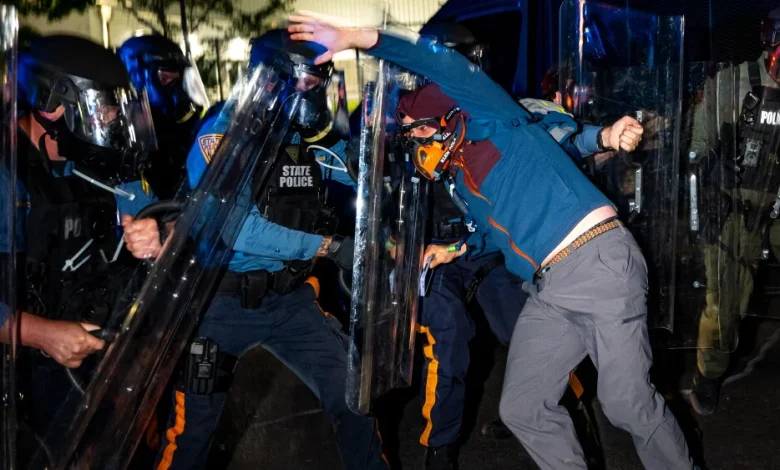
Delaney Hall, a major detention facility situated in Newark, New Jersey, has repeatedly served as a major flashpoint for tense standoff situations and vocal demonstrations. The site frequently draws massive crowds protesting the federal government’s immigration policies, immigration jail operations, and controversial detainee transfers. On Saturday, May 30, 2026, the atmosphere grew increasingly hostile as anti-ICE demonstrators confronted local, county, and state law enforcement agencies. Officers deployed a variety of tactical assets, including tear gas, flashbangs, and rubber bullets, to control the crowd. The ongoing civil clashes run parallel to broader systemic battles over executive overreach, such as the legal warfare that ensued when grants halted by Trump administration deemed unconstitutional sent shockwaves through public advocacy sectors.
In the middle of this escalating chaos, photojournalist Angelina Katsanis was actively capturing the frontline clashes for the Associated Press when she was suddenly struck in the knee by a six-foot wooden 2×4 beam. The force of the blow severely injured her leg, rendering her unable to walk or carry her heavy equipment without immediate assistance.
How the Theft Unfolded Amid the Chaos
Left with no alternative but to seek urgent medical attention, Katsanis hobbled over a half-mile to a makeshift medical tent set up by volunteer street medics. Because of the sheer physical agony and the speed at which police lines were advancing, she had to leave her primary camera gear bag behind. The heavy bag was not anonymous; it was clearly labeled with her name, phone number, and direct contact details, ensuring that anyone who found it could immediately identify its owner.
After receiving emergency treatment, Katsanis was placed in a wheelchair and, accompanied by several of her journalistic colleagues, attempted to return to the cordoned-off frontline area to retrieve her expensive professional tools. However, police officers barred her entry. When she was eventually permitted back into the secure perimeter hours later, her bag—valued at approximately $10,000—had completely vanished. Because only authorized law enforcement officers had access to that highly restricted, barricaded zone at that point in the evening, Katsanis immediately harbored suspicions that a police officer was responsible for the disappearance of her property.
The Apple AirTag Investigation and Sparta Tracking
Determined to locate her vital work equipment, Katsanis immediately consulted her Apple “Find My” application, as she had wisely placed an Apple AirTag tracker inside her gear bag. The real-time geolocation tracking revealed a shocking truth: the bag was not sitting in a lost-and-found bin or an evidence locker at the local Newark precinct. Instead, the tracker indicated that her professional gear was actively traveling down a major New Jersey highway, moving rapidly away from the protest site.
While Katsanis sought professional treatment at a regional hospital, she watched the digital signal make its way north. The AirTag eventually came to rest and pinged continuously at a specific residential address located in Sparta, New Jersey—a quiet suburban town miles away from Newark. A public records search of the address revealed that the home belonged to none other than Darryl Brown, a veteran sergeant working within the Essex County Prosecutor’s Office.
The Discarded Tracker and the Local Address Match
As the investigation developed, details emerged regarding the suspect’s apparent attempt to cover his tracks. Sometime after arriving in Sparta, the individual in possession of the bag discovered the tracking beacon. The AirTag was aggressively stripped from the bag’s keyrings and subsequently thrown out of a vehicle window onto the side of a road, several miles away from the home.
Despite this attempt to sever the digital trail, the geographic history had already been securely logged. The initial pings at the Sparta residence created an undeniable connection that Katsanis and her colleagues promptly reported to state authorities. This precise electronic footprint left the New Jersey State Attorney General’s office with an incredibly solid lead, completely bypassing the typical bureaucratic delays that often stall investigations involving internal police misconduct.
Official Charges and Evidence Uncovered
Upon receiving the detailed tracking data and Katsanis’ formal report, the New Jersey State Attorney General’s Office launched an immediate, aggressive investigation. Investigators quickly pulled and reviewed the body-worn camera footage of the officers assigned to the Delaney Hall perimeter. The footage yielded critical evidence, capturing Sergeant Darryl Brown directly “interacting” with Katsanis’ marked camera bag at the protest scene.
Armed with both the digital tracking history and the damning video evidence, state authorities secured a search warrant for Brown’s Sparta residence. On Wednesday, June 3, 2026, the search warrant was executed. Inside Brown’s home, detectives recovered several pieces of the photographer’s missing high-end camera equipment, with some items still visibly displaying Katsanis’ name and phone number. The meticulous collection of digital evidence, body camera footage, and coordinate data mirrored other high-profile state investigations. In many complex criminal matters, such detailed timelines are vital to securing indictments, as seen in cases where prosecutors detail d4vd allegations timeline and charges to lay bare the sequence of unlawful events.
Profile of Sergeant Darryl Brown
Darryl Brown’s arrest has sent shockwaves through the New Jersey law enforcement community. As a sergeant within the Essex County Prosecutor’s Office, Brown was a high-ranking officer entrusted with upholding public integrity and preparing criminal prosecutions against offenders. Instead, he now faces a criminal prosecution of his own.
Following the execution of the search warrant and the recovery of the stolen goods, the Essex County Prosecutor’s Office officially suspended Brown without pay. Under New Jersey state law, third-degree theft is a serious criminal offense. It carries a potential prison sentence of three to five years upon conviction, along with substantial financial penalties and the permanent forfeiture of public office. The stark contrast between Brown’s official duty to protect the public and his actions at Delaney Hall has ignited intense public criticism of local police culture.
Broader Patterns of Misconduct and Public Trust
When those tasked with maintaining order instead exploit crises for personal gain, it deeply damages public faith in institutional integrity. Such systemic betrayal of trust by professionals in high-ranking positions is reminiscent of corporate and executive scandals, such as when JPMorgan was sued after an executive was accused of drugging a male broker, highlighting how institutional failures cross the boundaries of public and private sectors.
Katsanis herself addressed the broader implications of the theft in a social media post, noting that her discovery might represent just the tip of the iceberg. “It seems like many people have had items stolen from the scene of Delaney,” she wrote, hinting that a systemic pattern of opportunistic theft by officers may have been occurring under the cover of protest control operations. For many civil rights advocates, this case validates long-standing complaints that police forces frequently treat the personal property of demonstrators and bystanders with utter disregard, operating under an assumption of total impunity.
The Backlash and Advocacy for Journalists’ Safety
The targeting and mistreatment of journalists covering civil unrest is an escalating national crisis. Photojournalists are particularly vulnerable, as they must work on the front lines to capture visual documentation of events, often placing them directly in the crosshairs of both aggressive demonstrators and heavy-handed police tactical units. Katsanis’ experience at Delaney Hall was not an isolated incident; just days prior, on Thursday, she had been pepper-sprayed directly in the face by an ICE officer while trying to perform her duties.
The theft of $10,000 worth of vital camera gear is not merely a financial loss; it is a direct assault on the freedom of the press. Like organizations such as the Committee to Protect Journalists (CPJ), media advocacy groups have vehemently condemned the incident, demanding stricter protections for reporters and independent oversight of police officers who target the press.
Summary of the Delaney Hall Incident Timeline
To understand how a routine photojournalism assignment escalated into a high-level state investigation and the arrest of a veteran Essex County sergeant, it is helpful to look at the exact chronological sequence of events. The following table highlights the critical dates, actions, and pieces of evidence that defined this case from the initial protest to the official charging of Darryl Brown.
| Date | Key Event | Details & Evidence Involved |
|---|---|---|
| May 30, 2026 | Delaney Hall Clash & Theft | AP journalist Angelina Katsanis is injured by a 2×4 wooden beam; leaves labeled gear bag behind to seek medical aid. Bag goes missing soon after. |
| May 30, 2026 | Initial AirTag Tracking | Katsanis tracks the bag via Apple AirTag as it travels down a New Jersey highway and pings at a home in Sparta, NJ. |
| June 3, 2026 | Search Warrant Executed | State authorities execute a search warrant at the Sparta residence of Sergeant Darryl Brown, recovering stolen cameras and equipment. |
| June 4, 2026 | Official Charges Filed | New Jersey Attorney General announces third-degree theft charges against Brown. Essex County Prosecutor’s Office suspends him without pay. |
Systematic Violations and Law Enforcement Accountability
The conviction or indictment of an officer like Darryl Brown underscores the indispensable value of consumer-grade tracking technology in the modern era of civil rights. Historically, allegations of petty theft, destruction of property, or physical assault leveled against law enforcement officers during chaotic protests were easily dismissed by departments as unsubstantiated or impossible to prove. The infamous “blue wall of silence” historically shielded officers from internal scrutiny, leaving victims with no recourse.
However, the ubiquity of high-precision GPS tracking devices like Apple AirTags, combined with mandatory body-worn cameras, has shifted the balance of power. In this case, the combination of Katsanis’ proactive tracking and the state’s review of Brown’s own bodycam footage left the suspect with absolutely no room for denial. As this case moves forward through the New Jersey judicial system, it will undoubtedly serve as a landmark example of how technological transparency can dismantle institutional protectionism and force accountability upon those who abuse their badges.