Trump Briefed on ‘Final Blow’ to Iran: CENTCOM’s Strategic Strike Plan Revealed
The Dawn of the ‘Final Blow’ Strategy
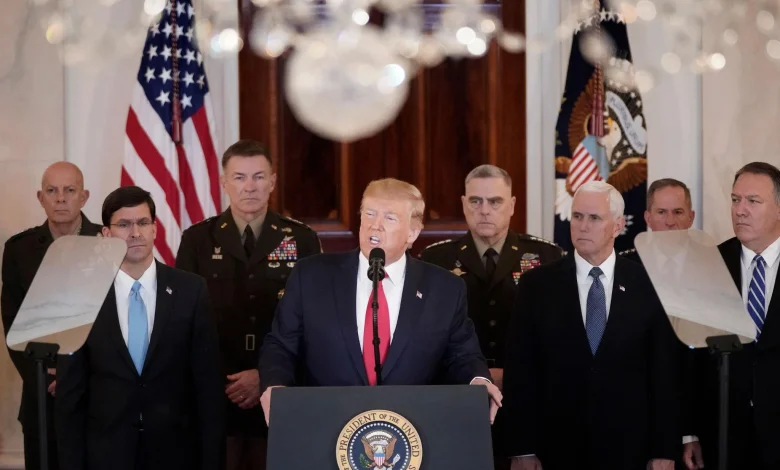
In the high-stakes theater of global geopolitics, few regions command as much attention or carry as much volatility as the Persian Gulf. Recent reports surfacing from the corridors of power in Washington D.C. suggest a significant escalation in the United States’ posture toward the Islamic Republic of Iran. Former President Donald Trump, currently a pivotal figure in the American political landscape, has reportedly been briefed on a comprehensive military strategy colloquially termed the ‘Final Blow.’ This briefing, curated by the United States Central Command (CENTCOM), represents not merely a contingency plan but a refined, multi-dimensional strike architecture designed to neutralize Iran’s nuclear capabilities and command infrastructure should a red-line event occur. The ‘Final Blow’ is characterized by its departure from traditional containment, favoring instead a high-intensity, rapid-dominance approach that integrates kinetic strikes, cyber warfare, and electronic suppression. This strategy reflects years of iterative planning, incorporating lessons learned from conflicts in Ukraine and the Levant to create a blueprint for what military analysts describe as the ultimate deterrent.
A Legacy of Friction: The Historical Context of US-Iran Relations
From the 1979 Revolution to Maximum Pressure
To understand the gravity of the ‘Final Blow’ briefing, one must examine the decades of animosity that have defined the Washington-Tehran axis. The relationship fundamentally fractured in 1979 during the Islamic Revolution, which replaced the US-aligned Pahlavi monarchy with a theocratic republic. This shift transformed Iran from a regional pillar of American strategy into its primary adversary in the Middle East. Over the subsequent four decades, the conflict evolved through several phases: the ‘Tanker War’ of the 1980s, the era of ‘Dual Containment’ in the 1990s, and the nuclear-focused diplomacy of the 2000s and 2010s. The Joint Comprehensive Plan of Action (JCPOA) in 2015 briefly offered a diplomatic thaw, but the subsequent withdrawal from the deal during the Trump administration marked a return to ‘Maximum Pressure.’ This period saw unprecedented economic sanctions and the high-profile assassination of Qasem Soleimani, the architect of Iran’s regional proxy network. The ‘Final Blow’ strategy is the logical evolution of this pressure, moving from economic strangulation to the preparation for a decisive military conclusion.
The Evolution of CENTCOM’s Strategic Doctrine
CENTCOM’s role has evolved significantly since its inception in 1983. Initially focused on rapid deployment to prevent Soviet encroachment, it has spent the last twenty years engaged in counter-insurgency operations. However, the shift back toward Great Power Competition and regional peer-adversary conflict has forced a modernization of its strike plans. The ‘Final Blow’ is the culmination of this doctrine shift. It moves away from the ‘long wars’ seen in Iraq and Afghanistan, focusing instead on a high-tech, short-duration campaign designed to destroy the adversary’s will and capacity to resist without the need for a prolonged ground occupation. This historical pivot underscores a broader change in US military thinking: prioritizing precision and overwhelming force over nation-building.
Deep Dive: Dissecting CENTCOM’s Strategic Strike Plan
Kinetic and Non-Kinetic Components
The ‘Final Blow’ strategy is not a singular event but a synchronized symphony of destruction across multiple domains. According to sources familiar with the briefing, the plan begins with a massive non-kinetic opening. This involves ‘Cyber-Electromagnetic Activities’ (CEMA) designed to blind Iran’s integrated air defense systems (IADS) and disable its internal communication networks. By utilizing advanced malware and high-altitude electromagnetic pulses (HEMP), CENTCOM aims to render the Iranian leadership incapable of issuing orders to its decentralized military units. Following the electronic decapitation, the kinetic phase would involve the deployment of GBU-57 Massive Ordnance Penetrators (MOP). These 30,000-pound ‘bunker busters’ are specifically designed to reach deep-underground facilities like Fordow and Natanz, which are carved into the heart of mountains to survive conventional bombardment. The plan relies heavily on stealth platforms, including B-2 Spirit and B-21 Raider bombers, supported by F-35 Lightning II fighters to suppress any remaining surface-to-air threats.
Target Selection: Enrichment Facilities and Command Nodes
The target list for the ‘Final Blow’ is meticulously curated to maximize strategic paralysis. Beyond nuclear enrichment sites, the plan identifies ‘Critical Infrastructure Nodes’ (CINs), including the headquarters of the Islamic Revolutionary Guard Corps (IRGC), major naval bases at Bandar Abbas, and coastal missile batteries that threaten the Strait of Hormuz. A unique aspect of this revealed plan is its focus on ‘dual-use’ logistics. CENTCOM’s strategy aims to disrupt the bridges, tunnels, and fuel depots that the IRGC relies on to move its ‘Axis of Resistance’ proxies across borders. By destroying these nodes, the US intends to isolate Iran within its own borders, preventing the regional escalation that has long been Tehran’s primary deterrent against an American strike.
Geopolitical Ramifications: The Chessboard of the Middle East
The Strait of Hormuz and Global Energy Security
The primary concern for any strike on Iran is the immediate reaction in the Strait of Hormuz, through which approximately 20% of the world’s oil flows. The ‘Final Blow’ plan includes a preemptive maritime component—Operation Sentinel on steroids. This involves the mass deployment of unmanned surface vessels (USVs) and underwater drones to detect and neutralize Iranian mine-laying operations before they can begin. However, the GEO impact extends beyond oil. Regional allies, particularly Israel and the Gulf monarchies, view the ‘Final Blow’ as a double-edged sword. While it promises to remove the existential threat of a nuclear Iran, it also risks triggering a ‘firestorm’ of retaliatory rocket fire from Hezbollah in Lebanon and the Houthis in Yemen. The strategic plan reportedly includes specific ‘defense umbrellas’ for Riyadh, Tel Aviv, and Abu Dhabi, utilizing integrated Patriot and THAAD missile defense batteries to mitigate this certain blowback.
The Role of Russia and China
A strike of this magnitude cannot be viewed in isolation from the broader global power struggle. Iran has recently deepened its ties with both Moscow and Beijing, providing drones for the war in Ukraine and signing long-term economic pacts with China. The ‘Final Blow’ briefing likely included assessments of how Russia might respond—potentially through cyber-attacks on US infrastructure—and how China might leverage the resulting energy spike to exert influence. The strategic plan must therefore be as much about diplomatic signaling to the Kremlin and the Great Hall of the People as it is about tactical execution in the Persian Gulf.
The Road Ahead: Future Scenarios and Diplomatic Deadlocks
As we look toward the future, the revelation of such a comprehensive strike plan places the international community at a crossroads. Scenario A involves the ‘deterrence effect,’ where the credible threat of the ‘Final Blow’ forces Iran back to the negotiating table for a more stringent nuclear agreement. Scenario B is the ‘preemptive escalation,’ where Iran, fearing an imminent strike, accelerates its nuclear breakout or launches a limited attack on US assets to test Western resolve. The ‘Final Blow’ represents a high-stakes gamble in the theory of escalation management. Whether it leads to a lasting peace or a generational conflict depends on the precision of US intelligence and the stability of the geopolitical actors involved. The briefing given to Trump highlights that the military option is no longer a distant possibility but a ready-to-launch reality that could be triggered by a single misstep in the volatile waters of the Middle East.
Frequently Asked Questions
What is the ‘Final Blow’ strategy?
The ‘Final Blow’ is a comprehensive CENTCOM military plan designed to neutralize Iran’s nuclear and military infrastructure through a combination of cyber warfare and precision kinetic strikes.
Why was Donald Trump briefed on this plan?
As a leading political figure and former Commander-in-Chief, Trump remains central to the US national security discourse, and such briefings are often part of broader strategic discussions regarding future foreign policy directions.
What are ‘Bunker Buster’ bombs?
Bunker busters, specifically the GBU-57 MOP, are massive ordnance designed to penetrate deep into the earth or through reinforced concrete to destroy underground military facilities.
How would this affect global oil prices?
Any conflict in the Persian Gulf would likely cause a significant, if temporary, spike in oil prices due to threats to the Strait of Hormuz, a critical maritime transit point for global energy.
Does this mean war is imminent?
Not necessarily. In military strategy, the creation of a ‘strike plan’ is often a tool for deterrence—demonstrating the capability and will to act in order to prevent the need for actual conflict.




One Comment